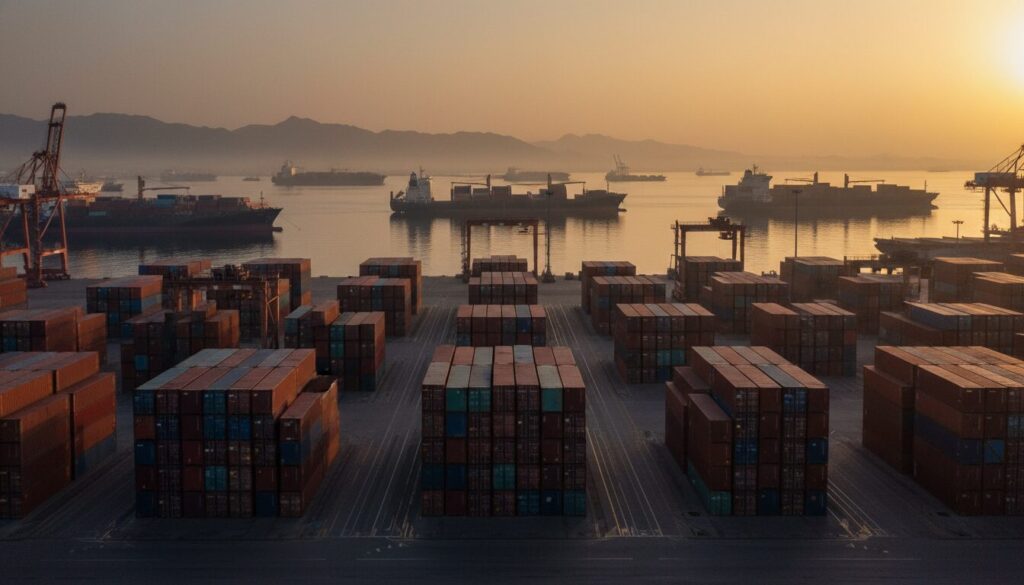
The geopolitical landscape of global maritime trade is currently undergoing a structural realignment. As escalating security risks in the Middle East continue to mount, supply chain leaders are being forced to re-evaluate their fundamental operating models. In a decisive move that has sent shockwaves through the industry, Maersk suspends more container services due to Middle East risks, specifically halting its FM1 (Far East-Middle East) and ME11 (Middle East-Europe) loops, while entirely ceasing its local Gulf shuttles. Furthermore, Dubai’s critical Jebel Ali port has been abruptly removed from Maersk’s ME1 service rotation.
With the Strait of Hormuz experiencing a near-total standstill—recording a chilling low of merely two commercial transits in a 24-hour window—the maritime artery that sustains a massive portion of global energy and goods movement is effectively paralyzed. For strategy executives and innovation leaders in the US, Europe, and Asia, this is no longer a temporary disruption; it is a permanent mandate for supply chain resilience.
Why It Matters: The Global Supply Chain Paradigm Shift
To understand the gravity of these service suspensions, one must look at the market mathematics. Maersk controls approximately one-sixth of the global container shipping fleet. When a logistics leviathan of this magnitude drastically alters its routing, the ripple effects instantly compress global shipping capacity, driving up spot rates and extending lead times across the board.
As discussed in our previous analysis, Strait of Hormuz Near-Zero Traffic: Global Resilience Case, the near-total cessation of commercial traffic through this maritime chokepoint has created an unprecedented capacity vacuum. The Strait of Hormuz is not just an oil corridor; it is a vital transshipment gateway connecting the manufacturing powerhouses of Asia with the consumer markets of Europe and the Middle East.
The Amplification of Insurance and Operational Costs
The decision to suspend the FM1 and ME11 routes was not made in a vacuum. Rising drone threats, missile attacks, and the subsequent skyrocketing of war-risk insurance premiums have made traversing the Gulf commercially unviable for many operators.
This operational retreat is a systemic issue affecting all major carriers. We saw early indicators of this structural retreat when CMA CGM Reverses Red Sea Return, signaling that the world’s top shipping lines were abandoning hopes for a quick resolution. The subsequent removal of Dubai’s Jebel Ali port from the ME1 rotation marks a significant blow to the Middle East’s status as a bulletproof logistics hub, forcing global shippers to rapidly rethink their transshipment dependencies.
Global Trends: Ripple Effects Across US, China, and Europe
The suspension of Maersk’s Middle East routes is not an isolated regional issue; it is a global capacity crisis. Here is how the disruptions are reshaping logistics strategies across the world’s major economic zones.
Asian Export Markets Face Severe Bottlenecks
For manufacturers in China, South Korea, and Japan, the FM1 (Far East-Middle East) suspension cuts off a direct, high-volume artery. Chinese exporters of electronics, automotive parts, and fast fashion are suddenly finding their primary routes to Middle Eastern and European buyers severed. This forces Asian exporters to rely on fragmented, highly congested alternative transshipment hubs like Colombo (Sri Lanka) or Singapore, adding days or even weeks to standard lead times.
See also: Hormuz Blockade: Japan Carrier Avoidance & Global Resilience
European Importers Struggle with Component Deficits
In Europe, the loss of the ME11 service is a critical blow to industrial manufacturing. European automakers and tech hardware firms rely heavily on the precise, just-in-time delivery of components from Asia via the Middle East. With vessels now forced to bypass the region entirely—often routing around the Cape of Good Hope—European supply chains are absorbing massive delays. This is compounding the existing inflationary pressures caused by elevated fuel and transit costs.
US Market Absorbs Secondary Capacity Shocks
While the US is geographically distant from the Strait of Hormuz, the interconnected nature of global shipping means American ports are not immune. Because global carriers are reallocating vessels to service the extended transit times required by the Cape of Good Hope diversions, transpacific and transatlantic routes are experiencing artificial capacity constraints. US retailers are simultaneously battling increased air freight costs as desperate shippers transition critical cargo to the skies.
| Region | Primary Disrupted Service | Operational Impact Level | Strategic Logistics Pivot |
|---|---|---|---|
| Asia (China/Japan) | FM1 (Far East-Middle East) | Critical | Shifting to Southeast Asian transshipment hubs; increased reliance on Sea-Air hybrid routes. |
| Europe (EU/UK) | ME11 (Middle East-Europe) | Critical | Absorbing 10-14 day lead time extensions; nearshoring critical component manufacturing. |
| North America (US) | Global Vessel Reallocation | Moderate to High | Securing long-term contracted capacity early; accelerating East-to-West coast rail alternatives. |
Case Study: Siemens’ Multimodal Agility Network
When a carrier like Maersk removes a linchpin hub like Jebel Ali from its rotation, traditional ocean-reliant supply chains inevitably break. However, proactive innovation leaders are leveraging these disruptions as catalysts for logistical transformation. A prime example of this resilience is the global technology and industrial conglomerate, Siemens.
Identifying the Chokepoint Vulnerability
Siemens relies on a complex, globally distributed manufacturing network. Components produced in their Asian facilities must flow seamlessly into European assembly plants. Historically, the FM1 and ME11 routes were integral to their cost-effective logistics strategy, utilizing Dubai as a central consolidation point.
When intelligence indicators suggested an impending closure of the Strait of Hormuz, Siemens did not wait for official carrier declarations. Utilizing their AI-driven “Dynamic Control Tower,” the company’s supply chain executives modeled the impact of a total Hormuz blockade weeks before Maersk officially suspended its Gulf shuttles.
Executing the Sea-Air Bypass Strategy
To safeguard their production schedules, Siemens executed a rapid multimodal pivot:
- Alternative Hub Utilization: Instead of routing through the vulnerable Persian Gulf, Siemens redirected ocean freight to the Port of Salalah in Oman and the Port of Colombo in Sri Lanka.
- Sea-Air Freight Integration: Upon arrival at these alternative, safer ports, critical high-value components were immediately transferred to air freight networks for the final leg into Frankfurt and Munich.
- Dynamic Inventory Buffering: Siemens temporarily increased holding stocks of lower-value C-parts at regional European warehouses, absorbing the higher working capital costs to guarantee continuous production line movement.
The Innovation Outcome
While competitors faced assembly line shutdowns due to the missing ME11 shipments, Siemens maintained a 94% on-time production rate globally. By sacrificing marginal transportation cost efficiency in favor of structural routing resilience, Siemens protected its broader revenue streams and market share.
For further context on how global enterprises are shifting from pure ocean reliance, see our deep dive: Iran Conflict: Ocean & Air Resilience Case Study.
Strategic Takeaways for Logistics Leaders
The Maersk service suspensions serve as a masterclass in why static supply chains are destined to fail in the modern geopolitical climate. Strategy executives must distill the following lessons into actionable operational changes.
Accelerating Transshipment Hub Diversification
Relying on a single mega-hub, regardless of its historical reliability, is now a confirmed strategic vulnerability. The sudden removal of Jebel Ali from the ME1 rotation proves that no port is too big to be bypassed. Global shippers must pre-qualify and contract alternative transshipment facilities in geographies like East Africa, India, and Southeast Asia to ensure they have immediate bypass options when primary routes collapse.
Deploying Predictive Multimodal Routing
The era of siloed logistics procurement is over. The most successful supply chains treat ocean, rail, and air not as separate departments, but as interchangeable nodes within a single ecosystem. Companies must implement digital control towers that can seamlessly transition a container from a delayed ocean vessel onto an air cargo charter or a transcontinental rail line with minimal administrative friction.
Re-evaluating Holding Costs Against Operational Stoppages
The foundational principles of Just-In-Time (JIT) manufacturing must be recalibrated. As transportation costs surge—driven by factors explored in Rising Diesel & Iran Conflict: Global Supply Chain Strategy—the financial models comparing the cost of storing buffer inventory versus the cost of an expedited air freight rescue have flipped. Strategic buffering is no longer a sign of inefficiency; it is a required insurance policy against geopolitical volatility.
Future Outlook: The Permanent Shift in Global Maritime Routes
Looking ahead to 2026 and beyond, innovation leaders must operate under the assumption that the Middle Eastern maritime corridor will remain fundamentally unstable. Maersk’s suspension of the FM1 and ME11 services is unlikely to be a brief pause. Instead, we are witnessing the redrawing of the global maritime map.
The near-zero traffic in the Strait of Hormuz and the continued avoidance of the Red Sea suggest that the Cape of Good Hope routing will transition from an “emergency alternative” to a “standard operating procedure” for Europe-Asia trade. Consequently, global shipping capacity will remain artificially constrained, keeping ocean freight rates elevated and highly volatile.
In response, the logistics industry will see a massive acceleration in nearshoring and friend-shoring initiatives. European and US corporations will aggressively invest in manufacturing footprints in Eastern Europe, Mexico, and South America to reduce their exposure to intercontinental maritime chokepoints.
Ultimately, the companies that thrive in this new era will be those that view supply chain agility not as a cost center, but as their primary competitive advantage. The suspension of Maersk’s Middle East services is a warning shot to the global market: adapt your network dynamically, or risk being stranded at the chokepoint.