
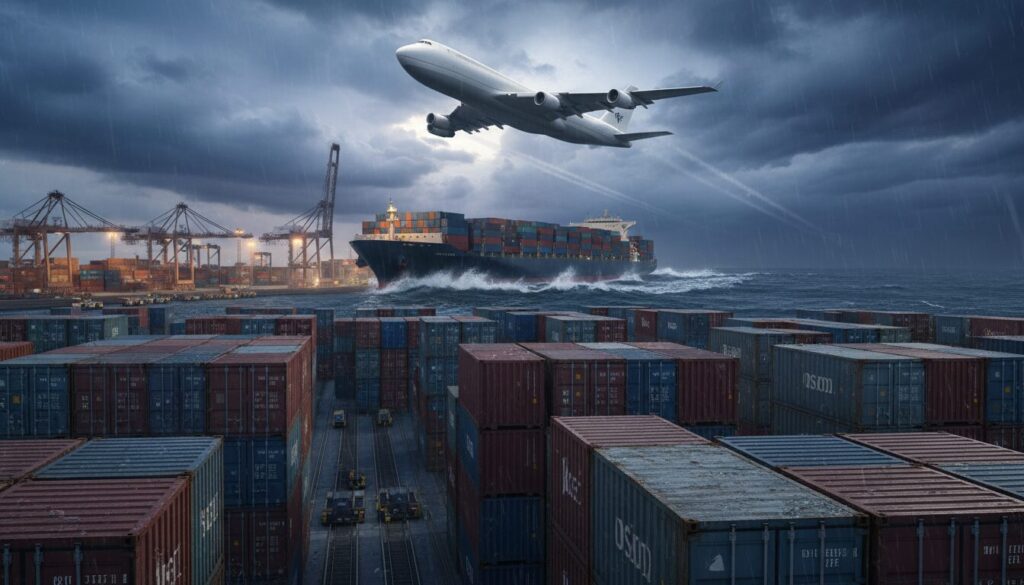
The escalation of the Iran conflict has transcended regional geopolitical tension to become a defining “Black Swan” event for global logistics in the mid-2020s. We are witnessing a simultaneous constriction of both maritime and aerial arteries connecting Asia, Europe, and the Americas.
For innovation leaders and supply chain strategists, the current landscape represents a critical stress test. The Iran conflict disrupts ocean, air cargo networks not merely by delaying shipments, but by fundamentally altering the cost structure and routing logic of global trade. With major players like CMA CGM and FedEx suspending services or imposing draconian surcharges, the era of predictable trans-Eurasian logistics has paused—potentially through 2026.
This article analyzes the structural breakdown of these networks, examines the data behind the capacity squeeze, and presents a strategic case study on how forward-thinking enterprises are navigating this blockade.
Why It Matters: The Dual-Mode Blockade
Unlike the pandemic-era disruptions, which were primarily driven by demand surges and port labor issues, the current crisis is a capacity and access denial event. The conflict has triggered a rare “dual-mode” disruption where the primary mode of transport (ocean via Suez) and the emergency backup mode (air via Middle East hubs) are compromised simultaneously.
As discussed in our report on the Hormuz Blockade: Japan Carrier Avoidance & Global Resilience, the effective closure of key straits forces vessels to reroute. However, the new development is the closure of airspace, forcing a total logistical recalibration.
The Numbers Behind the Disruption
The immediate impact is quantifiable and severe. Industry data indicates a massive absorption of capacity due to longer transit times, effectively removing ships from the rotation.
- Capacity Squeeze: Rerouting vessels via the Cape of Good Hope has absorbed approximately 2.5 million TEUs (Twenty-Foot Equivalent Units) of global shipping capacity.
- Surcharges: The cost of moving goods has spiked overnight.
- CMA CGM: Implemented emergency conflict fees ranging from $2,000 to $3,000 per container.
- Hapag-Lloyd: Introduced surcharges between $1.5k and $3.5k.
- Air Cargo Halt: Major integrators and belly-cargo carriers including FedEx, Emirates SkyCargo, and Qatar Airways have suspended operations or severely restricted bookings due to airspace closures over Iran and surrounding conflict zones.
Global Trend: The Ripple Effect Across Key Markets
The disruption is not localized; it creates a domino effect across the US, Europe, and Asia.
1. Europe: The Direct Hit
Europe is the most severely impacted region. The standard Asia-Europe trade lane relies heavily on the Suez Canal for ocean freight and Middle Eastern hubs (Dubai, Doha) for air freight.
- Ocean: Transit times have increased by 14–21 days due to the Cape of Good Hope detour.
- Air: With Iranian airspace closed, flights from Asia to Europe must detour North (over Central Asia) or South, reducing payload capacity due to extra fuel requirements.
2. Asia (China/Southeast Asia): The Equipment Deficit
For Asian manufacturers, the crisis is manifesting as an equipment shortage. Because containers are spending weeks longer at sea traveling around Africa, they are not returning to Chinese ports in time for reloading.
- Impact: A shortage of empty 40ft High-Cube containers in Shanghai and Ningbo.
- Strategy: Carriers are prioritizing high-yield cargo, leaving low-margin goods stranded at origin.
3. United States: The Inflationary Pressure
While the US West Coast remains relatively insulated via the Transpacific route, the US East Coast (often served via Suez) is seeing delays. Furthermore, the global removal of capacity raises rates for all lanes, including Transpacific.
See also: Oil Tankers Avoiding Hormuz: Global Supply Chain Strategy for insights on how fuel costs are exacerbating US inflation.
Comparative Impact Table
| Feature | Pre-Conflict Status | Current Status (Conflict Era) | Impact on Strategy |
|---|---|---|---|
| Ocean Routing | Suez Canal (Direct) | Cape of Good Hope (+3,500 nm) | +14-20 Days Lead Time |
| Ocean Cost | Spot Market Rates | Base Rate + $3k Surcharge | Budget overrun |
| Air Routing | Direct via Middle East | Northern/Southern Detours | Capacity cuts, Rates +40% |
| Availability | Daily Sailings/Flights | Blank Sailings / Booking Stops | Reliability < 50% |
Case Study: Kuehne+Nagel and the “Sea-Air” Pivot
When the Iran conflict disrupts ocean, air cargo networks, standard contingency plans fail. A specific success story in navigating this chaos can be found in the operational agility of major logistics integrators like Kuehne+Nagel (K+N), and their collaboration with high-tech shippers.
The Challenge
A European automotive electronics manufacturer faced a critical shortage of components from Malaysia.
- Ocean Issue: The Cape detour added 18 days, threatening a production line stoppage.
- Air Issue: Direct air freight via Dubai was suspended due to the conflict.
The Solution: The Singapore-LAX Bridge
Instead of trying to force cargo through the blocked Middle East corridor, K+N utilized a radical “West-about” strategy, leveraging the Transpacific route to reach Europe.
- Leg 1 (Ocean – Fast): Goods were shipped via express ocean feeder from Malaysia to Singapore.
- Leg 2 (Air – Transpacific): Instead of flying West (towards the conflict), cargo was flown East from Singapore to Los Angeles (LAX).
- Leg 3 (Air – Transatlantic): Cargo was transferred to transatlantic flights from LAX to Frankfurt (FRA).
The Results
While this route seems counter-intuitive geographically (circling the globe the “wrong” way), it bypassed the conflict zone entirely.
- Reliability: 100% schedule integrity (no war risk delays).
- Time: 7 days total transit (vs. 45 days via Cape ocean, or indefinite delay via Middle East air).
- Cost: 30% cheaper than direct charter air freight (which had skyrocketed due to risk premiums).
Why This Matters
This case study illustrates Network Agnosticism. In a global crisis, the shortest distance between two points is no longer a straight line; it is the line with the lowest geopolitical risk. Companies that rigidly stuck to “standard” trade lanes remain stuck in holding patterns.
For more on carrier strategic reversals during this period, refer to CMA CGM Reverses Red Sea Return.
Key Takeaways for Logistics Leaders
The disruption of the Iran conflict is a lesson in the fragility of chokepoints. Here are the actionable takeaways for strategy executives.
1. Diversify Modal Entry Points
The “Hub-and-Spoke” model is efficient until the Hub is in a war zone.
- Action: Do not rely solely on Middle East transshipment hubs (Dubai/Doha) for air-sea connectivity. Qualify alternative hubs in Singapore, Incheon, or even Colombo as backups.
2. Update Cost Baselines for “War Risk”
The surcharges from Hapag-Lloyd ($1.5k+) and CMA CGM ($2k+) are likely to be sticky.
- Action: Finance teams must re-forecast landed costs for 2025-2026. These are not “temporary” fees; they represent the new cost of insurance and fuel for longer voyages.
3. Embrace “Slow Steaming” Inventory Logic
With 2.5 million TEUs absorbed by the Cape route, “Just-in-Time” (JIT) is dangerous for Europe-Asia trade.
- Action: Increase safety stock levels by 2-3 weeks for critical components. The cost of holding inventory is now lower than the cost of expedited air freight (which may not even be available).
4. Visibility is the New Currency
When air and ocean networks fracture, you cannot manage what you cannot see.
- Action: Invest in real-time container tracking that integrates external risk data (e.g., airspace closures) to predict delays before the carrier sends a notification.
Future Outlook: The “2026 Normal”
Industry analysts and maritime consultants are now predicting that a large-scale return to Red Sea and Iranian airspace transits is unlikely until 2026. The geopolitical fracture is deep, and insurance underwriters are hesitant to cover assets in the region even if hostilities technically cease.
The Long-Term Shift
We are moving toward a bifurcated supply chain:
- The “Safe” Route: Higher cost, longer lead times (Cape of Good Hope / Transpacific).
- The “Risk” Route: Lower theoretical cost but uninsurable risks (Suez / Middle East Air).
For the next 18 to 24 months, the competitive advantage will belong to companies that can master the “Safe Route” economics—optimizing inventory for 45-day ocean transits and utilizing creative sea-air hybrids that avoid the Middle East entirely.
The Iran conflict disrupts ocean, air cargo networks, but it also clarifies the necessity of resilience. The era of cheap, fast, and risk-free logistics is over; the era of strategic, robust, and adaptable supply chains has begun.