
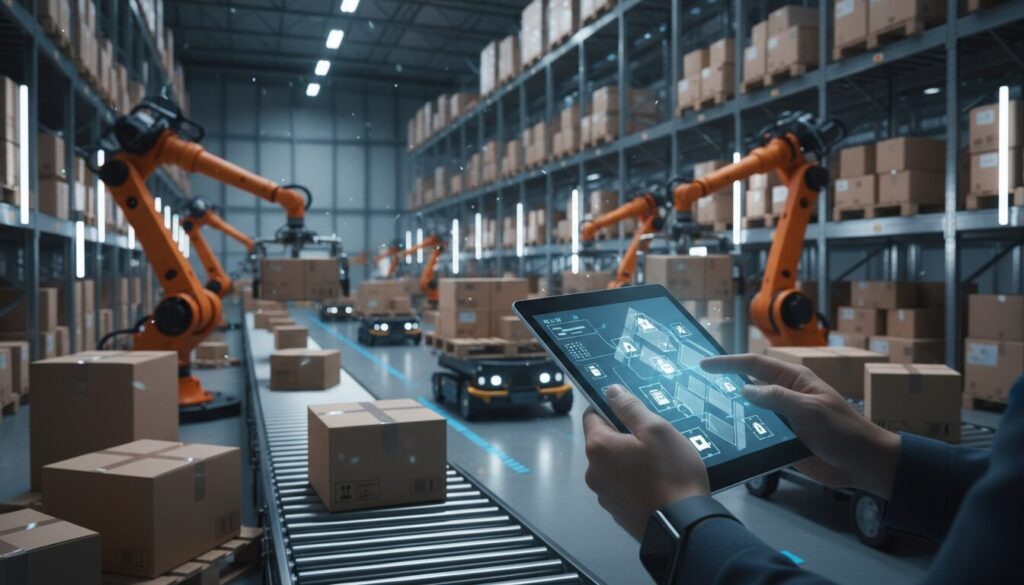
Introduction: The Human Element in the Age of Automation
Are you drowning in data but starving for insights? This is the paradox facing modern logistics leaders. You are likely battling rising freight costs, unpredictable labor shortages, and the constant pressure to deliver “faster and cheaper.”
Many organizations rush to adopt the latest Artificial Intelligence (AI) tools, hoping for a silver bullet. However, as noted in our analysis of the recent OpenAI COO: AI Yet to Penetrate Enterprise, simply purchasing technology does not solve business process issues. The technology is often ready, but the organizational capability is lagging.
The solution is not to replace humans with algorithms, but to evolve the human role.
This article explores the critical equation: AI + Human Intelligence = New Skillsets for SCM Leaders. We will define exactly what skills you need to transition from a traditional logistics manager to a tech-enabled supply chain strategist, turning potential disruption into a competitive advantage.
Basics: Understanding the Equation
To master the new era of Supply Chain Management (SCM), we must first demystify what the convergence of AI and human intelligence actually looks like. It is not about automation removing the need for thought; it is about “Augmented Intelligence.”
What is the “AI + Human” Model?
In traditional logistics, humans did the calculation and the strategy. In the AI-only model (which often fails), algorithms make decisions without context. The “AI + Human” model leverages the strengths of both:
- The AI Role (The Engine): Processing massive datasets, pattern recognition, predictive analytics, and executing repetitive tasks (e.g., demand forecasting, route optimization).
- The Human Role (The Steering Wheel): Contextual understanding, negotiation, ethical judgment, creative problem solving, and managing ambiguity.
The New Definition of Leadership
For SCM leaders, this equation means your value is no longer defined by how well you can build a spreadsheet or track a shipment manually. Your value is now defined by how effectively you can direct AI agents to do those tasks for you.
As highlighted in Supply Chain Planning Reimagined: Embedded AI Guide, the goal is to move away from firefighting and toward “sensing and responding.” This requires a shift from operational execution to strategic orchestration.
Why Now? The Urgency of Skill Evolution
Why is this shift in skillsets critical right now? The global supply chain environment has moved beyond simple volatility—it is now structurally unpredictable.
1. The Collapse of Historical Data Reliability
Pre-2020, historical data was a reliable predictor of future demand. Today, relying solely on history is dangerous. AI can analyze trends, but it requires human intuition to factor in unprecedented events like pandemics or trade wars.
2. Geopolitical Complexity
Algorithms are binary; geopolitics is nuanced. An AI might suggest the cheapest shipping route through a contested sea lane because the math works. A human leader must apply “Network Intelligence” to override that decision based on risk.
For a deeper dive on this, see: Network Intelligence & AI: Circumventing Global Geopolitics.
3. The “Black Box” Problem
As AI models become more complex, they become harder to explain. If an AI recommends a 20% inventory increase, a leader cannot simply say “the computer said so” to the CFO. You need the skills to interrogate the data and validate the logic.
The 5 Essential New Skillsets for SCM Leaders
To thrive in this environment, logistics professionals must cultivate these five specific competencies.
1. “Digital Sandbox” Architecture
Gone are the days of rigid planning. The modern leader must be adept at simulation—creating “what-if” scenarios to test strategies before execution.
- The Skill: The ability to set parameters for AI simulations and interpret the range of outcomes.
- Application: Instead of guessing the impact of a port strike, you use AI to run 50 scenarios. You then use your judgment to select the most resilient path.
This concept is essential for escaping “Excel Hell,” as detailed in Digital Sandboxes: The Ultimate Guide to Smarter Planning.
2. Algorithmic Management & Oversight
You do not need to be a coder, but you must be a competent “editor” of AI output.
- The Skill: Identifying AI hallucinations (errors) and bias.
- Application: An AI tool might suggest switching to a low-cost carrier that has a history of damaging goods—data the AI might not have weighted heavily. A human leader spots this qualitative risk and adjusts the parameters.
3. Data Storytelling and Translation
SCM leaders often sit between technical data teams and executive boards.
- The Skill: Translating complex AI-generated probabilities into clear business language (ROI, Risk, Customer Satisfaction).
- Application: converting a “95% confidence interval in lead time deviation” into “We need to increase safety stock by 3 days to protect our key customer launch.”
4. Collaborative Intelligence (Human-Machine Interaction)
This is effectively “Prompt Engineering” for logistics.
- The Skill: Asking the right questions to get valuable answers from analytical tools.
- Application: Knowing the difference between asking “How do we reduce costs?” (too vague) and “Analyze the impact of consolidating LTL shipments from Region A to Region B on delivery windows and carbon footprint.”
5. Emotional Intelligence (EQ) in Change Management
As AI takes over analytical tasks, the human connection becomes premium.
- The Skill: Managing the fear and resistance of teams who worry AI will replace them.
- Application: Reassuring staff that AI in Supply Chains: Global Progress Report shows that operational reality lags behind hype, and their role is evolving, not disappearing.
Benefits: The Quantitative Advantage
Adopting these new skillsets creates a measurable divide between modernized leaders and traditional managers.
Comparative Analysis: Traditional vs. AI-Augmented Leadership
| Feature | Traditional SCM Leadership | AI + Human Intelligence Leadership |
|---|---|---|
| Decision Speed | Days/Weeks (Manual analysis) | Minutes (AI analysis + Human approval) |
| Risk Management | Reactive (Firefighting) | Proactive (Predictive modeling) |
| Data Usage | Historical data & Spreadsheets | Real-time structured & unstructured data |
| Focus | Cost minimization | Resilience & Value creation |
| Scalability | Linear (Requires more people) | Exponential (Requires better algorithms) |
Qualitative Wins
- Reduced Burnout: Automating the mundane allows leaders to focus on high-value strategy.
- Talent Retention: Top talent wants to work with cutting-edge tools, not antiquated legacy systems.
- Customer Trust: Being able to explain why a delay is happening and how you are mitigating it (backed by data) builds immense credibility.
Implementation: How to Build These Skills
You cannot acquire these skills overnight, but you can structure a development plan.
Step 1: Conduct a “Digital Fluency” Audit
Assess your current team. Who relies entirely on gut feeling? Who is comfortable with data visualization? Identify the gaps.
Step 2: Implement “Human-in-the-Loop” Workflows
Do not automate a process 100% immediately.
- Phase 1: AI suggests, Human decides.
- Phase 2: AI acts on low-risk items, Human reviews exceptions.
- Phase 3: Autonomous execution for standard tasks, Human focuses on strategy.
Step 3: Focus on Supply Chain Planning (SCP)
SCP is the safest and most effective place to start practicing these skills. As discussed in Supply Chain Planning Reimagined, modern planning tools are designed to embed AI, giving leaders a safe environment to practice interpreting signals without breaking the physical supply chain.
Key Points for Success
- Start Small: Pick one problem (e.g., inventory optimization for one SKU category).
- Question Everything: Encourage your team to challenge AI recommendations. “Does this make sense in the real world?”
- Continuous Learning: The technology changes monthly. Dedicate time to staying updated on industry trends.
Conclusion
The equation AI + Human Intelligence = New Skillsets for SCM Leaders is not just a trend; it is the new survival mechanism for the industry.
The “AI revolution” in logistics is not about robots taking over warehouses. It is about leaders who can bridge the gap between computational power and human wisdom. By mastering digital sandboxing, algorithmic oversight, and data storytelling, you ensure that your supply chain is not just efficient, but resilient and adaptable.
Recommended Next Steps:
- Read our Global Progress Report to understand where your competitors likely stand.
- Identify one manual process in your forecasting that can be augmented with AI.
- Begin training your team on “asking better questions” of their data.
The future belongs to the augmented leader. Are you ready to upgrade your skillset?