
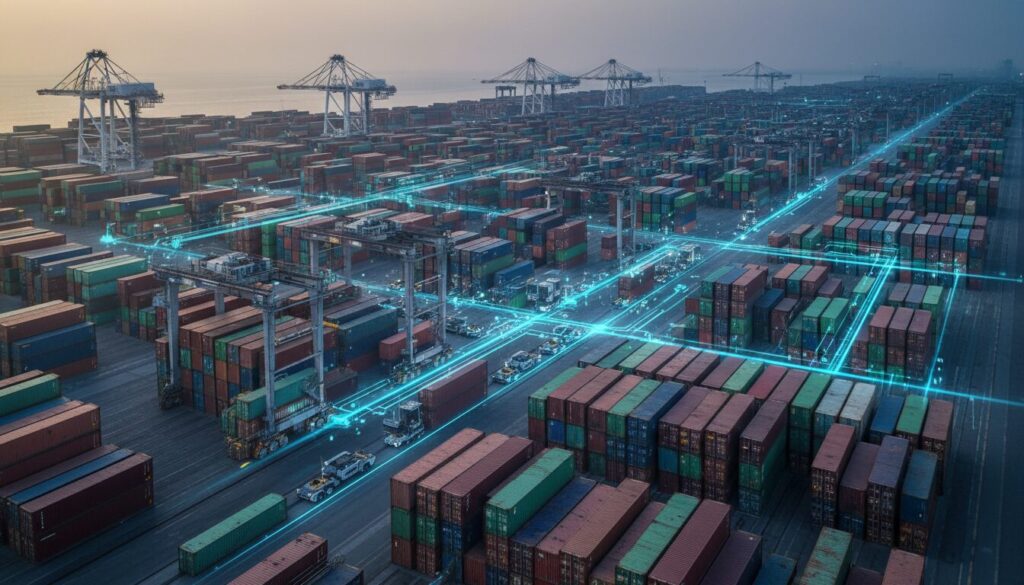
Why It Matters: The End of Static Supply Chains
The era of stable trade routes and predictable tariffs is over. From the Houthi attacks in the Red Sea to shifting tariff regimes between the US, EU, and China, volatility is now the only constant. For decades, supply chain strategy prioritized “Just-in-Time” efficiency. Today, the priority has shifted to “Just-in-Case” resilience. However, resilience usually comes with a high price tag—unless technology intervenes.
The critical failure in most modern supply chains is not a lack of data, but a lack of connection. Most organizations utilize Artificial Intelligence (AI) in silos—optimizing their own warehouses or demand planning based on internal historical data. But internal data cannot predict a geopolitical blockade or a sudden regulatory change at a foreign port.
To circumvent geopolitical uncertainty, innovation leaders are shifting toward Network Intelligence. This involves integrating real-time data from the entire ecosystem—suppliers, logistics service providers (LSPs), carriers, and customs brokers—into a unified digital fabric. As discussed in our previous analysis of Supply Chain Maturity: A Modern Approach to Disruption, true maturity means moving from reactive firefighting to proactive, network-aware orchestration.
Global Trend: The Rise of “Agentic AI” and Ecosystem Integration
The global logistics landscape is bifurcating. Companies are no longer just competing on product quality; they are competing on their ability to navigate a fractured geopolitical map.
The Shift from Silos to Ecosystems
The US, Europe, and Asia are adopting distinct but converging approaches to this challenge:
- United States: The focus is on “Friendshoring” and diversifying away from single-source dependencies (primarily China). As complexity grows, companies are relying more on Fourth-Party Logistics (4PL) providers to manage these multi-shored networks. See: Gartner Debuts 4PL Magic Quadrant: Tariffs Reshape Logistics.
- Europe: The drive is heavily influenced by the Corporate Sustainability Due Diligence Directive (CSDDD) and the Carbon Border Adjustment Mechanism (CBAM). Here, Network Intelligence is not just about agility; it is a compliance necessity to track carbon and labor standards across tiers.
- Asia (Japan/China): Japan is combatting a severe labor shortage through state-sponsored digitalization. As noted in Japan’s 2026 Logistics Budget: A Global Efficiency Blueprint, the government is investing heavily in standardization (like eBL) to ensure continuity despite demographic decline.
The Technology: Agentic AI
The technological enabler for this shift is “Agentic AI.” Unlike traditional AI, which provides analytics for humans to interpret, Agentic AI systems are designed to:
- Monitor the entire network autonomously.
- Detect ripple effects (e.g., a port strike in Hamburg affecting a production line in Ohio).
- Orchestrate a response (e.g., automatically re-booking freight to an alternative carrier) with minimal human oversight.
This capability relies on the adoption of digital standards such as the electronic Bill of Lading (eBL) and eCMR. Without standardized digital documents, AI is blind to the real-time movement of goods between parties.
Comparison: Traditional vs. Network Intelligent Models
| Feature | Traditional Supply Chain | Network Intelligent Supply Chain |
|---|---|---|
| Data Scope | Internal (ERP, WMS) | Ecosystem-wide (Partners, Carriers, IoT) |
| Response Time | Days or Weeks (Post-event) | Minutes (Real-time/Predictive) |
| AI Role | Descriptive (What happened?) | Agentic (Make it happen) |
| Geopolitical Strategy | Reactive (Emergency meetings) | Proactive (Scenario modeling & auto-routing) |
| Primary KPI | Cost Optimization | Resilience & Continuity |
Case Study: Unilever’s Virtual Ocean Control Tower
To understand how Network Intelligence circumvents geopolitical friction, we look to Unilever, the transnational consumer goods giant. With a footprint in over 190 countries, Unilever is uniquely exposed to every geopolitical ripple, from Brexit to the Red Sea crisis.
The Challenge
Unilever faced a fragmented logistics landscape. While they had robust internal systems, their visibility into ocean freight—the arteries of global trade—was dependent on disparate reports from carriers and forwarders. When the pandemic hit, followed by geopolitical instabilities in Eastern Europe and the Middle East, the lack of real-time “truth” meant that inventory was often trapped in transit, invisible to planners until it was too late.
The Solution: Network Intelligence via SAP
Unilever implemented a strategy focused on a Virtual Ocean Control Tower, leveraging the SAP Business Network for Logistics.
Instead of building a proprietary tool from scratch, they connected to an existing multi-enterprise network. This allowed them to:
- Ingest Real-Time Signals: They integrated live tracking data from carriers and third-party aggregators (like project44 or FourKites) directly into their planning systems.
- Standardize Documentation: By moving toward digital documentation, they reduced the administrative friction that often slows down cross-border movements during trade disputes.
- Cross-Company Collaboration: The system allowed for “handshakes” between logistics partners. If a primary route through the Suez Canal became high-risk, the system could visualize the disruption and suggest alternative routings or transport modes instantly.
The Results
By utilizing Network Intelligence, Unilever achieved a level of agility that traditional cost-focused models could not support:
- Operational Velocity: Response times to logistics disruptions were cut from days to minutes. The system automatically flagged delayed vessels, allowing planners to reroute goods or adjust production schedules immediately.
- Demurrage Reduction: By knowing exactly when containers would arrive (and predicting delays), Unilever significantly reduced detention and demurrage costs—savings that are crucial when freight rates spike due to geopolitical tension.
- Continuity: During the Red Sea crisis, where many companies lost visibility of their diverted cargo, network-connected companies maintained a digital thread, allowing them to reassure customers and manage inventory levels proactively.
This case exemplifies the shift discussed in Supply Chain Planning Reimagined: Embedded AI Guide: AI was not just analyzing history; it was sensing the network and enabling immediate action.
Key Takeaways for Innovation Leaders
For executives looking to replicate this success, the path forward involves three strategic pillars:
1. Break the Data Silos
AI is only as good as the data it feeds on. If your AI only sees your ERP data, it is blind to the world. You must invest in platforms that facilitate multi-tier visibility. This means connecting digitally with your suppliers’ suppliers and your forwarders’ carriers. The goal is a “Single Version of the Truth” shared across the ecosystem.
2. Adopt Digital Standards (eBL/eCMR)
Geopolitics often manifests as bureaucracy—increased inspections, slower customs, and documentation hurdles. Digital standards like the electronic Bill of Lading (eBL) are not just “paperless” initiatives; they are the foundation of AI accuracy. They allow data to flow seamlessly across borders, bypassing physical bottlenecks that often trap traditional paperwork.
3. From Optimization to Orchestration
Stop using AI solely to shave cents off transport costs. Start using Agentic AI to simulate geopolitical scenarios. Ask: If the Taiwan Strait is blockaded, what happens to my Tier 2 suppliers? Network Intelligence tools can model these scenarios and, crucially, orchestrate the necessary shifts in logistics providers before the crisis hits the mainstream news.
4. The Human-AI Hybrid
While Agentic AI can automate routine rerouting, the strategic response to a major geopolitical event (e.g., exiting a market entirely) requires human judgment. The role of the supply chain planner is evolving from “data chaser” to “network strategist,” supported by AI that handles the execution details.
Future Outlook: The Great Bifurcation
As we look toward 2026 and beyond, the divide between “Network Intelligent” companies and “Legacy” companies will widen. We are entering what we call the “Great Bifurcation” of logistics strategy.
Companies that rely on static contracts and email-based coordination will be victimized by every tariff hike and regional conflict. In contrast, companies that deploy Agentic AI over a connected network will treat geopolitical instability as a manageable variable rather than a fatal blow.
The future of supply chain resilience is not about hoarding inventory; it is about information liquidity. The ability to move data faster than physical goods will be the defining competitive advantage in a fragmented world.
For a deeper dive into the risks and AI opportunities defining the coming year, read our analysis: 2025 AI vs Risk: The Good, Bad, and Ugly.