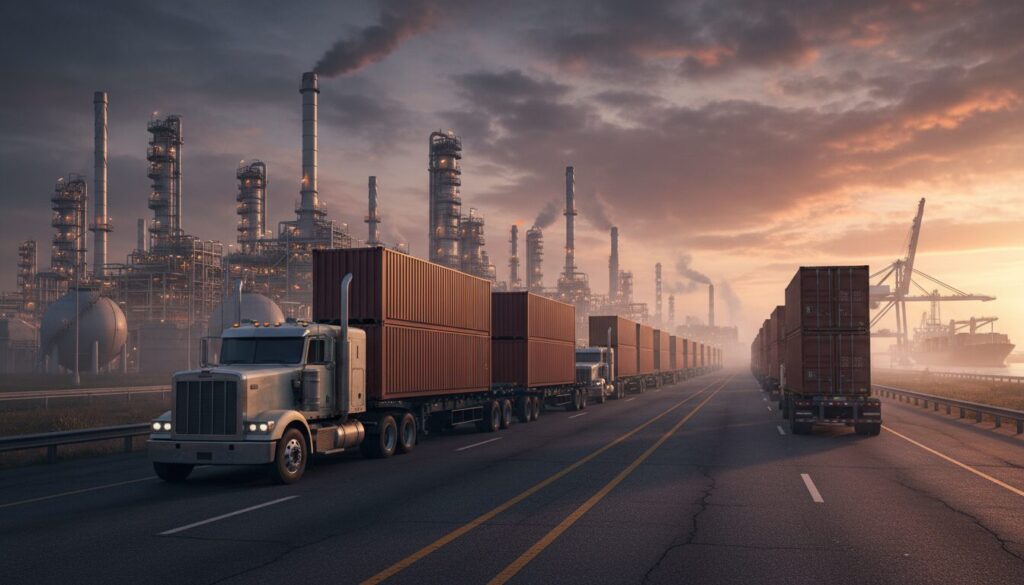
The global energy market is reacting violently to renewed geopolitical friction. U.S. diesel prices have surged to an average of $3.897 per gallon, marking an 8.8-cent increase in a single week. This spike is not merely a localized fluctuation; it is a symptom of a broader crisis as diesel prices continue upward trend as Iran conflict prompts more constraints on global shipping lanes.
With Brent crude oil surpassing $83 per barrel—shattering earlier forecasts of $58—logistics leaders are facing a “perfect storm” of rising operational costs and security risks. The Strait of Hormuz, a critical choke point handling 20% of the world’s oil, is under threat, forcing carriers to re-evaluate routing strategies that have held steady for decades.
This article analyzes the cascading effects of this volatility across the US, Europe, and Asia, and examines how industry giants are pivoting to maintain resilience.
Why It Matters: The Geopolitical Risk Premium
For supply chain executives, the correlation between Middle Eastern tension and logistics margins is immediate. Fuel costs typically represent 20-30% of a carrier’s operating expenses. When volatility strikes the Strait of Hormuz or the Red Sea, the impact is twofold:
- Direct Cost Increase: The fear premium drives up crude prices, which trickles down to diesel pump prices within days.
- Operational Inefficiency: To avoid conflict zones, vessels re-route (often around the Cape of Good Hope), increasing voyage lengths by 10-14 days. This burns more fuel, compounding the cost increase.
As discussed in our analysis of Oil Tankers Avoiding Hormuz: Global Supply Chain Strategy, the avoidance of these straits removes effective capacity from the market, driving up freight rates while simultaneously increasing the carrier’s cost base.
The Forecast vs. Reality Gap
The industry was prepared for a softer energy market in 2026. Financial forecasts predicted Brent crude stabilizing near $58 per barrel. The jump to $83+ represents a 43% deviation from strategic plans. This variance wreaks havoc on annual logistics budgets, specifically for shippers who locked in lower fuel surcharge (FSC) tables based on Q4 2025 predictions.
Global Trend: Regional Impacts of the Diesel Spike
While the root cause is centralized in the Middle East, the fallout varies significantly by region.
United States: The Owner-Operator Squeeze
In the U.S., the diesel price jump to $3.897/gal creates a precarious environment for domestic trucking.
- Spot Market Buffer: Currently, high spot rates are providing a temporary revenue buffer. However, this is deceptive.
- The Surcharge Trap: Large enterprise carriers (like Knight-Swift or Old Dominion) have dynamic Fuel Surcharge (FSC) programs that pass costs to shippers automatically.
- Small Carrier Risk: Small fleets and owner-operators, who make up the backbone of U.S. trucking, often lack the leverage to enforce immediate surcharge adjustments. They must absorb the 8.8-cent weekly hike out of their margins. If the conflict drags on, cash flow for these smaller entities will evaporate, potentially leading to a capacity crunch similar to 2022.
Europe: The Inflationary Feedback Loop
Europe is arguably more exposed than the U.S. due to its reliance on energy imports that traverse the Suez Canal and Strait of Hormuz.
- Re-routing Costs: European carriers are increasingly abandoning the Red Sea route. For more on this strategic shift, see CMA CGM Reverses Red Sea Return.
- Greenflation: The EU’s stringent emissions regulations (ETS) mean that longer routes not only cost more in fuel but also incur higher carbon taxes, creating a double operational penalty.
Asia: Energy Security Anxiety
For Asian economies, particularly Japan and China, the Strait of Hormuz is an existential lifeline.
- Strategic Reserves: Governments are releasing strategic reserves to dampen price shocks, but logistics costs are rising.
- Carrier Avoidance: As detailed in Hormuz Blockade: Japan Carrier Avoidance & Global Resilience, Japanese carriers are issuing avoidance orders, effectively lengthening supply chains for automotive and electronics components bound for the West.
Regional Impact Comparison
The following table outlines how the diesel surge impacts different global regions.
| Region | Primary Driver | Logistics Impact | Risk Level |
|---|---|---|---|
| North America | Domestic Pump Prices ($3.897/gal) | Margin compression for small carriers; Rising FSC for shippers. | Medium (Buffered by domestic oil production) |
| Europe | Route Extensions (Cape of Good Hope) | Compounding costs: Higher fuel burn + EU ETS Carbon Tax. | High (Directly linked to Suez access) |
| Asia (China/Japan) | Energy Security / Crude Supply | Delays in raw material imports; Export costs rising. | Critical (Dependency on Hormuz transit) |
Case Study: Maersk’s Dual Strategy – Surcharges and Sustainability
To understand how top-tier logistics firms handle diesel volatility amidst conflict, we look at A.P. Moller – Maersk. Their response to the Iran/Red Sea constraints offers a blueprint for resilience.
The Challenge
Maersk faced a dual threat:
- Immediate Security Risk: Vessels threatened in the Strait of Hormuz and Red Sea.
- Cost Explosion: Re-routing around Africa increases fuel consumption by approximately 40% per voyage, right as global oil prices spiked to $83/barrel.
Strategy A: Immediate Commercial Response (The Shield)
Maersk did not wait for quarterly reviews. They implemented Peak Season Surcharges (PSS) and Transit Disruption Surcharges (TDS) almost immediately.
- Mechanism: By de-coupling the “risk cost” from the “base freight rate,” Maersk protected its baseline margins.
- Lesson: Transparency with shippers is vital. Maersk communicated that these costs were pass-throughs necessitated by geopolitical force majeure, not profit-taking.
Strategy B: Long-Term Decarbonization (The Sword)
Interestingly, the oil crisis validated Maersk’s aggressive investment in Green Methanol.
- The Pivot: With the launch of vessels like the Ane Maersk, the company is slowly reducing its dependency on conventional bunker fuel (and by extension, the volatility of Brent Crude).
- Resilience: While methanol prices have their own dynamics, they are less correlated to Middle Eastern conflict than fossil fuels. This diversification acts as a long-term hedge against the very instability causing today’s diesel spikes.
For a broader look at how air and ocean networks are intertwining to solve these issues, refer to our Iran Conflict: Ocean & Air Resilience Case Study.
Key Takeaways for Logistics Leaders
The current upward trend in diesel prices is a reminder that energy strategy is supply chain strategy.
1. Dynamic Fuel Surcharge Agreements (FSC)
Shippers must renegotiate contracts to allow for rapid FSC adjustments. Static tables are obsolete in a world where Brent Crude misses forecasts by 43%.
- Action: Move from monthly to weekly FSC updates based on DOE (Department of Energy) indexes.
2. Modal Diversification
The constraints in Hormuz prove that relying solely on ocean freight through specific chokepoints is risky.
- Action: Evaluate Sea-Air hybrid solutions (e.g., Ocean to Dubai/Singapore, Air to Europe/US) to bypass maritime conflict zones while managing costs better than pure air freight.
3. Support Your Carrier Base
For shippers utilizing truckload capacity in the US:
- Action: Ensure your payment terms and FSC pass-throughs are efficient. Squeezing small carriers during a fuel spike leads to bankruptcies, which ultimately destroys your future capacity options when the market flips.
4. Accelerate Alternative Propulsion
The volatility of oil is a geopolitical constant.
- Action: Pilot EV trucks for short-haul and explore renewable diesel (HVO) or LNG for long-haul. Decoupling from crude oil is no longer just an environmental goal; it is a financial risk mitigation strategy.
Future Outlook
The volatility surrounding the Strait of Hormuz is unlikely to resolve in the short term. With Iran-U.S. tensions escalating, the “war risk premium” on oil will persist.
- Price Prediction: Analysts suggest that if the Strait faces partial or full blockage, oil could breach $100/barrel, pushing U.S. diesel well past $4.50/gal.
- Strategic Shift: We expect a permanent shift in routing. The Cape of Good Hope is becoming the “primary” route for risk-averse shippers, normalizing higher transit times and higher costs as the new baseline.
Innovation leaders must stop viewing fuel prices as a variable to be monitored and start viewing energy independence as a strategic imperative to be built.
See also: