The era of “pilot purgatory” in logistics automation is coming to a close. For years, major distributors have dabbled in robotics, running small-scale tests while the bulk of their operations remained manual. NAPA’s recent announcement to scale its deployment of Brightpick’s AI-powered robots to over 100 units is a definitive signal that the technology has matured from experimental to essential.
For the automotive aftermarket sector, characterized by massive SKU counts and urgent delivery windows, this move represents a critical shift in operational strategy. It suggests that legacy infrastructure can be modernized without the massive capital expenditure of building new facilities from scratch.
As discussed in our analysis of 5 Steps: Warehouse Robotics Use Expands Beyond Big Companies, automation is no longer the exclusive domain of greenfield giants. NAPA’s expansion proves that integrating advanced AI into existing brownfield sites is not only possible but the new baseline for competitive advantage.
The Facts: NAPA’s Automation Surge
NAPA (a subsidiary of Genuine Parts Company) has moved beyond the proof-of-concept phase. After a successful pilot, the company is deploying a fleet of over 100 Brightpick AI robots at a new distribution center to service its extensive network.
This deployment is not merely about replacing human legs with wheels; it is a strategic overhaul of how high-volume SKUs are handled within a complex supply chain.
Key Deployment Metrics
The following table outlines the core components of NAPA’s initiative:
| Component | Detail |
|---|---|
| Technology Provider | Brightpick (AI-powered mobile robotics) |
| Scale of Deployment | 100+ robots at an additional distribution hub |
| Operational Model | Goods-to-Person (GTP) |
| Network Reach | Servicing 6,000 stores |
| SKU Complexity | Handling inventory from a pool of ~800,000 unique parts |
| Primary Goal | Optimize replenishment and eliminate human travel time |
| Integration | Custom integration with NAPA’s existing tech stack |
Technology Focus: Beyond the AGV
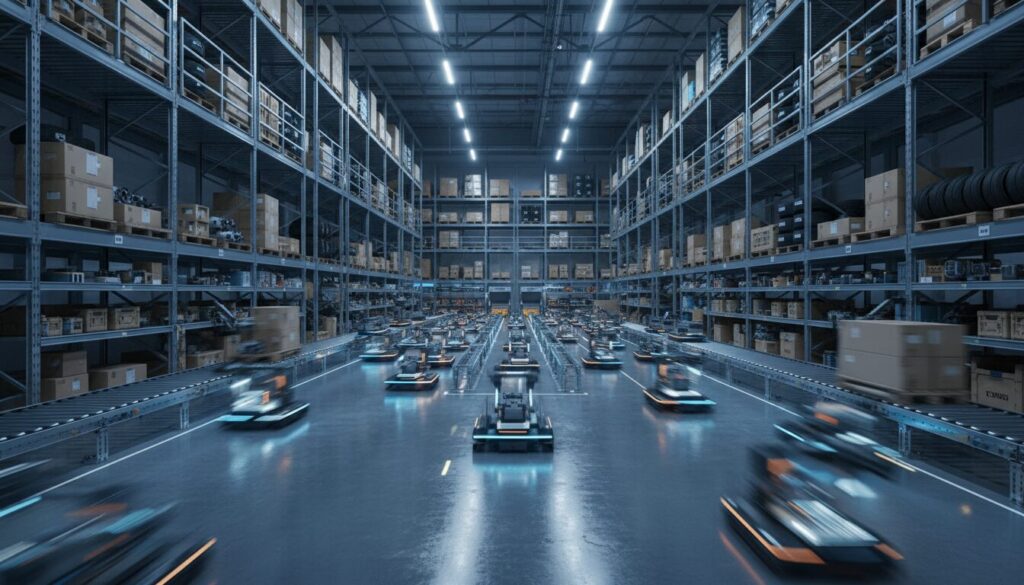
Unlike traditional Automated Guided Vehicles (AGVs) that often require magnetic tape or rigid paths, Brightpick’s solution utilizes AI to navigate and pick autonomously. These robots are designed to work within existing warehouse aisles, retrieving bins and bringing them to human pickers. This “Goods-to-Person” model addresses the most inefficient part of warehouse labor: walking time.
Industry Impact: The Ripple Effect
NAPA’s decision creates a ripple effect that extends beyond the automotive parts industry. It validates a specific approach to automation that favors flexibility over rigid infrastructure.
1. The Brownfield Renaissance
The most significant impact of this news is the validation of brownfield automation. Building new, fully automated “dark warehouses” is expensive and time-consuming. NAPA is demonstrating that you can inject high-efficiency automation into standard warehouse environments.
This aligns perfectly with the trends observed in Watch: The ROI of Automating Brownfield Facilities Unlocked. Companies are increasingly looking to optimize current assets rather than acquiring new real estate. Brightpick’s robots do not require the complete reconstruction of racking systems, allowing NAPA to modernize without a complete operational shutdown.
2. Managing Extreme SKU Diversity
The automotive aftermarket is notorious for its “long tail” of inventory. With approximately 800,000 SKUs, NAPA cannot rely on simple A-B-C slotting.
- Traditional Methods: Human pickers walk miles to find obscure parts.
- The AI Shift: Robots handle the retrieval of high-volume and mid-velocity SKUs, concentrating the labor density at the picking station.
This capability forces competitors in the auto parts sector to re-evaluate their manual picking strategies. If NAPA can reduce order cycle times by 30-50% using robots, competitors relying on manual carts will face margin compression.
3. Integration is the New Battleground
The announcement highlights that Brightpick will “customize and integrate” with NAPA’s stack. As hardware becomes commoditized, the differentiator becomes software integration. The ability for the robot fleet management system (FMS) to talk seamlessly with the Warehouse Management System (WMS) is where efficiency is won or lost.
LogiShift View: The “So What?”
Why does this specific expansion matter in the broader context of 2026 logistics?
The Shift to “Elastic” Automation
We are witnessing a move away from “monolithic” automation (like bolted-down conveyor systems) toward “elastic” automation (AMRs).
- Monolithic: If you need 20% more capacity, you might have to build a new building.
- Elastic: If NAPA needs 20% more capacity next year, they can simply add 20 more robots to the existing fleet.
This scalability is crucial in an economic environment where capital efficiency is paramount. As noted in Walmart: Supply Chain Spending Peak & Automation, even the largest players are looking to cap spending. Scalable robotics allow for “pay-as-you-grow” models rather than massive upfront CapEx dumps.
AI as the Orchestrator
The term “AI-powered” is often overused, but in this context, it refers to path planning and order batching. In a warehouse with 100 robots, traffic jams are a real risk. NAPA’s reliance on Brightpick suggests confidence in the AI’s ability to orchestrate complex traffic flows without human intervention. This moves the warehouse manager’s role from “people manager” to “fleet supervisor.”
The 98% Fulfillment Standard
In the spare parts industry, availability is the product. A mechanic waiting for a brake pad will not wait two days. By automating the distribution center, NAPA is likely aiming to extend its cut-off times for same-day or next-day delivery. This raises the service level agreement (SLA) standard for the entire industry.
Takeaway: Strategic Moves for Executives
The NAPA expansion serves as a blueprint for executives managing complex, high-SKU operations.
- Audit Your “Walking Time”: If your workforce spends more than 40% of their shift walking rather than picking, you are bleeding margin. Investigate Goods-to-Person solutions immediately.
- Prioritize Brownfield Compatibility: Do not assume automation requires a new building. Look for vendors (like Brightpick, Locus, or 6 River) that adapt to your racks, not the other way around.
- Start with the “Head,” Automate the “Tail” later: NAPA is likely focusing these robots on high-volume zones initially. Don’t try to automate 100% of SKUs on day one. Focus on the 20% of SKUs that generate 80% of the movement.
- Demand Integration Flexibility: When selecting a robotics partner, the first question should not be “How fast is the robot?” but “How fast is the API integration?”
NAPA has signaled that the pilot phase is over. The race for automated efficiency in the aftermarket sector has officially begun.