For decades, the narrative in logistics has been discouragingly consistent: automation is a luxury reserved for the industry giants. Small and mid-sized enterprises (SMEs) have watched from the sidelines as mega-corporations deployed massive ASRS (Automated Storage and Retrieval Systems) and miles of conveyor belts.
However, a critical shift has occurred. The barrier to entry has crumbled.
The Operational Pain: The “Middle Market” Squeeze
As a warehouse manager for a mid-sized facility, you likely face a specific set of paralyzing challenges that larger competitors can automate away.
- Labor Volatility: You spend 30% of your time recruiting and training temporary staff for peak seasons, only to see high turnover rates.
- Space Constraints: You operate in a “Brownfield” facility—an older building with pillars, uneven floors, and layouts that cannot accommodate rigid automation infrastructure.
- CapEx Paralysis: You cannot get approval for a $5 million automation overhaul, but you are bleeding money on overtime and error correction.
The result is a stagnant operation where picking errors rise with volume, and “scaling up” simply means “hiring more bodies,” which is no longer a sustainable strategy.
See also: Watch: The ROI of Automating Brownfield Facilities Unlocked
The Solution: ‘It’s not just all the big companies’: Warehouse robotics use expands
The solution lies in a market trend that has rapidly become an operational reality: ‘It’s not just all the big companies’: Warehouse robotics use expands.
This phrase encapsulates the democratization of logistics automation. It is driven by three technological and economic shifts that specifically benefit the SME sector:
1. The Rise of AMRs (Autonomous Mobile Robots)
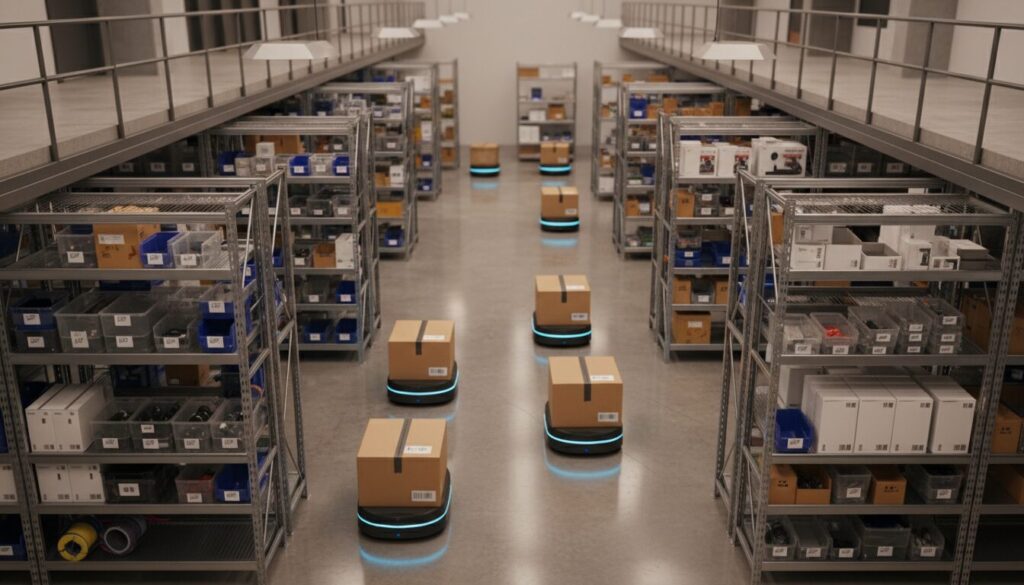
Unlike traditional AGVs (Automated Guided Vehicles) that required magnetic strips or wires in the floor, modern AMRs use LiDAR and cameras to navigate dynamic environments. They require zero infrastructure changes, making them perfect for older warehouses.
2. RaaS (Robotics-as-a-Service)
This is the financial game-changer. Instead of a massive upfront Capital Expenditure (CapEx), vendors now offer robots on a subscription basis (OpEx). You pay a monthly fee based on usage or number of units. This shifts the risk from the warehouse to the provider and aligns costs with revenue.
3. Accessible Software Integration
Historically, integrating robots with a WMS (Warehouse Management System) took months of custom coding. Now, middleware and standardized APIs have reduced this to weeks.
See also: Intrinsic Joins Google: The Physical AI Shift in Logistics
Process: Implementing SME Robotics in 5 Steps
How do you move from manual picking to a robotic-assisted workflow without halting operations? Follow this step-by-step implementation guide designed for facilities that cannot afford downtime.
Step 1: The “Low Hanging Fruit” Audit
Do not attempt to automate everything at once. Identify the process with the highest “waste” in terms of walking time.
- Analyze Picking Data: Look at your SKUs. Usually, 20% of your SKUs account for 80% of the volume (Pareto Principle). However, look at the tail—the slow movers that require your pickers to walk long distances.
- Calculate Travel Time: In a manual warehouse, pickers spend roughly 50-60% of their shift walking, not picking.
- Target: The goal is to automate the movement of goods, not necessarily the picking of goods (yet).
Step 2: Select the Right Form Factor
Based on the trend ‘It’s not just all the big companies’: Warehouse robotics use expands, various robot types are now accessible. Choose based on your specific pain point:
| Robot Type | Best Use Case | Infrastructure Need | Cost Model |
|---|---|---|---|
| Goods-to-Person (GTP) | High-density storage, small items. | Low (Shelves/Pods) | Medium CapEx or RaaS |
| Assisted Picking AMRs | Robots follow humans or meet them at pick locations. | None (Works in current aisles) | Low OpEx (RaaS) |
| Heavy Payload AMRs | Moving pallets from receiving to staging. | None | Medium OpEx |
Step 3: The “Sandbox” Pilot Program
Unlike the “Big 3” logistics companies, you cannot afford a failed full-scale rollout. You must use a pilot approach.
- Isolate a Zone: Designate one aisle or one product category for the pilot.
- Deploy Limited Units: Start with 3-5 robots.
- Test “Brownfield” Readiness: As discussed in our analysis of Neura & Drees & Sommer, ensure your facility’s physical constraints (floor flatness, Wi-Fi dead zones) are identified during this phase.
Step 4: Software Integration & WES Layer
The hardware is the body; the software is the brain. You need a lightweight Warehouse Execution System (WES) or a robotics middleware layer.
- Mapping: The robots will scan your facility to create a digital map.
- Task Interleaving: Ensure the software optimizes missions. If a robot drops off an item at packing, it should not return empty; it should pick up a return or dunnage on the way back.
- API Connection: Connect the robot fleet manager to your WMS. When an order drops, the WMS pushes it to the robot manager, which dispatches the bot.
Step 5: Change Management & Human-Robot Collaboration
This is where most implementations fail. It is not technical; it is cultural.
- The Narrative: Explain that robots are “Co-bots” (Collaborative Robots). They are there to do the heavy lifting and walking, so humans can focus on value-added tasks.
- Gamification: Use the robot screens to show pick rates and team goals.
- Training: Train your best associates to be “Robot Wranglers” (super users).
See also: Toyota Contracts 7 Agility Humanoids: Global Innovation Case – While humanoids are the future, the principle of collaboration remains the same.
Results: The Operational Transformation
By embracing the philosophy that ‘It’s not just all the big companies’: Warehouse robotics use expands, you can expect tangible shifts in your metrics within 3-6 months.
Here is a comparison of a typical SME warehouse before and after implementing a collaborative AMR solution.
Before vs. After Comparison
| Metric | Before Automation (Manual) | After Automation (AMR/RaaS) | Improvement Impact |
|---|---|---|---|
| Picker Walking Distance | 10-15 km per shift | < 2 km per shift | Reduces fatigue, increases retention. |
| Units Per Hour (UPH) | 60 – 80 UPH | 150 – 200 UPH | 2x – 2.5x Productivity Boost |
| Picking Accuracy | 98.5% (Human Error) | 99.9% (Scan/Light Verify) | Reduces returns processing costs. |
| Onboarding Time | 2 Weeks to full speed | 2 Days to full speed | Robots guide the new hires. |
| Scalability | Hire 20 temps (3 weeks lead time) | Rent 10 more bots (48 hours lead time) | Flexible response to demand spikes. |
Case Insight: Commercial Scalability
We are seeing this success replicated globally. For instance, in our coverage of the Noematrix Case Study, we observed how commercial embodied AI successfully moved from labs to real-world retail and logistics environments (pharmacies), proving that complex environments are no longer a barrier to entry.
Summary: Keys to Success for the Mid-Market Manager
The era where automation was a moat protecting the largest players is over. The keyword of the year is accessibility.
To succeed in this transition, remember three core principles:
- Don’t Pave the Cow Path: Do not just automate your current inefficient process. Optimize the process first, then automate the movement.
- Think OpEx, Not CapEx: Leverage RaaS models to keep cash flow healthy while accessing top-tier technology.
- Start with “Brownfield” Logic: Assume your building won’t change. Choose robots that adapt to your floor, not the other way around.
‘It’s not just all the big companies’: Warehouse robotics use expands—and it is time for your facility to join the expansion. By starting small, measuring ROI accurately, and leveraging flexible financing, you can turn your logistics operation from a cost center into a competitive advantage.