The logistics landscape is no longer defined by how accurately you can forecast next quarter, but by how quickly you can react to the next hour. As we approach 2026, the era of static, linear supply chains is officially over. We are entering the age of Real-Time Agility.
For decades, the “Just-in-Time” model reigned supreme. Then, the pandemic forced a pivot to “Just-in-Case” inventory bloating. Now, innovation leaders are identifying a third, more sustainable path. By 2026, logistics will be driven by a resale market growing significantly faster than retail, humanoid robotics entering production at scale, and AI agents that don’t just optimize routes, but make purchasing decisions.
This article outlines five critical predictions for Supply Chain 2026 and analyzes how global leaders are leveraging these trends to build resilience against rising tariffs and fragmented demand.
Why It Matters: The Collapse of the Two-Week Cycle
The defining metric for 2026 is Time to Recovery (TTR). Historically, when a disruption occurred—be it a blocked canal or a new tariff—the average response time for global organizations hovered around two weeks. By 2026, that window must close.
Average response time to disruptions needs to drop from two weeks to hours to maintain service.
The pressure comes from three converging vectors:
- Geopolitical Friction: With rising trade tariffs and protectionism in the US and EU, cross-border flows are volatile.
- Sustainability Mandates: The “half-empty truck” problem is no longer just a cost issue; it is a regulatory liability under new Scope 3 reporting standards.
- Technological Deficit: Despite the hype, only 23% of supply chain organizations currently have a formal AI strategy in place. This gap separates the market leaders from the laggards who will be priced out by inefficiency.
As discussed in our previous analysis on volatility, static planning is dead. Leaders must move toward embedded AI that senses changes instantly.
See also: Supply Chain Planning Reimagined: Embedded AI Guide
Global Trends: 5 Predictions for 2026
The shift in 2026 is not just about technology; it is about the fundamental structure of trade in the US, China, and Europe.
1. Reverse Logistics Becomes the Prime Profit Center
For years, returns were an afterthought—a cost center to be minimized. In 2026, the global resale market is growing 2.7x faster than the overall apparel market.
This is driven by the circular economy mandates in the EU (like the Digital Product Passport) and the rise of platforms like ThredUp and Vinted in the US. Supply chains must now be bidirectional. The infrastructure required to inspect, repair, and resell an item is vastly different from the infrastructure used to ship a new one.
- Impact: Warehouses will transform into “re-commerce hubs” where inbound goods are graded by AI vision systems for immediate resale, bypassing the landfill entirely.
- Tech Enabler: RFID and traceability are crucial here. You cannot resell what you cannot authenticate.
See also: RFID vs. Tariffs: Supply Chain Visibility Case Study
2. The Rise of the “AI Consumer” and Fragmented Demand
We are witnessing the birth of the “Agentic Economy.” By 2026, a significant portion of e-commerce orders will be initiated not by humans clicking buttons, but by AI shopping agents programmed to find the best value or specific attributes (sustainability, speed).
This fragments demand. Instead of bulk orders from predictable demographics, logistics networks will face micro-spikes in demand generated by AI agents reacting to real-time pricing changes.
- Challenge: Traditional “Track and Trace” cannot handle this volume of micro-queries.
- Solution: Logistics providers are deploying their own AI agents to interface with consumer bots, automating the negotiation and tracking process.
See also: How AI Agents Solve Track and Trace: 4 Steps to Zero Errors
3. Humanoids Leave the Lab for the Floor
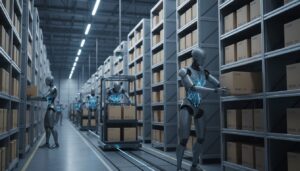
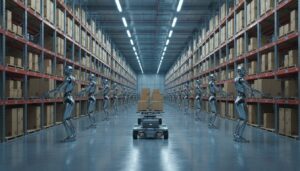
The labor shortage in logistics is chronic in the US and acute in Japan and Europe. The solution is no longer just stationary arms, but mobile, humanoid robots.
The humanoid robot market is projected to reach $38B by 2035, but 2026 marks the year they move from “pilot” to “production.” Companies like Tesla (Optimus), Figure, and Agility Robotics (Digit) are deploying units that can walk into existing brownfield warehouses and perform tasks designed for humans—lifting totes, loading trucks, and sorting pallets—without requiring a complete facility redesign.
4. Utilization is King: Solving the Empty Truck Crisis
Inefficiency is the silent killer of margin. 58% of truckloads were driven half-empty last year, highlighting an immediate optimization opportunity.
In 2026, “Shared Truckload” (STL) algorithms will become standard. Unlike Less-Than-Truckload (LTL) which uses a hub-and-spoke model (slow, high damage risk), STL uses AI to pool freight from different shippers into one multi-stop truck that moves directly to destinations. This reduces carbon emissions and shipping costs simultaneously.
5. Network Intelligence Overcomes Borders
With trade wars intensifying, the ability to reroute supply chains away from high-tariff zones is a competitive advantage. This requires “Network Intelligence”—a live map of global suppliers, risks, and alternative routes.
Companies are moving away from single-source reliance (e.g., China only) to “China Plus One” strategies involving Vietnam, Mexico, or India.
See also: Network Intelligence & AI: Circumventing Global Geopolitics
Case Study: Walmart’s Automated Agility
While many companies are predicting the future, Walmart is actively building it. Their strategy for 2026 serves as a prime example of how to integrate automation, cross-border resilience, and AI planning.
The Challenge
Walmart faces the dual pressure of needing to keep prices low (Everyday Low Prices) while navigating a complex cross-border environment with Mexico and China, all amidst a labor shortage in the US logistics sector.
The Strategy: Symbotic & Cross-Border Integration
Walmart’s approach combines heavy hardware automation with software agility.
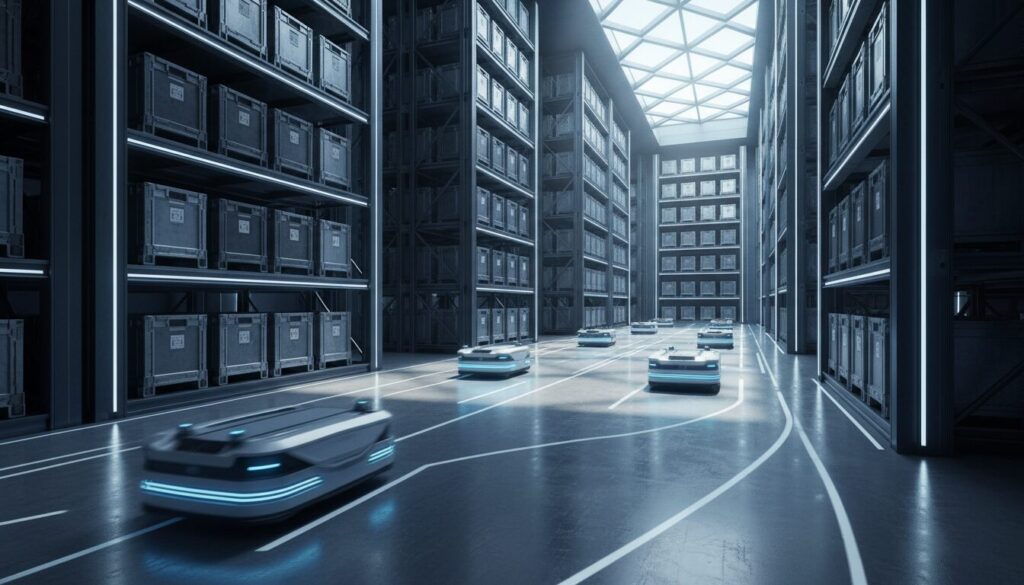
- Hardware (The Humanoid Proxy): Walmart has aggressively rolled out Symbotic’s AI-powered automation across its 42 regional distribution centers. While not humanoid, these bots treat the warehouse as a dynamic grid, processing pallets faster than any human workforce could, effectively insulating Walmart from labor volatility.
- Cross-Border Agility: Walmart has launched a dedicated cross-border service for sellers. By handling the customs brokerage and freight from China/Mexico directly, they utilize their own density to lower costs. This allows them to “re-plan” routing in hours if a new tariff is announced, rather than weeks.
Comparison: Traditional vs. Walmart 2026 Model
| Feature | Traditional Retail Logistics | Walmart’s 2026 Agile Model |
|---|---|---|
| Inventory Strategy | Predictive (Forecast-based) | Responsive (Real-time consumption data) |
| Warehousing | Manual/Conveyor-based | Symbotic AI Automation & Dynamic Grids |
| Cross-Border | Third-party dependencies | Integrated “White Glove” Seller Services |
| Reaction Time | 2-4 Weeks | < 24 Hours |
| Reverse Logistics | Cost Center (Disposal focus) | Value Recovery (Resale/Refurb integration) |
The Result
By integrating these systems, Walmart has moved toward the “hours not weeks” replanning cycle. Their ability to offer cross-border logistics to third-party sellers also turns their supply chain cost center into a revenue-generating service (Logistics as a Service).
For a deeper dive into their specific cross-border tactics, read: Walmart Cross-Border Logistics Case Study
Key Takeaways for Logistics Leaders
To survive the shift to the 2026 landscape, strategy executives must prioritize the following:
- Audit Your “Empty Space”: If your fleet utilization mirrors the global average (58% empty), you are burning cash and carbon. Invest in load-pooling technology or platforms like Flock Freight immediately.
- Formalize the AI Strategy: With only 23% of organizations having a plan, developing one now provides “first-mover” advantage. Focus on embedded AI for planning, not just generative AI for chatbots.
- Prepare for Resale: If you are in retail or consumer goods, your supply chain must handle flow in both directions. The 2.7x growth in resale is a revenue stream you cannot ignore.
- Embrace Humanoids for Brownfield Sites: You do not need to build a new “dark warehouse” to automate. Humanoid robots are reaching maturity to work alongside humans in your current facilities.
Future Outlook: Beyond 2026
As we look toward 2027 and beyond, the trends of 2026 will calcify into standards. The “Autonomous Supply Chain” will cease to be a buzzword and become an operational reality.
The ultimate goal is a Self-Healing Network. In this future state, when a shipment is delayed by weather, the AI doesn’t just alert a human manager; it automatically re-books the freight on an alternative carrier, updates the customer, and adjusts the inventory forecast at the destination—all within seconds.
The winners of 2026 will be those who stop trying to predict the future perfectly and start building the agility to handle whatever the future throws at them. The transition from “Predictive” to “Agile” is not optional; it is the new baseline for survival.