
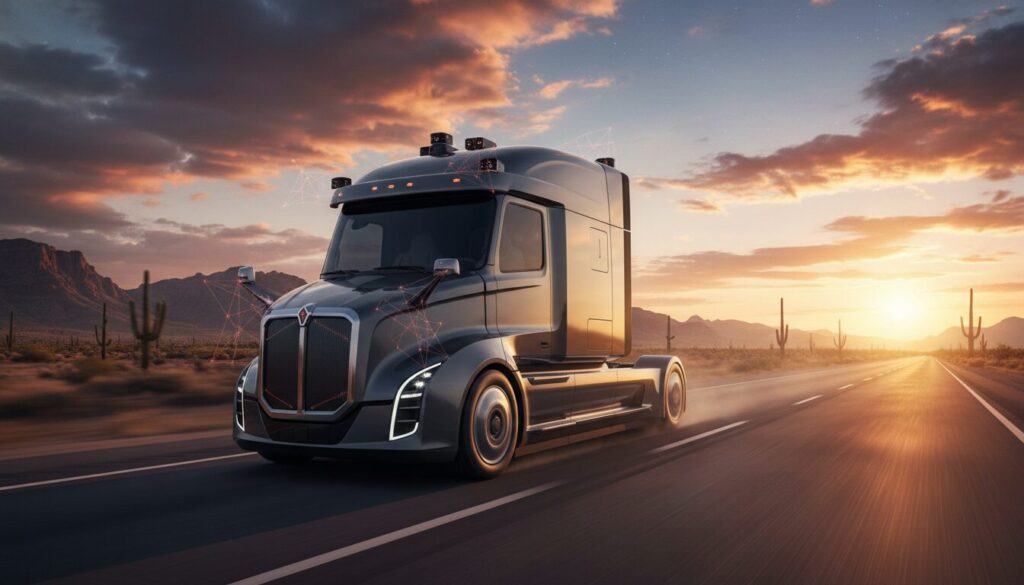
The logistical ceiling imposed by human biology and federal regulation is cracking. For decades, the speed of over-the-road freight has been dictated not by the engine’s capability, but by the driver’s need to sleep.
Aurora Innovation has effectively shattered this constraint. By successfully operating driverless trucks on a 1,000-mile route between Fort Worth, Texas, and Phoenix, Arizona, in just 15 hours, the company has demonstrated a capability that no compliant human driver can match.
This development is not merely a technical pilot; it is the opening salvo of a structural shift in North American logistics. For executives and supply chain managers, the “superhuman” freight era is no longer a futurist prediction—it is an operational reality that demands immediate strategic attention.
The End of the 11-Hour Limit
The core value proposition of Aurora’s latest achievement is the bypass of the Federal Motor Carrier Safety Administration’s (FMCSA) Hours of Service (HOS) regulations.
Under current laws, a human driver is restricted to 11 hours of driving time within a 14-hour duty window, followed by a mandatory 10-hour break. Consequently, a 1,000-mile run, which physically takes about 15–16 hours at highway speeds, is legally impossible to complete in a single sitting for a solo driver. It essentially guarantees a two-day transit time.
Aurora’s autonomous trucks do not sleep. They do not require breaks. They turn a two-day lane into a same-day lane.
The Facts: Aurora’s 15-Hour Run
To understand the scale of this shift, we must look at the specific operational data provided by Aurora’s recent expansion.
| Component | Detail |
|---|---|
| The Route | Fort Worth, TX ↔ Phoenix, AZ (approx. 1,000 miles). |
| Transit Time | 15 Hours (Autonomous) vs. 2 Days (Human Solo). |
| The Technology | The “Aurora Driver” system (LIDAR, radar, cameras). |
| Capacity Strategy | Scaling from 30 trucks currently to 200+ by the end of 2026. |
| Partners | FedEx, Uber Freight, Werner, Schneider. |
| Strategic Goal | Expansion across the U.S. Sun Belt; high-volume, long-haul corridors. |
This efficiency gain effectively doubles the utilization of the asset. A truck that drives 20+ hours a day generates twice the revenue of a truck limited to 11 hours, fundamentally altering the unit economics of long-haul transport.
Industry Impact: The Ripple Effect
The ability to move freight 1,000 miles in 15 hours does not just change the trucking industry; it ripples through warehousing, inventory management, and manufacturing.
1. Carrier Economics and Fleet Utilization
For carriers, the equation is simple: higher asset turnover. The fixed cost of a Class 8 tractor remains the same whether it runs 100,000 miles or 200,000 miles a year. By utilizing driverless technology, carriers can amortize these costs faster.
However, this creates a bifurcated market.
- Tier 1 (Autonomous): Premium, time-sensitive freight moving continuously.
- Tier 2 (Human): Standard freight subject to HOS limits.
As we analyzed in our previous coverage, Driving the Autonomous Supply Chain: Are We There Yet? Guide, the integration of these assets will likely follow a “hub-to-hub” model, requiring human drivers for the complex first and last miles. This preserves human jobs but shifts them toward regional, home-daily routes.
2. Shippers and Inventory Velocity
For shippers, specifically those in retail and perishables, a 15-hour transit time between major distribution hubs (like Texas to Arizona) allows for:
- Reduced Safety Stock: Faster replenishment cycles mean less capital tied up in inventory.
- Extended Shelf Life: For produce moving from the West Coast or imports crossing the border, saving a day in transit is critical.
Partnerships with giants like FedEx and Uber Freight suggest that the initial capacity will be absorbed by high-value, time-critical parcels and LTL (Less-Than-Truckload) shipments.
3. The Global Context
While Aurora is making headlines in the US Sun Belt, it is vital to remember this is a global race. As discussed in Momenta’s Autonomous Trucking Entry: Global Innovation Case, competitors in Asia are also aggressively pursuing mass production of autonomous units. The technology is maturing simultaneously across major markets, meaning global supply chain leaders must prepare for autonomy on multiple continents.
LogiShift View: The “Superhuman” Arbitrage
The narrative surrounding autonomous trucking often focuses on “solving the driver shortage.” While true, this misses the more profound point: Autonomy creates a new product class.
At LogiShift, we view Aurora’s 15-hour run as the validation of “Superhuman Logistics.” This is not just replacing a driver; it is exceeding human biological limits.
The 2026 Convergence
The timing of Aurora’s scaling—aiming for 200 trucks by 2026—is not coincidental. It aligns with broader market cycles.
In our analysis of 2026 Trucking Capacity: Why It Tightens & Who Wins, we predicted a tightening of freight capacity due to carrier bankruptcies and regulatory pressures. Aurora’s timeline suggests that just as traditional capacity tightens, autonomous capacity will become viable at scale.
This creates a strategic advantage for early adopters. Shippers who secure autonomous capacity contracts now will have a “fast lane” option when the general market tightens in 2026. Those relying solely on the spot market or traditional brokerage may find themselves paying premium rates for standard speeds.
The Infrastructure Gap
The main bottleneck is no longer the software; it is the physical infrastructure.
- Transfer Hubs: These trucks need dedicated terminals to swap trailers with human drivers near highways.
- Maintenance: 24/7 running times mean accelerated wear and tear. Maintenance intervals will shorten, requiring predictive maintenance capabilities that match the sophistication of the driving AI.
Strategic Takeaway: What Executives Should Do
The Aurora announcement is a signal that the technology has moved from “R&D” to “ROI.” Logistics leaders should take the following steps immediately:
-
Audit Your Lanes:
Identify routes in your network that are 600–1,200 miles long. These are the “Goldilocks” zones where autonomy beats human HOS most significantly (turning 2 days into 1). -
Evaluate 24/7 Receiving:
If a truck arrives at 3:00 AM because it didn’t stop, but your dock doesn’t open until 8:00 AM, you have lost the autonomous advantage. Warehouses must adapt to continuous ingress/egress. -
Engage with Forward-Thinking 3PLs:
You likely won’t buy an autonomous truck yourself. You will hire a carrier that uses them. Ask your strategic partners (Uber Freight, FedEx, Werner, etc.) what their roadmap is for autonomous lane access on the Sun Belt corridors.
The Bottom Line: The 15-hour mile marker set by Aurora is the new benchmark. In logistics, speed is currency, and the exchange rate just shifted in favor of the machines.