Logistics leaders today face a perfect storm: chronic labor shortages, fluctuating fuel costs, and consumer demands for instant delivery. You have likely heard the buzzwords—autonomous trucks, lights-out warehouses, and AI-driven decision-making. But amidst the hype, a critical question remains for operations executives: Is the autonomous supply chain a reality today, or still a futuristic concept?
This guide cuts through the noise. We will analyze the current state of supply chain autonomy, defining exactly where the technology stands, the tangible benefits available right now, and the steps you need to take to prepare your operations for a driverless, automated future.
What is the Autonomous Supply Chain?
Before determining “are we there yet,” we must define the destination. The “Autonomous Supply Chain” refers to an end-to-end logistics network that operates with minimal human intervention. It is not just about self-driving trucks; it is a convergence of hardware and software where machines execute physical tasks and Artificial Intelligence (AI) makes operational decisions.
The Two Pillars of Autonomy
To understand the maturity of the market, we must distinguish between the physical and the digital aspects of autonomy.
-
Physical Autonomy (Hardware):
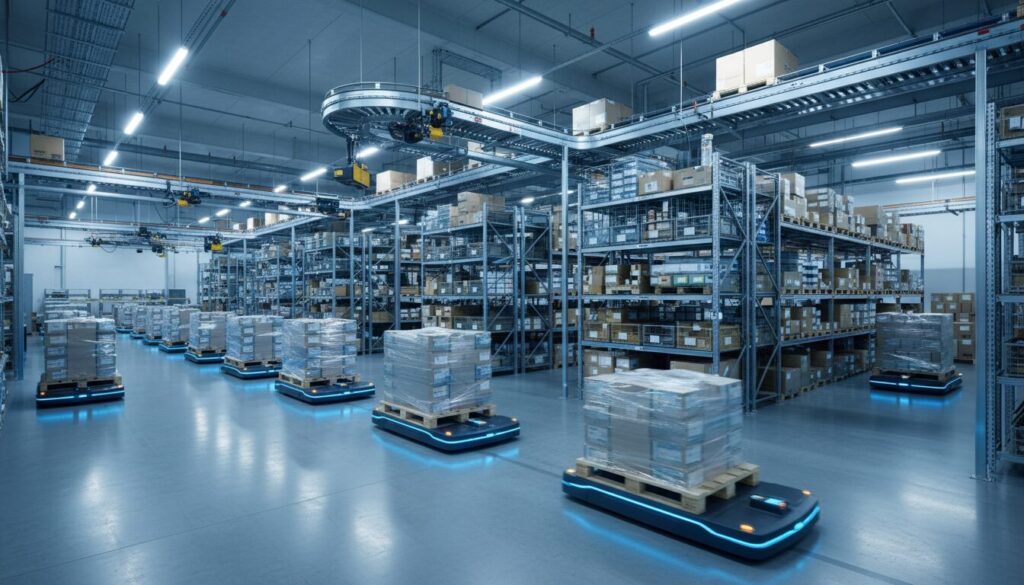
This involves machines moving goods without human operators.- Autonomous Mobile Robots (AMRs): Used in warehouses for picking and sorting.
- Autonomous Trucks (Level 4/5): Vehicles capable of highway driving without a driver.
- Autonomous Ships & Drones: Unmanned maritime and aerial delivery vehicles.
-
Digital Autonomy (Software):
This involves systems “thinking” and planning without human manual input.- Agentic AI: Software agents that predict disruptions and execute rerouting automatically.
- Predictive Maintenance: IoT sensors triggering repair orders before breakdowns occur.
For a deeper dive into the software side of autonomy, particularly how AI agents function, read our guide: From Insight to Action: The Agentic Supply Chain Guide.
Why Now? The Drivers of Automation
The push for an autonomous supply chain is no longer just about “innovation theater.” It is a survival strategy driven by urgent macro-economic trends.
The Global Labor Crisis
The logistics sector is experiencing a severe workforce deficit. In Japan, the “2024 Problem” limits driver overtime, creating a massive capacity gap. In the US and Europe, an aging driver workforce means there simply aren’t enough humans to move the freight required by the economy.
Technological Convergence
Several technologies have matured simultaneously to make autonomy viable:
- LiDAR and Computer Vision: allowing vehicles to “see.”
- 5G Connectivity: enabling real-time communication between assets.
- Generative AI: allowing systems to process unstructured data and make complex decisions.
We are seeing rapid movement in the market. For instance, the collaboration between T2 and PlusAI is accelerating the rollout of Level 4 autonomous trucks specifically to address these labor shortages. You can learn more about this pivotal alliance here: T2 & PlusAI L4 Japan Rollout: Global Logistics Innovation.
Are We There Yet? Evaluating Maturity Levels
To answer the core question—”Are we there yet?”—we must look at the different segments of the supply chain. The answer varies depending on the mode of transport and the environment.
The Autonomy Maturity Matrix
| Segment | Status | Maturity Level | Key Challenges |
|---|---|---|---|
| Warehousing | High | Mature (Commercialized) | Integration with legacy WMS. |
| Long-Haul Trucking | Medium | Pilot / Early Commercial | Regulations, liability, weather. |
| Last-Mile Delivery | Low-Medium | Experimental / Niche | Urban complexity, pedestrians. |
| Maritime | Medium | Proof of Concept | International maritime laws. |
1. Trucking: The Middle Mile Revolution
The middle mile (highway driving between distribution centers) is the closest to full autonomy. Companies like PlusAI are nearing public listing and commercial deployment, targeting 2027 for widespread Level 4 operations. This shift is critical because it addresses the longest, most monotonous routes where human fatigue is a risk.
See also: PlusAI Listing: 2027 L4 Autonomous Freight.
2. Maritime: The Silent Giant
While autonomous cars get the headlines, autonomous ships are making history. The MEGURI2040 project recently debuted the world’s first commercial Level 4 autonomous ship on a regular route. This proves that autonomy is feasible even in complex maritime environments.
See also: MEGURI2040: World’s First Commercial L4 Autonomous Ship.
3. Last Mile: The Final Frontier
The last mile remains the hardest puzzle due to unpredictable traffic and human interaction. However, breakthroughs like the Tesla Robotaxi in Austin demonstrate that “no human driver” operations are moving from test tracks to real city streets.
See also: Tesla Robotaxi Austin Launch: Autonomous Logistics Impact.
Benefits of the Autonomous Supply Chain
Transitioning to autonomous operations offers quantifiable benefits that go directly to the bottom line.
Operational Cost Reduction
- Fuel Efficiency: Autonomous trucks drive more smoothly than humans, optimizing acceleration and braking to save 10-20% on fuel.
- Labor Reallocation: Reduced reliance on drivers for long hauls allows human workers to focus on complex tasks like customer service or last-yard delivery.
Increased Asset Utilization
Human drivers are legally restricted by Hours of Service (HOS) regulations to prevent fatigue. Autonomous systems do not sleep.
- 24/7 Operations: An autonomous truck can run nearly 24 hours a day, stopping only for refueling and maintenance.
- Faster Lead Times: Doubling the operating hours can effectively halve the delivery time for cross-country shipments.
Enhanced Safety
The vast majority of logistics accidents are caused by human error (distraction, fatigue, impairment). Autonomous systems, equipped with 360-degree sensors and millisecond reaction times, drastically reduce accident rates, protecting both cargo and public safety.
Implementation: How to Prepare Your Logistics Strategy
If you are an operations leader, you cannot simply “buy” an autonomous supply chain tomorrow. However, you must start building the foundation today to plug into these networks as they come online.
1. Digitize Your Data (The Prerequisites)
Autonomous hardware requires clean data to function. If your inventory tracking relies on spreadsheets or manual entry, you are not ready for autonomy.
- Action: Implement a cloud-based WMS and TMS (Transportation Management System). Ensure your data on package dimensions, weight, and delivery windows is 100% accurate.
2. Identify “Autonomy-Friendly” Routes
Autonomy will not rollout everywhere at once. It will start on “high-volume, low-complexity” lanes (e.g., highway corridors between major hubs).
- Action: Analyze your shipping lanes. Identify fixed routes with high volume that are prime candidates for early autonomous trucking adoption.
3. Adopt Hybrid Models
We are entering a “hybrid era” where human-driven and autonomous assets coexist.
- Action: Look for “Hub-to-Hub” models. Use human drivers for the complex first and last mile, and utilize autonomous providers for the long-haul middle mile.
4. Invest in Agentic Workflows
Before your trucks become autonomous, your decision-making should.
- Action: Utilize AI tools that can predict delays and automatically reroute shipments. This “software autonomy” yields immediate ROI while you wait for the hardware to mature.
Conclusion: We Are “Almost” There
So, Driving the Autonomous Supply Chain: Are We There Yet?
The answer is a nuanced “Yes and No.”
- No, we do not yet have a fully driverless global network where a product moves from factory to doorstep without human touch.
- Yes, the components are live. Commercial L4 ships are sailing, L4 trucks are piloting in Japan and the US, and AI agents are managing freight logic.
We are currently at Level 3.5. The technology exists, but regulatory frameworks and infrastructure integration are catching up. For logistics executives, the waiting game is over. The competitive advantage belongs to those who begin integrating these autonomous modules—starting with digital autonomy and pilot hardware programs—today.
Next Steps:
- Audit your current supply chain data maturity.
- Explore partnerships with autonomous freight carriers for your long-haul lanes.
- Read our detailed analysis on From Insight to Action: The Agentic Supply Chain Guide to automate your decision-making processes immediately.