
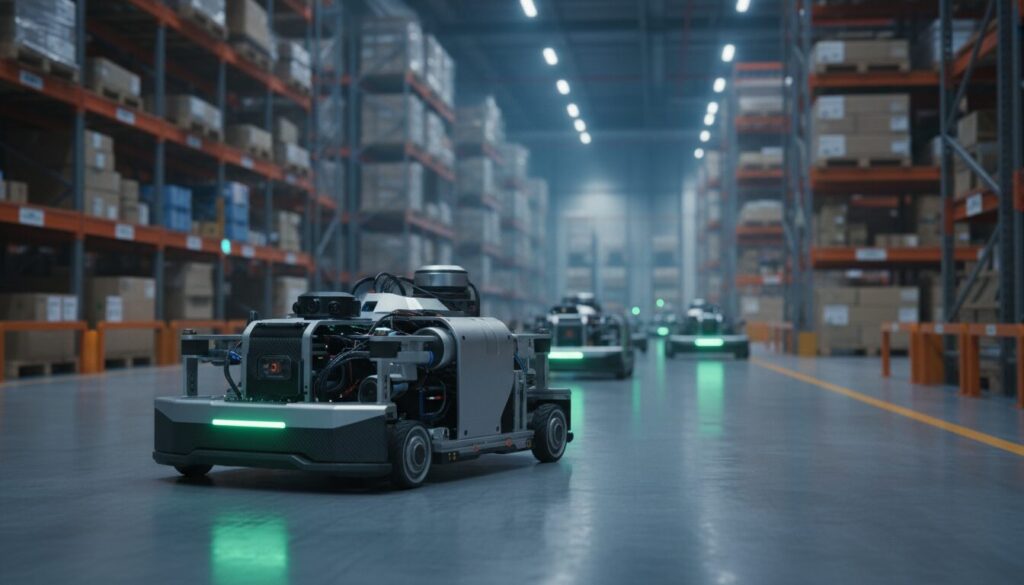
The era of “break-fix” maintenance in warehouse automation is rapidly becoming a liability. As logistics facilities transition from pilot robotic programs to full-scale autonomous fleets, the sheer volume of maintenance tickets can threaten to erase the ROI of automation.
Roboworx has addressed this critical bottleneck by integrating AI-powered predictive analytics into its Robot Service Manager (RSM). By shifting maintenance from reactive to predictive, the company claims a reduction in downtime by up to 93%.
For supply chain executives, this is not just a software update; it is a signal that the industry is moving toward “Zero-Downtime Operations.” This analysis explores the mechanics of this shift, its impact on the logistics ecosystem, and why data fatigue is the next enemy to conquer.
The Facts: Roboworx’s Predictive Shift
The core of this announcement is the integration of Machine Learning (ML) and real-time telemetry into the existing Roboworx RSM platform. The system is designed to identify potential component failures before they disrupt operations.
Key Capabilities and Metrics
The updated RSM software utilizes odometry data—tracking miles traveled, cycles completed, and units lifted—to build a health profile for each robotic asset. Instead of waiting for a breakdown, the AI flags anomalies in motor performance or battery degradation.
Summary of Key Features:
| Feature | Function | Strategic Benefit |
|---|---|---|
| Predictive Analytics | Analyzes telemetry (miles, cycles) to forecast failure. | 93% reduction in break-fix calls; prevents unplanned downtime. |
| Health Summaries | Generates automated, plain-language status reports. | Eliminates data fatigue; allows managers to make quick decisions without interpreting raw logs. |
| Technician Prep | Pre-orders parts and diagnoses issues before dispatch. | 50% reduction in repair times; increases First-Time Fix Rate. |
| Cost Model | Offered at no additional charge to Roboworx partners. | Maximizes the lifespan of automation assets without increasing OPEX. |
This update directly targets the “Efficiency Paradox” where adding more robots creates more maintenance overhead. As discussed in our Driving the Autonomous Supply Chain: Are We There Yet? Guide, the success of autonomy relies not just on the hardware moving, but on the infrastructure keeping it moving.
Industry Impact: Beyond the Warehouse Floor
The introduction of high-level predictive analytics by Roboworx ripples through the entire logistics chain, affecting facility managers, third-party maintenance providers, and financial planners.
1. The Death of the “Break-Fix” Model
Traditionally, warehouse maintenance has been reactive. A robot stops, a ticket is logged, and a technician is dispatched. This model incurs two costs: the repair cost and the opportunity cost of lost throughput.
By claiming a 93% reduction in break-fix calls, Roboworx is essentially selling “uptime insurance.” For high-volume fulfillment centers, where a single hour of downtime can delay thousands of packages, this reliability is more valuable than the hardware itself.
2. Solving the “First-Time Fix” Problem
One of the costliest inefficiencies in field service is the “truck roll” that results in no fix because the technician lacks the right part or diagnosis.
By analyzing telemetry beforehand, Roboworx’s system ensures technicians arrive with the correct components and a specific repair plan. Cutting repair times by 50% effectively doubles the capacity of the existing maintenance workforce—a critical advantage given the current shortage of skilled robotics technicians.
3. Alignment with Zero-Downtime Goals
This development parallels broader industry trends where hardware providers are prioritizing continuity over novelty. Similar strategies are being employed in industrial manufacturing to ensure legacy systems can be modernized without halting production.
See also: ABB Automation Extended: Zero-Downtime Upgrade Impact
LogiShift View: The End of Data Fatigue
The most underrated feature of the Roboworx update is the “plain-language health summary.”
In the current logistics landscape, facility managers are drowning in data. Dashboards flash red, yellow, and green lights constantly. This leads to alert fatigue, where critical warnings are ignored because they are buried in a sea of minor notifications.
The “Agentic” Shift
Roboworx is moving toward an “Agentic” approach. Instead of presenting raw data (e.g., “Motor 4 voltage variance 0.5%”), the AI interprets the data and presents a conclusion (e.g., “Replace Motor 4 within 48 hours to prevent failure”).
This reduces the cognitive load on human managers. It shifts the role of the software from a monitor to an advisor. This mirrors the broader trend of AI agents taking over decision-making processes in the warehouse, freeing leaders to focus on strategy rather than triage.
For a deeper dive into how AI is solving alert fatigue, read: Implement Agentic AI: What Leaders Get Right (and Wrong)
The Economic Moat
By offering this analytics capability at “no additional charge” to partners, Roboworx is aggressively securing its ecosystem. In the Robotics-as-a-Service (RaaS) market, hardware is becoming commoditized. The real value differentiator is now the software stack that guarantees uptime.
Roboworx is betting that by giving away the “doctor” (the diagnostic AI), they will ensure the long-term health of the “patient” (the robots), thereby securing long-term service contracts and hardware renewals.
Takeaway: What Executives Should Do Next
The Roboworx announcement is a case study in how maintenance is evolving from a cost center to a strategic advantage. Executives overseeing automated facilities should take the following steps:
- Audit Service Level Agreements (SLAs): Review current maintenance contracts. Do they incentivize “time to fix” (reactive) or “uptime percentage” (proactive)?
- Demand Predictive Data Access: If your current automation vendors do not offer predictive telemetry, demand a roadmap. You cannot afford to run modern hardware on legacy “break-fix” models.
- Evaluate “Plain Language” Capabilities: Assess your current WMS and Fleet Management dashboards. If your managers are spending hours interpreting codes, you are losing productivity. Look for tools that synthesize data into actionable English.
- Prepare for the Technician Shortage: Invest in tools that make your existing technicians more efficient. Technologies that prep techs before they arrive on-site are essential for scaling operations without linear headcount growth.
The future of logistics is not just about robots that move faster; it is about robots that never stop. Roboworx’s predictive push is a significant step toward that reality.