
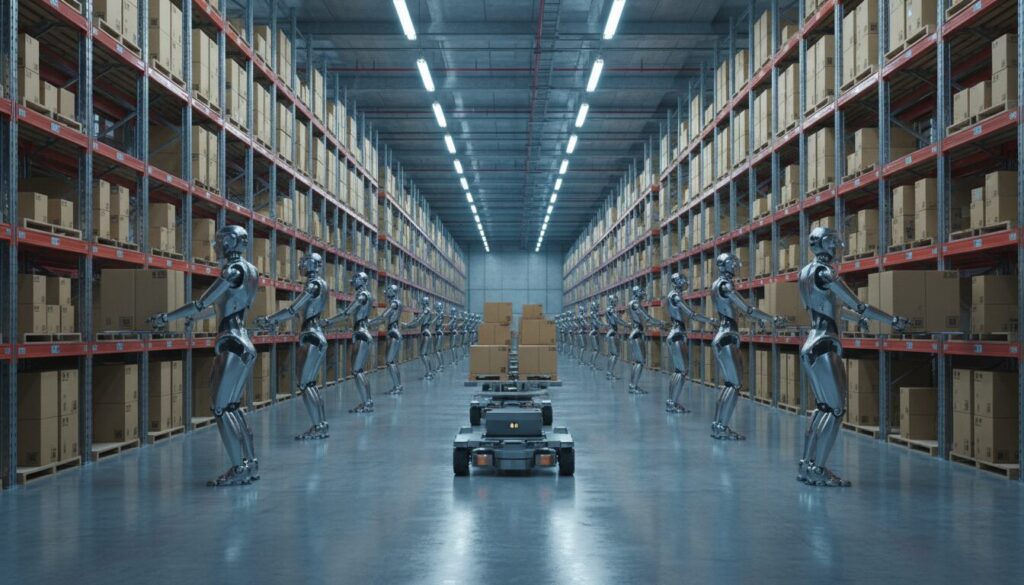
The era of “robotics theater”—where humanoid robots were admired for viral backflips but questioned for their ROI—is effectively over. With Apptronik securing a massive $520 million in Series A-X funding, the logistics industry is witnessing a decisive pivot from Research & Development to mass commercialization.
This capital injection, bringing Apptronik’s total funding near the $1 billion mark, is not merely a vote of confidence; it is a signal flare. Backed by heavyweights like Mercedes-Benz, GXO Logistics, and Google DeepMind, this move validates the thesis that general-purpose humanoid robots are the solution to the persistent labor volatility in global supply chains.
For logistics executives, the question is no longer if humanoids will enter the warehouse, but how quickly they can be integrated into existing workflows.
The Facts: Apptronik’s Strategic Expansion
Apptronik’s recent financial milestone fundamentally alters the competitive landscape of embodied AI. While competitors like Boston Dynamics have led in dynamic mobility, Apptronik is positioning its ‘Apollo’ robot as the pragmatic, scalable workforce solution.
The following table summarizes the core components of this announcement:
| Component | Details |
|---|---|
| Funding Amount | $520 Million (Series A-X) |
| Total Capital | ~$935 Million (approaching $1 Billion) |
| Primary Goal | Mass production of the ‘Apollo’ humanoid robot. |
| Key Investors/Partners | Mercedes-Benz (Auto Mfg), GXO Logistics (3PL/Warehousing), Google DeepMind (AI/Gemini Robotics). |
| Target Application | Collaborative kitting, tote handling, sorting, and pallet transport. |
| Market Context | Valuation tripled since the original round; competing with Hyundai/Boston Dynamics (aiming for 30k units/year by 2028). |
This funding round aligns with broader industry trends we have tracked. As discussed in our analysis of Boston Dynamics’ Atlas Pilot, the focus has shifted from mechanical capability to commercial necessity, driven by electric actuators and commercially viable ROI models.
Industry Impact: Why This Funding Changes the Game
The sheer size of this investment impacts three distinct layers of the supply chain ecosystem: the shippers (manufacturers), the carriers/3PLs, and the technology infrastructure.
1. The 3PL Revolution (The GXO Factor)
GXO Logistics’ involvement is arguably the most significant aspect of this news for the warehousing sector. 3PLs operate on thin margins and face extreme seasonal labor fluctuations.
- Brownfield Compatibility: Unlike Automated Storage and Retrieval Systems (AS/RS), which require massive infrastructure changes, Apollo is designed to work in “brownfield” sites—standard warehouses designed for humans.
- Flexibility: Specialized robots (like AMRs) are excellent at moving point A to point B, but they cannot pick a box off a shelf and place it on a pallet. Apollo bridges this gap.
- Labor Stability: By deploying humanoids for high-turnover roles (kitting and sorting), 3PLs can stabilize their operational costs against wage inflation.
2. Manufacturing Precision (The Mercedes-Benz Factor)
The manufacturing floor requires a higher degree of dexterity than simple box moving. Mercedes-Benz’s backing suggests that Apollo is meeting strict reliability standards for line-side delivery.
This mirrors the trends we observed in the UBTECH & Airbus Partnership, where humanoids are being utilized to reduce repetitive strain injuries in aircraft assembly. The capital from this round will likely accelerate the refinement of Apollo’s fine-motor skills needed for these complex environments.
3. The Cognitive Leap (The Google DeepMind Factor)
Hardware is useless without a brain. The collaboration with Google DeepMind (Gemini Robotics) addresses the biggest bottleneck in robotics: generalization.
- From Scripted to Adaptive: Traditional robots follow strict scripts. With DeepMind’s integration, Apollo moves toward “Embodied AI”—the ability to understand unstructured commands and adapt to changing environments.
- The Software Moat: As we explored in AI Robotics Shift: From Hardware to Cognitive Swarms, the true differentiator in 2025 and beyond is not the actuator, but the cognitive software stack. This funding ensures Apptronik can compete on the “intelligence” front against Tesla’s Optimus and Figure AI.
LogiShift View: The Battle for “General Purpose” Dominance
The injection of $520 million signifies a pivotal shift in the “Capex Wars.” It is no longer just about cloud computing infrastructure; it is about physical automation infrastructure.
The “So What?” for Logistics Leaders
The entry of nearly $1 billion in capital into Apptronik suggests that we are moving toward a Robot-as-a-Service (RaaS) model for humanoids. Just as SaaS revolutionized software procurement, RaaS will lower the barrier to entry for mid-sized logistics operations. You won’t buy the robot; you will hire it by the hour.
However, a critical challenge remains: Data Scarcity.
To make Apollo truly autonomous, it needs to be trained on millions of edge cases. While the funding builds the bodies, the industry still needs a robust “data engine.” This is a gap currently being addressed by specialized firms, as detailed in our coverage of Noitom Robotics, which focuses on generating the motion data required to train these humanoids.
The Scale Comparison
To understand the magnitude, compare Apptronik’s trajectory with the broader market:
- Hyundai/Boston Dynamics: Targeting 30,000 units/year by 2028.
- Amazon: Investing heavily in Digit (Agility Robotics) and its own robotic ecosystem.
- Apptronik: With this funding, they are aiming to match or exceed these production numbers by leveraging contract manufacturing rather than just in-house builds.
See also: Winning the AI Capex Race: Amazon’s Logistics Strategy to understand the macroeconomic environment driving these investments.
Takeaway: Strategic Steps for Executives
The commercialization of Apollo is not a future concept; it is a current capitalization reality. The window to view humanoids as “experimental” is closing.
Actionable Recommendations:
- Audit “Human-Only” Zones: Identify workflows in your warehouse that have resisted automation because they require legs or arms (e.g., reaching high shelves, stepping over conveyors, manipulating irregular tote handles). These are the prime targets for Apollo-class robots.
- Evaluate WMS Readiness: A humanoid robot is only as good as the instructions it receives. Does your current Warehouse Management System have the API capability to dispatch tasks to a humanoid fleet, or is it stuck in legacy code?
- Monitor the RaaS Market: With GXO involved, expect new service models where 3PLs offer “humanoid-augmented” fulfillment at a competitive rate. Shippers should prepare RFPs that explicitly ask potential 3PL partners about their robotics roadmaps to ensure long-term cost containment.
Apptronik’s $520 million raise is the fuel; the engine is the logistics industry’s hunger for reliable labor. The race is no longer about who has the coolest robot, but who can manufacture and deploy them at scale.