
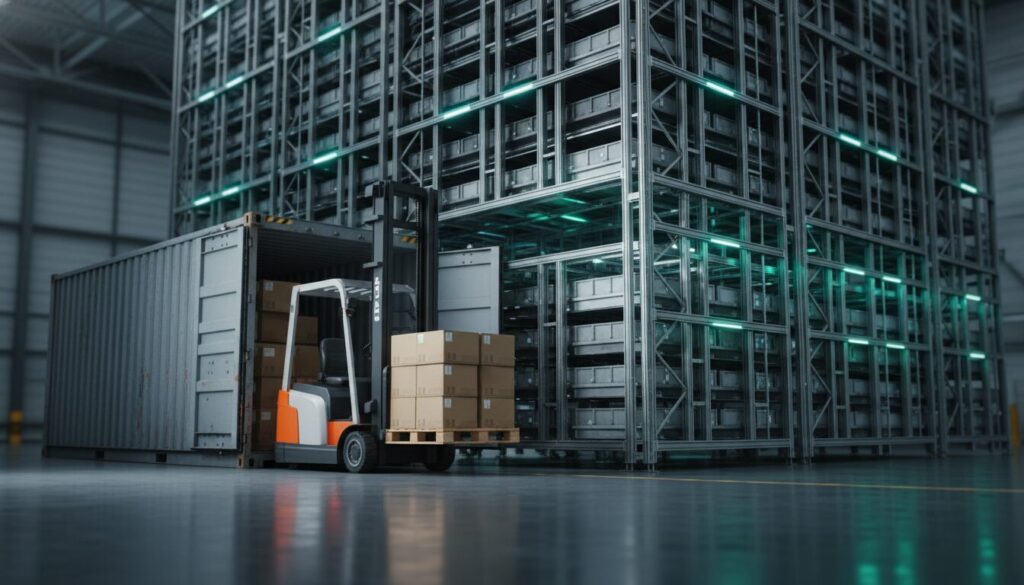
The landscape of warehouse automation just witnessed a pivotal consolidation. Symbotic, the giant known for its massive, cage-like inventory systems, has acquired Fox Robotics, the leader in autonomous trailer unloading.
For years, the industry has viewed warehouse automation as a dichotomy: either you invest hundreds of millions into fixed infrastructure (like Symbotic’s traditional system) or you deploy fleets of independent Annual Mobile Robots (AMRs) and Automated Guided Vehicles (AGVs). This acquisition shatters that divide. By bringing Fox Robotics’ autonomous forklifts under its umbrella, Symbotic is signaling a strategic pivot from purely fixed automation to a hybrid, end-to-end material handling ecosystem.
For logistics executives, this is not just M&A news; it is a signal that the barrier to entry for full-scale automation is lowering, and the “walled gardens” of logistics technology are beginning to merge.
The Facts: Expanding Beyond the Cage
Symbotic has long been the heavyweight champion of “inside the box” automation—processing pallets and cases within the storage grid. However, the receiving dock remained a manual or semi-automated bottleneck. Fox Robotics solves this specific pain point.
Fox Robotics is best known for the FoxBot, an autonomous forklift capable of unloading trailers without human intervention. With over 100 units deployed across 54 sites, they have proven that the chaotic environment of a shipping dock can be automated.
The following table summarizes the key elements of this acquisition:
| Feature | Details |
|---|---|
| Acquirer | Symbotic (Nasdaq: SYM) |
| Target | Fox Robotics (Austin-based autonomous forklift maker) |
| Primary Technology | Autonomous Trailer Unloading (ATU) & Pallet Movement |
| Strategic Goal | Expand addressable market to CPGs, 3PLs, and smaller facilities; create end-to-end automation. |
| Financial Context | Symbotic Q1 2026 Revenue: $630M (+29% YoY); Net Income: $13M. |
| Key Customer | Walmart (Accounts for ~90% of Symbotic revenue; also a Fox Robotics user). |
Financial Stability Meets Innovation
It is crucial to note the timing. As reported in Q1 2026, Symbotic has turned the corner on profitability, posting $13 million in net income with a 29% revenue jump. This suggests the acquisition is not a desperate bid for growth, but a calculated reinvestment of capital to diversify its product mix.
Industry Impact: Why Flexibility Wins
The immediate impact of this deal extends across three critical verticals: Retailers, CPG Manufacturers, and Logistics Real Estate.
1. Solving the Dock-to-Storage Disconnect
Until now, automated storage and retrieval systems (AS/RS) and the receiving dock existed as separate islands. Goods arrived, humans (or unrelated AGVs) unloaded them, and then fed them into the automation.
- The Change: Symbotic can now offer a seamless handoff. A FoxBot unloads the trailer and feeds the Symbotic system directly.
- The Benefit: This eliminates the “interface friction” and labor costs associated with staging areas, reducing dwell time for carriers.
2. Democratizing Automation for Brownfields
Symbotic’s traditional systems are massive. They often require custom-built facilities (Greenfields) or massive retrofits. This priced out many mid-sized CPG manufacturers and 3PLs operating in standard warehouses.
- The Pivot: By integrating Fox’s mobile technology, Symbotic can offer modular solutions. A warehouse might not need the giant “cage,” but they do need autonomous forklifts and lighter automation.
- Relevance: As discussed in our analysis of Democratizing Automation: NEOintralogistics RaaS Case Study, the industry is trending toward solutions that lower CapEx barriers. Symbotic is now positioning itself to compete in this “flexible” tier.
3. The Walmart Factor
Walmart is the elephant in the room. Being the primary revenue source for Symbotic and a major user of Fox Robotics, this acquisition essentially allows Walmart to deal with one vendor for their entire dry grocery intake process.
- Strategic Moat: For Walmart, this tightens integration. For competitors (Target, Kroger, Amazon), it raises the question: Can they piece together a similar end-to-end stack using disparate vendors, or will they need to find a similar consolidated partner?
- See also: Walmart Cross-Border Logistics Case Study for more on how the retail giant is reshaping global logistics standards.
LogiShift View: The “So What?”
At LogiShift, we believe this acquisition marks the beginning of the “Hybrid Automation Era.”
The End of Monolithic dominance
For the last decade, the debate was “Fixed vs. Mobile.” Fixed automation offered density and speed; mobile automation (AMRs/AGVs) offered flexibility. Symbotic’s move admits that fixed automation alone has a ceiling. To grow beyond the mega-DCs of Walmart, they must go mobile.
The “Middle Mile” of the Warehouse
The most overlooked aspect of this deal is the movement between functional areas. Fox Robotics doesn’t just unload trailers; their lifts can move pallets to staging, to outbound, or to cross-docking lanes.
- Prediction: Expect Symbotic to launch a unified software layer that controls the high-speed shuttles (inside the cage) and the FoxBots (on the floor) as a single swarm. This level of orchestration is the “Holy Grail” of WCS (Warehouse Control Systems).
Addressing the Labor Crisis Permanently
Trailer unloading is widely considered the worst job in the warehouse—physically demanding, hot, and injury-prone. It has the highest turnover rate.
By acquiring the leader in automated unloading, Symbotic is selling “labor resilience.” In a market where hiring reliable dock workers is near impossible, this value proposition is stronger than pure efficiency speed.
A Warning on Integration
History is littered with hardware acquisitions that failed due to poor software integration. Fox Robotics relies on sophisticated vision systems for dynamic environments. Symbotic relies on predictable, structured grid logic. Merging these two software philosophies will be the true test.
- Context: For a deeper dive on the reality of these technologies, refer to our guide: Driving the Autonomous Supply Chain: Are We There Yet? Guide.
Takeaway: What You Should Do
For supply chain leaders, this consolidation changes the vendor selection roadmap.
- For CPG Manufacturers: If you previously dismissed Symbotic as “too big” or “too expensive” for your regional DCs, revisit them. The addition of Fox Robotics likely signals a new, tiered product offering suitable for smaller footprints.
- For 3PLs: The ability to automate trailer unloading without rebuilding the facility is a game-changer for contract logistics. Evaluate autonomous forklifts not as standalone units, but as part of a potential future ecosystem.
- For Investors & Competitors: Watch the software. The hardware is proven, but the winner of the next five years will be the company that offers a “Universal WCS” that orchestrates the truck, the dock, and the rack seamlessly.
The Bottom Line: Symbotic has moved from being a “storage company” to a “flow company.” The acquisition of Fox Robotics proves that the future of logistics isn’t just about how much you can store, but how fast you can move it in and out of the building.