The era of “islands of automation”—where disjointed fleets of robots operate in silos alongside disconnected human workers—may finally be nearing its end. At the recent Manifest conference, Destro AI emerged from stealth mode to unveil its “Agentic AI Brain,” a technology poised to redefine how logistics leaders approach warehouse orchestration.
For years, the supply chain industry has invested heavily in hardware: Automated Mobile Robots (AMRs), automated forklifts, and robotic arms. Yet, a critical gap remains. These machines often operate on proprietary software stacks that do not communicate with one another, creating operational friction rather than flow.
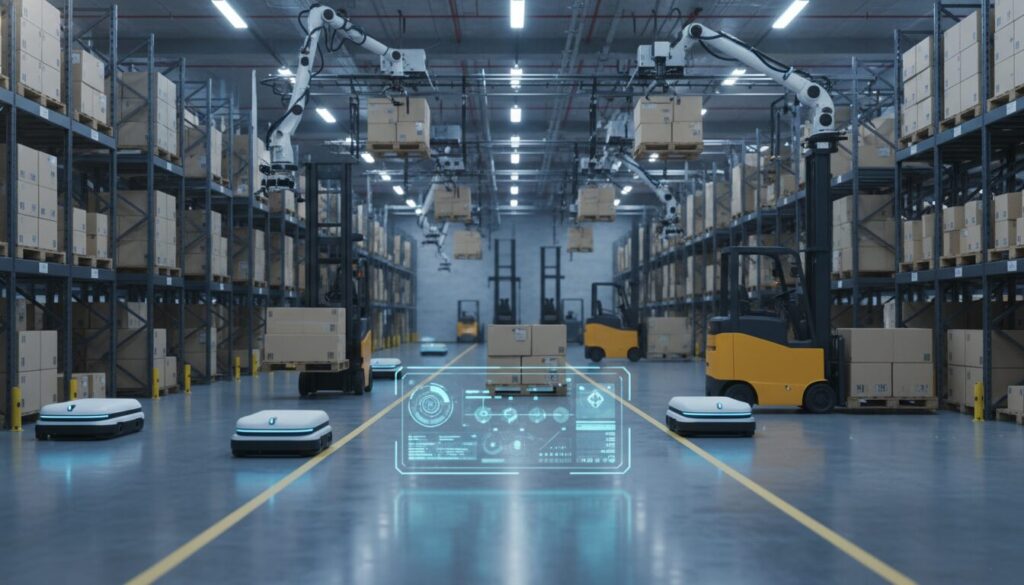
Destro AI’s launch of MothershipOS and VisionOS addresses this fragmentation head-on. By introducing a hardware-agnostic orchestration layer capable of treating thousands of distinct robot types as a single adaptive system, Destro AI is shifting the paradigm from static, pre-programmed workflows to dynamic, collective reasoning.
For executives and logistics managers, this development signals a move away from merely deploying robots to deploying truly intelligent, collaborative swarms. As discussed in our previous analysis on Driving the Autonomous Supply Chain: Are We There Yet? Guide, the industry is hungry for the software that makes hardware investments viable at scale. Destro AI may have just delivered the missing link.
The Facts: Destro AI’s Agentic Launch
Destro AI’s announcement centers on two core products designed to bridge the gap between human intuition and robotic precision. The company is targeting high-variability environments—such as cross-docking facilities—where traditional, rigid automation often fails.
Below is a breakdown of the key components of this launch:
| Component | Description | Key Capability |
|---|---|---|
| MothershipOS | A cloud-based orchestration engine (The “Brain”). | Treats 1,000+ AMR models and 600+ automated forklift types as a single, unified adaptive system. |
| VisionOS | Smart-glass technology for human workers. | Eliminates handheld scanners; uses embodied AI to track SKUs autonomously and calculate optimal grasping angles. |
| Core Philosophy | Agentic AI / Centralized Intelligence. | Shifts from siloed execution to collective reasoning; combines off-robot reasoning with on-robot execution. |
| Target Problem | “Islands of Automation.” | Solves the lack of interoperability between different robot vendors and human workflows. |
| Current Status | Emerging from Stealth. | Currently deployed with major logistics and retail operators. |
The Core Innovation: “Agentic” Reasoning
The term “Agentic AI” is critical here. Unlike traditional automation, which follows linear “if-this-then-that” scripts, Agentic AI possesses the ability to reason, plan, and adapt to changing variables in real-time.
In a traditional setup, if an AMR encounters a blocked aisle, it might stop and wait for a human override. Destro AI’s centralized intelligence allows the system to recognize the congestion, reroute the entire fleet to avoid the bottleneck, and simultaneously direct human workers to clear the obstruction via smart glasses.
For a deeper dive into the mechanics of this technology, refer to our article: Implement Agentic AI: What Leaders Get Right (and Wrong).
Industry Impact: Why Interoperability Changes the P&L
The introduction of a truly hardware-agnostic orchestration layer has profound implications for carriers, warehouse operators, and the broader supply chain ecosystem.
1. Breaking Vendor Lock-In
Historically, selecting a robotics vendor was a high-stakes marriage. If a warehouse committed to Vendor A’s AMRs, they were often forced to use Vendor A’s fleet management software, which rarely integrated well with Vendor B’s automated forklifts.
Destro AI’s MothershipOS disrupts this dependency. By claiming compatibility with over 1,000 AMR types and 600 forklift types, it commoditizes the hardware. Operations managers can now select the “best of breed” robot for a specific task—regardless of the manufacturer—confident that the central brain can coordinate them. This allows for a mixed-fleet environment that is optimized for cost and performance, rather than compatibility constraints.
2. Solving High-Variability Workflows
Automation has traditionally thrived in low-variability environments (e.g., manufacturing lines). However, logistics is defined by chaos: late trucks, damaged pallets, and fluctuating SKU velocities.
Destro AI targets these high-variability workflows, such as cross-docking, where speed and adaptability are paramount. By using centralized intelligence to handle exceptions (like missed handoffs or sudden congestion), the system maintains throughput where rigid automation would stall.
3. The Human-Robot Team (Centaur Model)
While automation grabs headlines, human labor remains essential for complex manipulation tasks. Destro’s VisionOS represents a significant leap in “embodied AI.” By equipping workers with smart glasses that calculate grasping angles and track SKUs without scanners, the technology reduces cognitive load and ergonomic strain.
This aligns perfectly with the trends identified in our report, Collaborative Robots: The Rise of Human-Robot Factory Teams, which highlights that the future of efficiency lies not in replacing humans, but in augmenting them. VisionOS effectively turns the human worker into a highly intelligent node within the robotic network.
LogiShift View: The Shift from Hardware to Cognitive Swarms
The launch of Destro AI validates a theory we have long held at LogiShift: The hardware wars are over; the software wars have begun.
For the past decade, the industry focused on better actuators, longer battery life, and higher payload capacities. We are now reaching a plateau in hardware innovation. The next frontier of efficiency will not come from a faster robot, but from a smarter swarm.
The Death of the “Integration Tax”
One of the hidden costs in modern logistics is the “integration tax”—the time and money spent trying to get WMS, WES, and various robotic fleet managers to exchange data. Destro AI’s approach suggests that the Warehouse Execution System (WES) as we know it is evolving into an Agentic Orchestrator.
This orchestrator does not just execute orders; it simulates the warehouse state. It understands that if Robot A is delayed, Robot B should be dispatched immediately, and Human C should be alerted to prep the dock. This level of dynamic reasoning is what separates “Smart Warehouses” from truly “Autonomous Supply Chains.”
Implications for Strategy
As we noted in AI Robotics Shift: From Hardware to Cognitive Swarms, leaders must stop viewing robots as capital assets and start viewing them as data endpoints. Destro AI proves that the value lies in the coordination layer.
Furthermore, the deployment of this technology with major logistics operators signals that this is not theoretical. The early adopters are already moving past the pilot purgatory of “testing robots” and are now “optimizing swarms.”
Takeaway: What Companies Should Do Next
The emergence of Destro AI acts as a wake-up call for logistics executives. The ability to orchestrate a mixed fleet of humans and robots is no longer a futuristic concept—it is a current competitive advantage.
Here is the strategic roadmap for the next 12 months:
- Audit for Interoperability: Review your current robotics contracts and WES architecture. Are you locked into a single vendor? Start prioritizing open APIs and hardware-agnostic control layers in future RFPs.
- Re-evaluate “Islands of Automation”: Identify bottlenecks where automated processes hand off to human processes. These are the prime targets for Agentic AI orchestration.
- Prepare for Wearable Integration: VisionOS highlights the move away from handheld RF guns. Begin piloting smart glass technologies or AR interfaces to prepare your workforce for hands-free, AI-guided operations.
- Shift KPI Focus: Move beyond “picks per hour” of individual units. Start measuring “system fluidity” and “exception recovery time”—metrics that Agentic AI is specifically designed to improve.
The technology to unify the warehouse brain is here. The question now is whether your operation is ready to give up control to the algorithm.
See also: 2026 Survey: Supply Chain Leaders Bet on AI for Resilience