The global sensor market is undergoing a seismic shift, moving away from the “hardware wars” of the 2020s toward a new era of integrated intelligence. In a defining move for the sector, Lidar leader Ouster has acquired computer vision pioneer StereoLabs.
The deal, valued at $35 million in cash plus 1.8 million shares, is more than a simple merger of assets; it signals the rise of “Physical AI” as the dominant paradigm for industrial automation. For logistics leaders and strategy executives, this acquisition offers a critical case study on how the supply chain technology stack is maturing from experimental components to certified, unified perception platforms.
Why It Matters: The Era of “Physical AI”
For the past decade, the logistics and autonomous vehicle industries have treated sensors as discrete commodities. You bought Lidar from one vendor, cameras from another, and spent millions of dollars on engineering hours trying to make them “talk” to each other via software. This fragmented approach created a massive barrier to entry for warehouse automation.
Ouster’s acquisition of StereoLabs marks a departure from this model. By combining high-resolution digital Lidar with StereoLabs’ foundational AI model for camera-based depth perception, Ouster is moving “up the stack.” They are no longer just selling “eyes” for robots; they are selling the “optic nerve” and the “visual cortex.”
This aligns perfectly with the trends we identified in our recent analysis, How Physical AI Will Reshape the Warehouse: 2025 Guide, where we predicted that hardware vendors would need to offer cognitive capabilities to survive.
The Problem with Pure Hardware
In the early 2020s, a “SPAC boom” flooded the market with Lidar companies (Velodyne, Luminar, Quanergy). However, hardware margins are notoriously thin, and Chinese competitors rapidly commoditized the raw technology. To restore profitability and relevance, US and European firms are now consolidating to create higher-margin, software-defined solutions.
Global Trend: The Great Sensor Consolidation
The Ouster-StereoLabs deal is not an isolated event. It is part of a broader global trend where the survivor companies of the autonomous boom are buying up complementary technologies to build “full-stack” perception systems.
United States: Integration over Fragmentation
In the US, the market is contracting into a few powerful players. Ouster previously merged with its rival Velodyne, effectively unifying the digital Lidar market. Meanwhile, MicroVision recently acquired assets from Luminar.
The US strategy is clear: Sensor Fusion. American firms are betting that the future isn’t Lidar vs. Camera, but Lidar plus Camera integrated at the chip/software level. This integration is crucial for safety-critical applications in US logistics hubs where liability and OSHA regulations are paramount.
China: Scale and Cost Leadership
Conversely, the Chinese market, led by giants like Hesai and Robosense, continues to focus on volume and cost reduction. They are aggressively supplying the booming EV market and domestic warehouse robotics sector with affordable raw sensors. While US firms focus on software integration (“Physical AI”), Chinese firms are winning the “hardware specifications” race, pushing lower costs per unit.
Europe: Industrial Precision
Europe remains focused on “Smart Infrastructure.” Companies like SICK and Siemens are integrating these advanced sensors not just into vehicles, but into the warehouse infrastructure itself (gates, conveyors, ceiling-mounted perception). The Ouster deal targets this European philosophy—moving away from speculative robotaxis toward “certified” industrial safety systems.
See also: Winning the AI Capex Race: Amazon’s Logistics Strategy to understand how giants like Amazon are utilizing these consolidated technologies.
Comparison: Global Sensor Strategies
| Feature | US Strategy (e.g., Ouster) | China Strategy (e.g., Hesai) | European Strategy (e.g., SICK) |
|---|---|---|---|
| Primary Focus | Physical AI & Sensor Fusion (Software + Hardware) | Hardware Volume (Cost reduction) | Industrial Safety (Infrastructure integration) |
| Key Market | Autonomous Warehousing, Robotics, Defense | Electric Vehicles (consumer), Delivery Bots | Factory Automation, Smart Cities |
| Consolidation | High (Mergers to acquire AI capability) | Moderate (State-backed scaling) | Low (Strategic partnerships) |
| Value Prop | “We provide the brain and the eyes.” | “We provide the cheapest eyes.” | “We guarantee it won’t crash.” |
Case Study: Ouster & StereoLabs
This acquisition serves as the perfect lens through which to view the future of logistics technology. It is a calculated move to solve the specific pain points of Autonomous Mobile Robot (AMR) manufacturers and warehouse operators.
The Players
- Ouster: A leading provider of high-resolution digital Lidar. They survived the market crash by focusing on industrial diversification rather than putting all their eggs in the self-driving car basket.
- StereoLabs: A pioneer in vision-based depth sensing. Their ZED cameras and software provide human-like depth perception using standard optical sensors, powered by deep learning.
The Deal Structure
- Cost: $35 Million Cash + 1.8 Million Ouster shares.
- Target: 100% acquisition of StereoLabs.
- Objective: Create a unified perception platform for the “Smart Infrastructure” and Robotics markets.
Strategic Rationale: Why 1 + 1 = 3
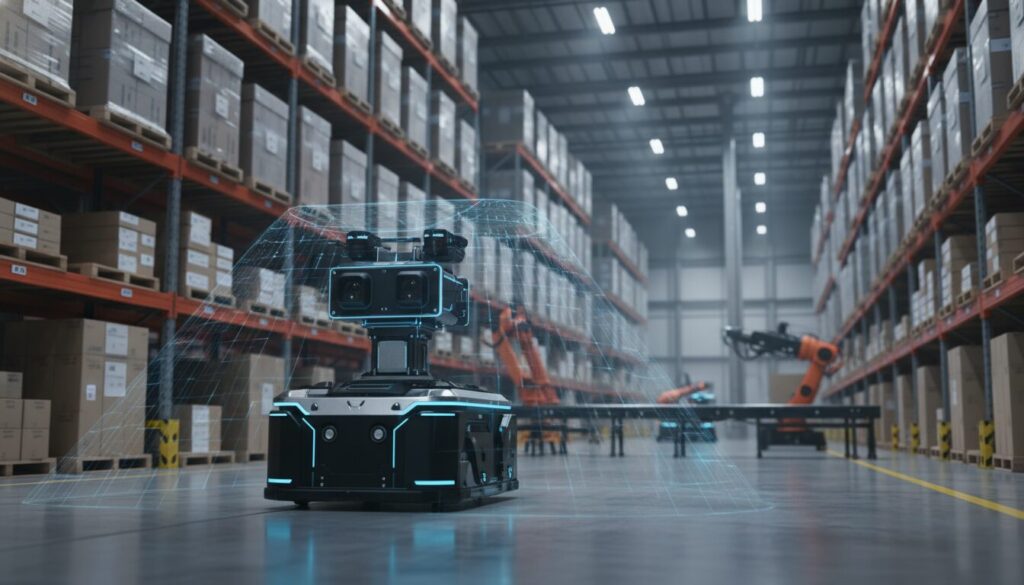
Lidar is excellent at determining where something is (geometry/distance) regardless of lighting conditions. Cameras are excellent at determining what something is (semantic classification: reading a label, identifying a human vs. a forklift).
By acquiring StereoLabs, Ouster solves the “Context Gap.”
- Unified Data Stream: Instead of an AMR manufacturer needing two separate computers to process Lidar data and Camera data, Ouster can now offer a pre-fused data stream. This reduces the compute power required on the robot, extending battery life.
- Addressing the “Edge Cases”: In a warehouse, a hanging plastic sheet might look solid to a camera but permeable to Lidar. A mirror might confuse Lidar but be clear to a camera. Combining them creates a “Safety Certified” system capable of navigating complex, messy distribution centers.
- From Speculation to Application: Ouster explicitly stated this move is to target “certified and safe physical AI systems for industrial use over speculative humanoid robotics hype.” This is a crucial distinction. While Elon Musk talks about humanoid robots, Ouster is building the boring, essential vision systems that will run the forklift fleets of 2026.
As discussed in AI Robotics Shift: From Hardware to Cognitive Swarms, the industry is pivoting from purely mechanical innovation to “Cognitive Swarms.” Ouster’s new platform is the sensory organ for these swarms.
Operational Impact on Logistics
For a logistics CTO, this consolidation simplifies procurement. Instead of sourcing vision AI from a startup and Lidar from a hardware vendor, they can procure a “Perception Module” that handles SLAM (Simultaneous Localization and Mapping) out of the box.
- Reduced R&D Time: Robot manufacturers can launch new AMRs 6-12 months faster.
- Enhanced Safety: The fusion of modalities reduces collision risks in mixed human-robot environments.
- Infrastructure Sensing: These sensors are not just for robots; they will be mounted on warehouse ceilings to track inventory flow in real-time, creating a live “Digital Twin.”
Key Takeaways for Logistics Leaders
The Ouster-StereoLabs acquisition provides three critical lessons for the industry:
-
Software is the New Moat:
Hardware commoditization is inevitable. The value in supply chain robotics now lies in the software stack that interprets the data. When selecting technology partners, prioritize those with robust “Physical AI” capabilities over those simply boasting the highest hardware specs. -
The “Full-Stack” Advantage:
The era of piecing together disparate sensors is ending. Look for integrated perception platforms. This reduces integration headaches and shifts liability for “perception failures” to the vendor. -
Industrial Pragmatism Wins:
While humanoid robots garner headlines, the immediate ROI is in “Smart Infrastructure” and specialized AMRs. Ouster’s pivot away from speculative consumer AVs toward industrial applications validates that the warehouse is currently the most profitable sector for automation technology.
Future Outlook: The Autonomous Supply Chain
We are entering the “post-hype” phase of logistics automation. The “Wild West” of dozens of sensor startups is consolidating into a mature market of platform providers.
In the next 24 months, expect to see:
- Pre-Certified Safety Modules: Sensors that come with ISO safety certifications pre-installed, allowing for faster deployment of automated forklifts.
- Smart Yards: The application of this Lidar-Vision fusion in outdoor logistics yards to track containers and chassis automatically, regardless of weather.
- Data as a Service: Companies like Ouster may eventually stop selling sensors entirely and start charging for “Perception API” access—charging per square meter of warehouse monitored.
The acquisition of StereoLabs is a strong signal that the technology driving the autonomous supply chain is finally ready for prime time. For a deeper dive into the reality of autonomy, read our analysis: Driving the Autonomous Supply Chain: Are We There Yet? Guide.