The global race for autonomous freight is undergoing a seismic shift. While early Western pioneers like Waymo have paused their trucking efforts to focus on robotaxis, a new wave of aggressive expansion is emerging from Asia, led by deep-tech unicorns pivoting toward logistics.
A prime example of this trend is Momenta, a leading autonomous driving technology company. Known primarily for its passenger vehicle software and partnerships with global OEMs like Toyota and GM, Momenta has officially established a dedicated in-house team to conquer the autonomous trucking sector. This move signals a critical maturity point in the industry: the transition from experimental pilots to vertically integrated, scalable logistics solutions.
For innovation leaders and strategy executives in the US, EU, and Asia, Momenta’s strategic pivot offers a blueprint for how data-driven scale can disrupt supply chain operations.
Why It Matters: The Global Context
The logistics sector is facing a “trilemma” of challenges that crosses borders: acute labor shortages, rising fuel costs, and increasing pressure for carbon neutrality.
- United States: The American Trucking Associations estimates a shortage of over 80,000 drivers, a number expected to double by 2030.
- Europe: The IRU reports a shortage of nearly 400,000 drivers across Europe.
- Asia (Japan/China): Japan faces the “2024 Problem” with strict overtime caps limiting capacity, while China seeks to modernize its massive but fragmented logistics network.
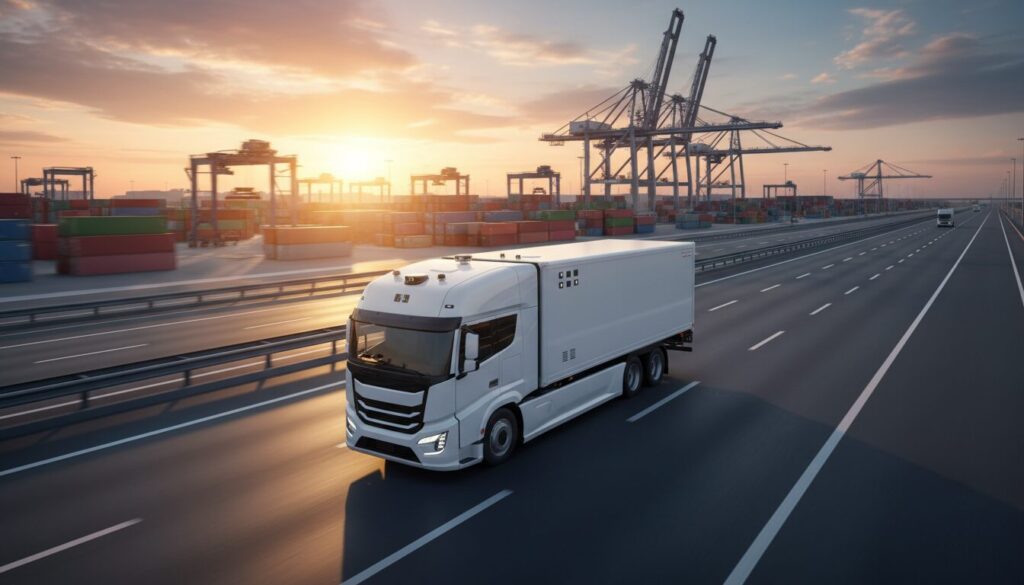
In this context, autonomous trucking (AT) is no longer a “moonshot”—it is a necessity for supply chain resilience. However, the technology is notoriously difficult. Heavy-duty trucks require longer braking distances, face complex articulation dynamics, and operate in high-speed, high-stakes highway environments.
Momenta’s entry is significant because it challenges the current status quo. Unlike competitors who started purely in trucking, Momenta is leveraging a “flywheel” of data from millions of passenger cars to “teach” trucks how to drive. This cross-domain knowledge transfer represents a new strategic frontier in AI logistics.
As discussed in our analysis of the sector’s readiness, the industry is moving past hype into hard reality.
See also: Driving the Autonomous Supply Chain: Are We There Yet? Guide
Global Trend: The Diverging Paths of AV Trucking
To understand Momenta’s move, one must analyze the divergent strategies currently playing out in the global theater (US, China, and Europe).
United States: Consolidation and Asset-Light
In the US, the market has consolidated. Players like Aurora Innovation and Kodiak Robotics focus on the “Driver-as-a-Service” model—selling the software and sensor suite to carriers rather than owning the trucks. Meanwhile, logistics aggregators are positioning themselves to manage these fleets.
See also: Uber is Literally in the Driver’s Seat of Global AV Bets
Europe: Hub-to-Hub and Electric Integration
Europe focuses heavily on combining autonomy with electrification. Companies like Einride (Sweden) prioritize cab-less electric pods for short-haul, hub-to-hub transport, navigating strict EU regulations regarding cross-border autonomy.
China/Asia: Vertical Integration and Mass Deployment
Asian players are pursuing a more aggressive, full-stack approach. Companies like Inceptio Technology and PlusAI are not just building software but heavily influencing vehicle design and operating large-scale commercial fleets immediately. The recent partnership between T2 and PlusAI in Japan highlights this push for rapid L4 rollout.
See also: T2 & PlusAI L4 Japan Rollout: Global Logistics Innovation
Comparison of Regional Strategies
| Feature | US Strategy (e.g., Aurora, Kodiak) | China Strategy (e.g., Momenta, Pony.ai) | EU Strategy (e.g., Einride) |
|---|---|---|---|
| Primary Focus | Long-haul Highway (Exit-to-Exit) | Port Logistics + Long-haul | Hub-to-Hub / Short-haul |
| Business Model | Driver-as-a-Service (SaaS) | Hybrid (SaaS + Fleet Ops) | TaaS (Transport-as-a-Service) |
| Regulation | State-by-state patchwork | Centralized Pilot Zones | Strict, country-specific |
| Hardware | Diesel retrofits mostly | OEM-integrated production | EV-first native designs |
Case Study: Momenta’s Dedicated In-House Team
Momenta’s decision to build a dedicated in-house trucking team marks a departure from its previous “passenger-first” public image. Here is how they are structuring this innovation.
1. The “Two-Leg” Strategy Applied to Freight
Momenta’s core philosophy is the “Two-Leg” strategy:
- Mpilot (Mass Production): L2+ ADAS software supplied to mass-market consumer cars.
- MSD (Momenta Self-Driving): L4 full autonomy targeting robotaxis and now, trucks.
The dedicated trucking team is tasked with adapting the massive data stream from Mpilot (millions of kilometers of real-world driving data) to train the MSD algorithms for heavy trucks. This Transfer Learning approach gives them a data advantage over trucking-only startups that have only a few hundred trucks on the road.
2. Vertical Integration of the “Robotruck”
By building a dedicated team, Momenta is moving to tighter integration with truck OEMs. Unlike a simple vendor relationship, this team works on:
- Chassis Control: Modifying braking and steering actuation for heavy loads (40+ tons).
- Sensor Fusion: Optimizing LiDAR and camera placement specifically for trailer blind spots.
- Domain Adaptation: Adjusting prediction algorithms to account for the slower acceleration and longer stopping distances of freight vehicles.
3. Commercialization Path
Momenta is not just testing; they are aiming for commercial viability. The new team is structured to support logistics partners by reducing Total Cost of Ownership (TCO).
- Fuel Efficiency: AI driving can reduce fuel consumption by 10-15% compared to human drivers via optimized acceleration and aerodynamic drafting.
- Safety: 360-degree perception eliminates blind spots, a major cause of truck accidents.
This mirrors the trajectory of other giants in the region. For instance, PlusAI is rapidly moving toward a public listing to fund similar L4 ambitions, validating the massive capital requirements of this sector.
See also: PlusAI Listing: 2027 L4 Autonomous Freight
Key Takeaways: Lessons for the Logistics Industry
For Strategy Executives and Innovation Leaders, Momenta’s move offers four critical lessons regarding the future of supply chains:
1. Data Scale Wins
The days of training AVs solely on simulation or small test fleets are ending. The winners will be those who can leverage “Big Data” from adjacent sectors (like passenger cars) to train niche applications (like heavy trucking). Logistics companies should look for technology partners with massive data moats.
2. The Shift from “Bolt-on” to “Built-in”
Momenta’s dedicated team signifies that autonomy cannot simply be “bolted on” to existing legacy trucks. It requires deep engineering collaboration with OEMs. Future fleets will be “born autonomous,” requiring logistics leaders to rethink their procurement cycles and OEM relationships.
3. Supply Chain Resilience via Technology
In a world of geopolitical instability and labor strikes, autonomous trucking offers a layer of resilience. While not replacing humans entirely, it provides a reliable “baseload” capacity for long-haul routes, allowing human drivers to focus on complex last-mile deliveries.
4. Asian Innovation Speed
The speed at which Asian tech firms move from “concept” to “dedicated division” to “rollout” is accelerating. Western companies operating global supply chains must integrate these Asian innovations or risk falling behind in efficiency in their APAC operations.
Future Outlook
The establishment of Momenta’s in-house trucking team is a leading indicator of the market’s direction for 2025-2030.
- 2025-2026: We will see an increase in “Safety Driver Onboard” commercial runs on highways in China and specific corridors in the US. The focus will be on data validation and fuel savings.
- 2027-2028: The “Driver-Out” era begins in earnest for hub-to-hub transport. Momenta’s “flywheel” of data will likely accelerate their ability to remove the driver faster than competitors lacking mass-market data streams.
- Consolidation: Expect further M&A activity. Tech companies with superior software (like Momenta) may partner more deeply with, or even acquire, traditional logistics fleet operators to control the full value chain.
Momenta’s move proves that autonomous trucking is not dead—it is just getting serious. For global logistics leaders, the time to pilot these technologies and prepare infrastructure is now.