The logistics sector is currently navigating a perfect storm. Operations leaders are caught between the rock of skyrocketing labor costs and the hard place of increasing order complexity. You know the struggle: finding reliable staff for repetitive, heavy lifting is difficult, yet fully automating these chaotic processes often requires a prohibitive capital investment.
Is there a middle ground between back-breaking manual labor and expensive, complex robotics?
The answer lies in a hybrid approach. This article explores “The view from Zasche: Where human skill meets smart automation – the case for semi-automated bin picking.” We will dissect how blending human cognitive flexibility with mechanical muscle can solve your efficiency and ergonomic challenges today.
What is The View from Zasche?
To understand the case for semi-automated bin picking, we must first define the philosophy behind it. Zasche Handling, a leader in material handling technology, champions a pragmatic approach to logistics.
The Core Philosophy: Synergy Over Replacement
The “View from Zasche” argues that while full automation (robots replacing humans) is ideal for standardized, high-volume tasks, it struggles with chaotic environments.
Bin picking—grabbing randomly oriented parts from a container—is notoriously difficult for robots. It requires advanced 3D vision, complex path planning, and expensive gripping technology. Humans, however, possess superior visual recognition and dexterity. We can instantly identify the best way to grab an odd-shaped part.
Semi-automated bin picking bridges this gap. It uses:
- Human Intelligence: For detection, decision-making, and fine manipulation.
- Smart Automation (Manipulators): To bear the weight, ensure safety, and reduce fatigue.
How It Works
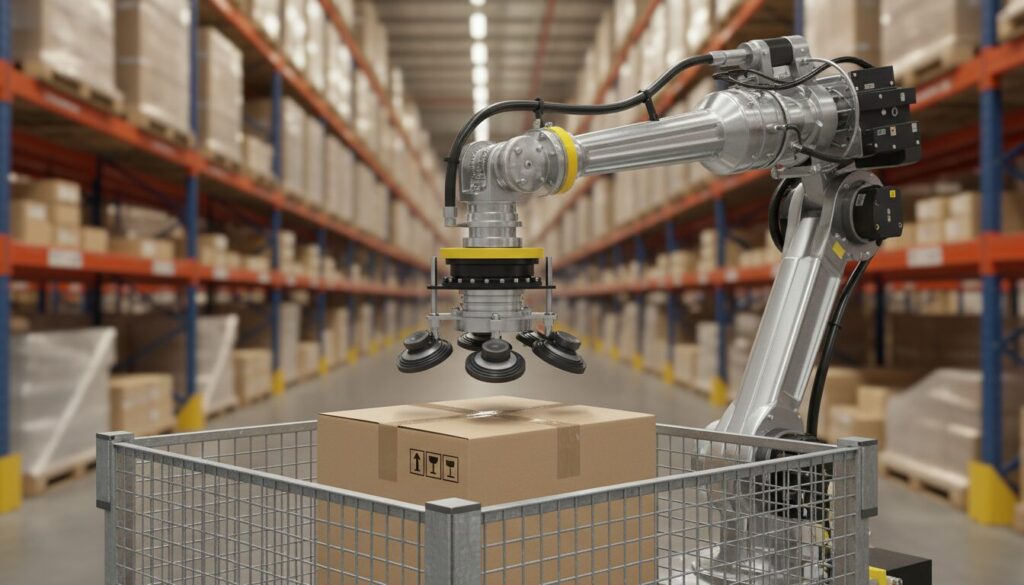
Unlike a standard crane that simply lifts, a semi-automated manipulator (often distinct to Zasche’s engineering) creates a “weightless” sensation.
- The Operator guides the device to the bin.
- The System senses the operator’s intent and moves seamlessly (often using force-sensing handles).
- The Gripper secures the load.
- The Machine bears 100% of the weight, allowing the operator to transfer heavy items with the touch of a finger.
Why Now? The Urgent Case for Hybrid Automation
Why should supply chain executives consider this specific approach in the current market? The trends point toward a need for flexibility that rigid automation cannot always provide.
1. The Labor Crisis and Ergonomics
The logistics workforce is shrinking. Older workers are retiring, and younger generations are avoiding physically demanding roles.
According to general industry statistics, musculoskeletal disorders (MSDs) account for a significant percentage of warehouse injuries. By implementing semi-automated handling, companies convert “heavy lifting” jobs into “machine operator” roles, drastically widening the candidate pool and extending the career longevity of existing staff.
2. The Limits of “Dark” Warehouses
While we often hear about the fully automated “dark warehouse,” the reality is more nuanced. As discussed in our article on How Physical AI Will Reshape the Warehouse: 2025 Guide, Physical AI is advancing, but it faces barriers in unstructured environments.
Full automation requires structure. If your bins contain mixed parts, oily components, or irregular shapes, a fully robotic cell might fail or cost nearly double that of a semi-automated station.
3. Scalability and Speed
Deploying a fully robotic solution can take 12–18 months. A semi-automated manipulator solution can often be integrated in a fraction of that time, providing immediate relief to bottlenecks.
Benefits: Quantitative and Qualitative Wins
Adopting the Zasche approach to semi-automated bin picking yields distinct advantages over both manual labor and full robotics.
Comparison of Picking Methods
| Feature | Manual Picking | Full Robotic Picking | Semi-Automated (Zasche) |
|---|---|---|---|
| Setup Cost | Low | High | Medium |
| Flexibility | High | Low | High |
| Ergonomics | Poor (High Risk) | Excellent | Excellent |
| Complexity | Low | High | Low |
Key Advantages
- Productivity Boost: Operators do not fatigue. A worker can lift a 50kg part at 4:00 PM with the same speed as at 8:00 AM.
- Reduced Product Damage: Smart manipulators prevent drops and ensure controlled placement, which is critical for sensitive components.
- Cost Efficiency: You avoid the massive integration costs of vision systems and safety fencing required for industrial robots.
- Retention: Improving working conditions is a direct strategy to reduce turnover rates.
For scenarios requiring extreme density and speed for smaller items, systems like those mentioned in Boozt & Cognibotics: Advanced AutoStore Automation are superior. However, for heavy, industrial, or irregular bin picking, the semi-automated route is often the ROI winner.
Implementation: Integrating Smart Automation
Successfully bringing the “Zasche view” into your facility requires more than just buying hardware. It requires a process shift.
Step 1: Analyze the “Pain” Points
Identify stations with the highest injury rates or the slowest cycle times due to weight.
- Are items over 15kg?
- Is the bin deep, requiring awkward bending?
- Is the variety of parts high (making robots impractical)?
Step 2: Select the Right End-Effector
The magic is in the gripper. A generic hook won’t work for bin picking. You need:
- Vacuum lifters: For flat surfaces or boxes.
- Pneumatic clamps: For oddly shaped castings.
- Magnetic grippers: For ferrous metal parts.
Step 3: Workflow Integration
Ensure the semi-automated system fits the flow.
- Inbound: Unloading varied goods from suppliers.
- Processing: Moving parts from storage bins to assembly lines or conveyors.
We have seen successful scaling strategies in other areas of logistics, such as the methods detailed in How to Scale Picking: The Nowaste & Cognibotics Method. While that example focuses on robotic cells, the principle of resolving the bottleneck remains the same for semi-automated solutions.
Step 4: Operator Training
The transition from “lifter” to “operator” requires training. Workers must learn to trust the machine and guide it smoothly rather than fighting the resistance.
Conclusion: The Future is Collaborative
The view from Zasche—where human skill meets smart automation—offers a compelling case for semi-automated bin picking. It is a sober, realistic response to the hype of total automation.
By recognizing that humans are still the best “vision systems” available, but acknowledging that our bodies have physical limits, operations leaders can create a warehouse that is efficient, safe, and cost-effective.
Recommended Next Steps:
- Audit your floor: Look for the “red zones” where heavy bin picking slows down operations.
- Calculate the cost of injury: Compare the cost of a single back injury claim against the investment in a manipulator.
- Explore hybrid solutions: Before committing to a fully robotic cell, ask if a human-assist device could achieve 90% of the benefit for 50% of the cost.
For further reading on high-tech logistics solutions for specific verticals, consider our analysis on beverage logistics in RAPTOR System Alert: Future of Beverage Logistics.
Embrace the synergy of man and machine. That is the smart path forward.