
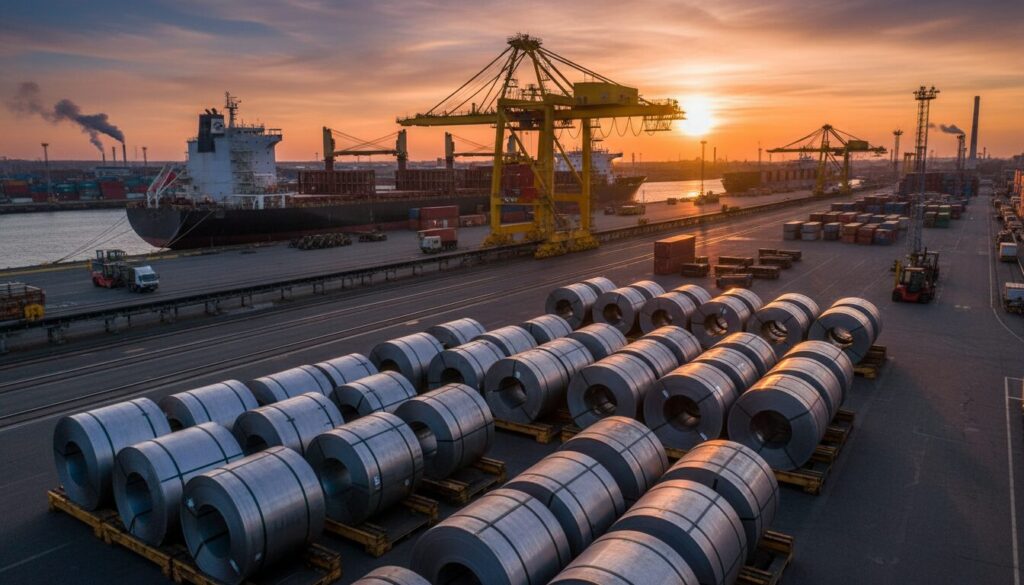
The era of unfettered globalization is rapidly evolving into an age of strategic regionalism. In a decisive move to fortify its industrial core, the Indian government has extended a significant import tariff on steel products for the next three years. This policy imposes a levy ranging from 11% to 12%, specifically targeting the influx of low-cost steel flooding the market—primarily from China.
For global logistics strategists and innovation leaders, this is not merely a local trade policy update. It is a signal of a deepening fracture in global commodity flows. As India positions itself as the next great manufacturing hub, its refusal to absorb China’s industrial overcapacity sets a precedent that will alter shipping routes, procurement strategies, and supply chain resilience models across Asia, the US, and Europe.
Why It Matters: The Geopolitics of Steel Logistics
Steel is the backbone of industrial infrastructure, automotive manufacturing, and construction. Consequently, the logistics of steel—moving heavy, high-volume bulk cargo—acts as a barometer for global economic health.
The current geopolitical landscape is defined by China’s economic slowdown. With a struggling domestic property sector, Chinese mills are exporting their surplus aggressively, driving global prices down. While this benefits buyers in the short term, it threatens the viability of domestic producers in other nations.
For the logistics sector, India’s protective measure implies three critical shifts:
- Route Re-engineering: The flow of bulk carriers from Chinese ports to Indian terminals (like Paradip or Mumbai) will face friction. Volumes will shift toward domestic movement within India, increasing demand for rail and coastal shipping.
- Inventory Strategy: Global manufacturers sourcing from India (e.g., automotive giants) must recalibrate their cost models. The “China price” is no longer the benchmark; security of supply is.
- The “China Plus One” Maturity: This tariff validates the “China Plus One” strategy. By protecting local mills like JSW Steel and Tata Steel, India ensures it has the domestic raw material capacity to support companies moving manufacturing out of China.
Global Trend: The Rise of Protective Industrialism
India’s move is not isolated. It mirrors a global trend where major economies are erecting barriers to protect strategic industries from non-market practices and oversupply. We are witnessing a divergence in how regions handle the “Steel Glut.”
Comparative Analysis: Global Steel Protection Strategies
The following table outlines how the three major economic blocs are currently managing steel supply chains and the resulting logistics impact.
| Region | Primary Policy Mechanism | Key Objective | Impact on Logistics & Sourcing |
|---|---|---|---|
| India | 11-12% Import Tariff (Extended 3 Years) | Prevent dumping; Protect JSW, Tata, SAIL market share. | shift from cross-border bulk imports to domestic rail/trucking; increased CAPEX in local logistics infra. |
| USA | Section 232 / Inflation Reduction Act (IRA) | National Security & “Buy American” for infrastructure. | Decoupling from Chinese materials; resurgence of near-shoring (Mexico/Canada); complexity in tracking “melted and poured” origins. |
| Europe | CBAM (Carbon Border Adjustment Mechanism) | Climate goals; preventing “Carbon Leakage.” | Heavy administrative burden on logistics to track carbon emissions; preference for “Green Steel” over cheap steel. |
The US and EU Context
In the United States, the legacy of Section 232 tariffs remains, but the focus has shifted to the Inflation Reduction Act (IRA). The IRA incentivizes the use of US-made steel in renewable energy projects, effectively creating a non-tariff barrier that forces supply chains to localize.
Meanwhile, the European Union is pioneering the Carbon Border Adjustment Mechanism (CBAM). Unlike India’s price-based tariff, the EU’s barrier is environmental. Importers must pay a price for the carbon emissions embedded in their steel. This forces logistics managers to not only track the location of the goods but the carbon intensity of the logistics and production process.
India’s 11-12% tariff is a blunt instrument compared to the EU’s scalpel, but it is immediate and effective. It halts the erosion of margins for local players and secures the domestic supply chain for India’s infrastructure boom.
Case Study: JSW Steel and the Domestic Pivot
To understand the tangible impact of this trend, we examine JSW Steel Ltd., India’s largest steel producer by capacity, and a direct beneficiary of this policy.
The Challenge: The Chinese Flood
In late 2023 and early 2024, JSW Steel and its peers (Tata Steel, SAIL) faced a crisis. Chinese steel exports hit an eight-year high, landing in Indian ports at prices significantly lower than domestic production costs. This compressed margins and threatened to stall capital expenditure (CAPEX) plans.
The Policy Intervention
The Indian government’s extension of the tariff (specifically the anti-dumping duty on certain steel products) acted as an immediate circuit breaker.
- Market Reaction: Upon the news, JSW Steel shares rallied over 5%, while the state-owned Steel Authority of India Ltd. (SAIL) jumped 4.2%.
- Strategic Shift: The tariff provides a three-year window of price stability.
JSW’s Strategic Response
JSW Steel is not merely resting on the protection; they are leveraging the stability to alter their supply chain and logistics footprint.
1. Capacity Expansion as a Logistics Strategy
JSW is aggressively expanding its capacity to 50 Million Tonnes Per Annum (MTPA) by the end of the decade. The tariff ensures that this new capacity will have a domestic market.
- Logistics Implication: JSW is investing heavily in slurry pipelines and conveyor systems to move iron ore from mines to plants (e.g., Vijayanagar works), reducing reliance on external rail and trucking networks that are often congested.
2. Backward Integration and Sourcing
With the sales price protected, JSW is focusing on cost optimization in sourcing coking coal (largely imported from Australia and the US).
- Innovation: They are utilizing larger vessels (Capesize) and upgrading port infrastructure at Jaigarh and Dharamtar to handle raw material imports more efficiently, offsetting the volatile global freight rates.
3. Value-Added Exports
While the domestic market is protected, JSW is pivoting its export strategy toward Europe, targeting the “Green Steel” market to bypass future CBAM hurdles. They are retrofitting plants to use renewable power, turning a defensive tariff situation at home into an offensive innovation strategy abroad.
Key Takeaways for Logistics Leaders
The “India Imposes Three-Year Steel Tariff to Support Local Industry” narrative offers four distinct lessons for strategy executives managing global supply chains:
1. Tariff Engineering is Back
Supply chain managers can no longer rely on static duty assumptions.
- Action: Implement dynamic “Total Landed Cost” modeling tools that account for sudden tariff spikes (like India’s 12%) or non-tariff barriers (like EU’s CBAM).
- Lesson: If sourcing steel-heavy components from India, ensure your suppliers (like JSW or Tata) have the domestic capacity to meet demand now that imports are expensive.
2. The Shift from “Just-in-Time” to “Just-in-Case”
Protectionism creates islands of supply.
- Action: Move away from lean, cross-border flows for critical commodities. Establish regional warehousing hubs.
- Lesson: For operations in India, increase inventory buffers of specialty steels that might still need to be imported and are now subject to higher duties, while localizing commodity steel sourcing.
3. Supply Chain Visibility Must Include Policy Intelligence
Tracking the shipment is no longer enough; you must track the policy governing the shipment.
- Action: Integrate geopolitical risk feeds into your Control Tower software. The reaction of JSW’s stock price was instant; your supply chain decisions must be equally agile.
4. Sustainability as a Trade License
The divergence between India (price protection) and Europe (green protection) creates a split market.
- Action: Logistics providers must offer dual-track reporting: Cost-efficiency for Asian markets and Carbon-efficiency for Western markets.
Future Outlook
The extension of India’s steel tariff for three years suggests that the fragmentation of global trade is not a temporary blip—it is the new normal.
Looking ahead to 2025-2027, we anticipate:
- Retaliatory Logistics: China may respond by restricting exports of critical minerals or graphite (essential for EV batteries), further complicating supply chains for nations enacting protectionist tariffs.
- Infrastructure Inflation: While Indian mills are protected, domestic steel prices in India may rise without the competitive pressure of imports. This could increase the cost of warehousing construction and industrial projects within the region.
- The Rise of the “Industrial Fleet”: Companies like Tata and JSW may expand their captive logistics arms (shipping and rail) to insulate themselves from global freight volatility, much like Amazon did with air freight.
For the innovation leader, the message is clear: The free flow of goods is being replaced by the managed flow of strategic assets. Success now depends on aligning your logistics network with these emerging geopolitical fortresses.