
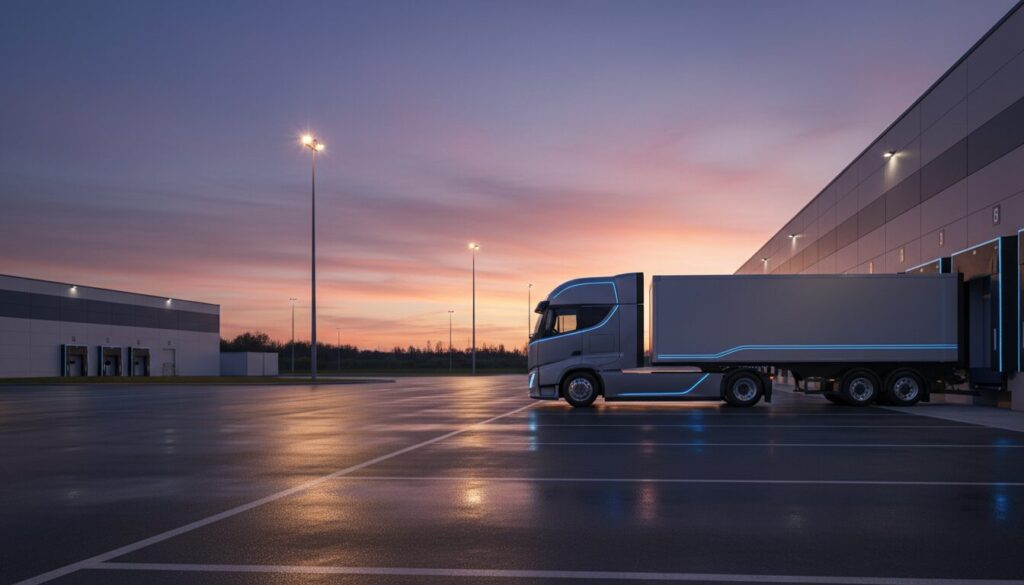
The era of “science experiments” in commercial transportation is officially over.
For years, logistics executives attended the Advanced Clean Transportation (ACT) Expo to witness prototypes and conceptual hardware. However, the narrative for ACT Expo 2026 has shifted aggressively. The conversation has moved from “Will this work?” to “How does this pay for itself immediately?”
The 2026 event highlights a critical pivot: the integration of Artificial Intelligence (AI) and Software-Defined Vehicles (SDVs) is no longer a futuristic add-on; it is the primary mechanism for driving Return on Investment (ROI) in decarbonized fleets. With commercial EV deployments having reached over 41,000 units in 2024—doubling annually since 2021—the hardware is proven. Now, the battleground is the “Digital Frontier,” where data determines profitability.
For logistics leaders, this signals a massive transition where Total Cost of Ownership (TCO) is dictated not by fuel prices, but by software efficiency.
The Facts: From R&D to Full Commercialization
The 2026 landscape is defined by the scaling of heavy-duty solutions and the digitization of assets. The focus is strictly on technologies that are commercially available and financially viable.
Key Developments at ACT Expo 2026
| Category | Key Trend | Impact on Logistics |
|---|---|---|
| Heavy-Duty Scaling | Tesla Semi, Volvo, and Daimler entering full commercial production. | Class 8 zero-emission trucks are now accessible for regional and long-haul routes. |
| Bridge Technology | Cummins X15N natural gas engine demonstrating proven ROI. | Provides an immediate carbon-reduction solution for carriers not ready for full electrification. |
| The Digital Frontier | Shift toward Software-Defined Vehicles (SDVs). | Vehicles are treated as computing platforms; updates and efficiency gains occur Over-the-Air (OTA). |
| Financial Safety | ADAS and camera systems as financial tools. | Technology is being deployed specifically to mitigate “nuclear verdicts” and lower insurance premiums. |
The Rise of the Software-Defined Vehicle (SDV)
The most significant takeaway from the 2026 showcase is the redefinition of the truck itself. An SDV allows fleet managers to upgrade vehicle capabilities—range management, torque distribution, and safety features—via software rather than mechanical intervention.
This mirrors the shift we analyzed in previous reports regarding infrastructure. Just as physical roads are being augmented by data, vehicles are following suit.
See also: DOT’s TDI Strategy: The Future of Freight Infrastructure
Industry Impact: The ROI of Intelligence
The “Digital Frontier” is not merely about having screens in the cabin; it is about leveraging data to maximize asset utilization. The integration of AI into fleet management is creating a divide between carriers who optimize via algorithms and those who rely on legacy intuition.
1. Carriers: Safety as a Financial Shield
The rise of “nuclear verdicts”—lawsuits resulting in jury awards exceeding $10 million—has driven insurance premiums to unsustainable levels.
In 2026, Advanced Driver Assistance Systems (ADAS) and AI-driven camera systems are no longer optional safety features; they are financial necessities. Carriers are deploying these technologies to provide irrefutable data in court and to negotiate lower premiums. This trend aligns with the broader push toward automation levels that reduce human error.
See also: PlusAI Listing: 2027 L4 Autonomous Freight
2. Warehouses and Yards: The Charging Bottleneck
As fleets scale their EV numbers from pilot programs (5–10 trucks) to full deployments (50+ trucks), the “Digital Frontier” extends to the yard. Managing the energy load of a heavy-duty fleet requires AI-driven charging management systems to avoid peak-demand charges that destroy ROI.
Without software to synchronize vehicle arrival times with charging schedules, the physical congestion in yards will worsen.
See also: Yard Bottlenecks Impact 2026 Supply Chains
3. Maintenance: Predictive over Reactive
The transition to SDVs allows for real-time predictive maintenance. Instead of scheduled downtime, AI analyzes component wear to schedule service only when necessary. This increases uptime—a critical metric as the initial purchase price of ZEVs (Zero Emission Vehicles) remains higher than diesel, requiring higher utilization to break even.
LogiShift View: The “Hardware Commoditization” Era
At LogiShift, we believe ACT Expo 2026 signals a fundamental maturity in the market: The hardware is beginning to commoditize, and the value is migrating to the software.
The End of Pilot Purgatory
For the last five years, fleets were stuck in “pilot purgatory,” testing small numbers of EVs. The data regarding 41,000+ deployments in 2024 confirms we have exited this phase. The doubling of deployments annually suggests that by 2027, non-ZEV procurement will become the exception for regional haulage, not the rule.
The Battery as a Data Asset
One often overlooked aspect of the “Digital Frontier” is the battery itself. It is no longer just a fuel tank; it is an IoT device.
As we discussed in our analysis of lithium innovation, the shift from passive energy storage to intelligent battery management systems (BMS) allows fleets to monitor degradation, optimize charging cycles, and even resell energy back to the grid (V2G). This turns a cost center (fuel) into a potential revenue stream, fundamentally altering the TCO calculation.
See also: IoT Truck Batteries: China’s Lithium Innovation Case Study
The “Nuclear Verdict” Defense
We predict that by 2027, shippers will begin mandating that their carriers utilize specific ADAS and AI-monitoring levels. Shippers want to avoid being pulled into negligence lawsuits. Thus, the “Digital Frontier” will soon become a procurement standard for RFPs (Request for Proposals).
Takeaway: What Companies Should Do Next
The digital transformation of the fleet is inevitable. To stay competitive, executives must move beyond evaluating trucks solely on range and price.
- Audit for Data Readiness: Before buying new SDVs, ensure your current Transport Management System (TMS) can digest and analyze the data streams these vehicles produce.
- Prioritize Safety Tech for ROI: Re-evaluate ADAS investments not just as safety compliance, but as a direct lever to reduce insurance OPEX.
- Plan Energy Management: If you are scaling EVs, you must integrate your yard management software with energy management software immediately to avoid infrastructure bottlenecks.
The ACT Expo 2026 proves that the future is green, but more importantly, the future is coded. The winners will be those who can translate terabytes of vehicle data into bottom-line savings.
See also: Driving the Autonomous Supply Chain: Are We There Yet? Guide