
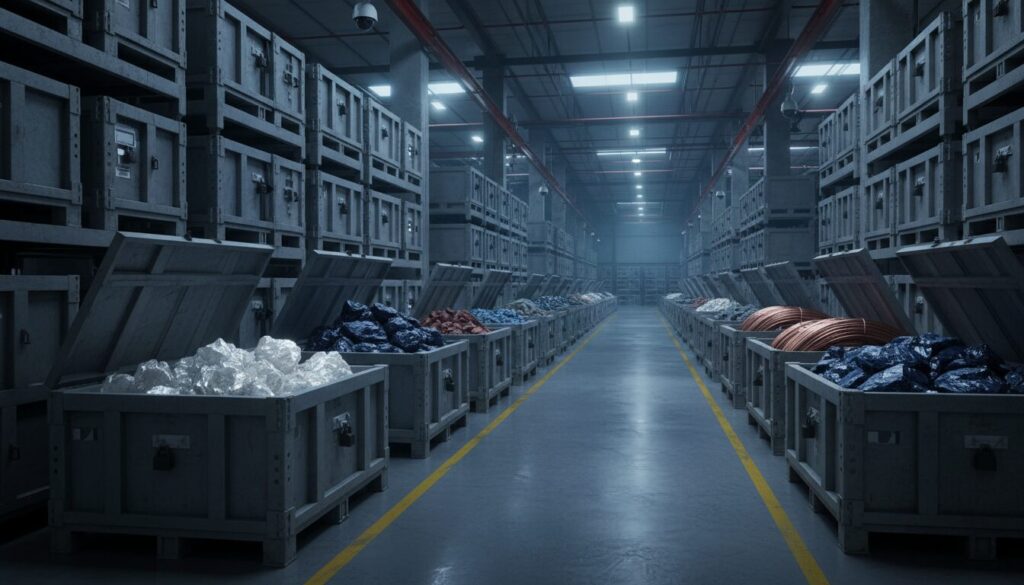
The global supply chain is witnessing its most significant structural pivot since the 1970s. Just as the oil shocks of the 20th century birthed the Strategic Petroleum Reserve (SPR), the digital and defense exigencies of the 21st century have necessitated a new kind of stockpile.
President Trump’s launch of ‘Project Vault,’ a $12 billion initiative to establish a strategic critical mineral reserve, marks a definitive end to the era of purely market-driven sourcing. This is not merely a policy announcement; it is a signal to innovation leaders and strategy executives that the United States is moving to aggressively decouple its essential industries—defense, automotive, and technology—from foreign volatility.
For logistics professionals, this move underscores a critical lesson discussed in our recent analysis of Top Supply Chain Risks and Trends to Follow in 2026: US & EU: government policy is now a primary driver of inventory strategy.
Why It Matters: The “SPR” for the Digital Age
For decades, the global economy operated on efficiency. Supply chains were lean, just-in-time, and largely agnostic to political geography. However, the concentration of critical mineral processing—specifically rare earths, lithium, and cobalt—in China has turned efficiency into a vulnerability.
Project Vault aims to replicate the Strategic Petroleum Reserve’s logic but applies it to the building blocks of the future economy. With $10 billion in loans from the Export-Import Bank of the United States (EXIM) and $2 billion in private sector financing, this initiative is designed to insulate the US economy from supply shocks.
The Geopolitical Trigger
The urgency of this project is highlighted by recent geopolitical maneuvers. As detailed in our coverage of how China Bans Dual-Use Item Exports to Japan: Global Impact, the weaponization of trade flows is no longer theoretical. By restricting exports of gallium, germanium, and other dual-use items, dominant players can choke off high-tech manufacturing instantly. Project Vault is the US counter-move, ensuring that Boeing, General Motors, and Western Digital have a domestic safety net.
Global Trend: The Race for Resource Sovereignty
While Project Vault is a US-specific initiative, it represents a broader global trend where major economic blocs are racing to secure “upstream” control. The logistics of the future will not just be about moving finished goods, but about securing the raw materials required to build them.
Comparative Strategies: US vs. EU vs. China
The approach to critical minerals varies significantly across major regions. The US is favoring public-private financial leverage, the EU is focusing on regulatory frameworks and recycling, while China maintains state-directed dominance in processing.
| Feature | United States (Project Vault) | European Union (CRMA) | China (State Strategy) |
|---|---|---|---|
| Primary Mechanism | Financial Leverage ($12B funding) | Regulation (Critical Raw Materials Act) | State-Owned Enterprise (SOE) Control |
| Key Focus | Stockpiling & Domestic Mining | Diversification & Circular Economy | Processing Dominance & Export Control |
| Private Sector Role | High (Public-Private Partnerships) | Moderate (Compliance & Targets) | Integrated (State-Directed) |
| Strategic Goal | Defense & Industrial Resilience | Sustainability & Strategic Autonomy | Global Supply Chain Leverage |
The European Context
Europe is pursuing a similar goal through the Critical Raw Materials Act (CRMA), aiming for 10% domestic extraction and 40% processing capacity by 2030. However, the US model differs by injecting massive, direct liquidity via EXIM Bank loans to jumpstart the infrastructure immediately, rather than relying solely on regulatory targets.
The Asian Context
China remains the benchmark. As noted in our article IoT Truck Batteries: China’s Lithium Innovation Case Study, Chinese firms like CATL have achieved dominance not just through raw volume, but through technological innovation in processing and application. Project Vault attempts to build a parallel ecosystem that can compete with this entrenched dominance.
Case Study: Project Vault and USA Rare Earth
To understand the logistics implications of this trend, we must look at the specific beneficiaries and the structure of the deal. Project Vault is not a government warehouse filling up with rocks; it is a financial ecosystem designed to accelerate the “mine-to-magnet” supply chain.
The Players
- USA Rare Earth: The primary beneficiary of a designated $1.6 billion support package.
- The Consortium: A strategic partnership involving Boeing (Aerospace/Defense), General Motors (Automotive), and Western Digital (Tech/Storage).
- The Financier: EXIM Bank providing the bulk of the capital ($10B), de-risking the investment for private equity ($2B).
The Mechanics of the Deal
1. Vertical Integration as a Requirement
USA Rare Earth is utilizing the funds to complete its fully vertical domestic supply chain. This involves not just mining the ore (at sites like the Round Top Heavy Rare Earth Project in Texas) but establishing the processing facilities required to separate the minerals and manufacture the permanent magnets used in EV motors and missile guidance systems.
2. The “Off-Take” Guarantee
The involvement of GM and Boeing is crucial. In logistics terms, they provide the “demand signal.” By committing to buy from this domestic reserve/production line, they validate the capital investment.
- GM’s Pivot: This aligns perfectly with GM’s broader strategy of localization. As we analyzed in Case Study: GM Moves China-Made Buick to US Factory, GM is actively dismantling its reliance on cross-Pacific supply lines for critical components to mitigate geopolitical risk.
3. Strategic Buffer vs. Commercial Inventory
Unlike standard commercial inventory, the reserves managed under Project Vault serve a dual purpose.
- Commercial Buffer: Stabilizes prices for consortium members during market volatility.
- National Security Asset: In the event of a conflict or total trade embargo, the US Department of Defense has priority access to these materials.
Success Factors
The success of this case study hinges on the “Public-Private Partnership” (PPP) model. Previous attempts to restart US mining failed because private capital deemed the projects too risky compared to cheap Chinese imports. By using EXIM Bank to guarantee the debt, Project Vault lowers the cost of capital, making domestic logistics viable against subsidized foreign competitors.
Key Takeaways for Logistics Leaders
The launch of Project Vault signals a shift in how strategy executives must evaluate their supply chains.
1. Inventory is No Longer “Waste”
The lean manufacturing philosophy treated excess inventory as waste. Project Vault redefines strategic inventory as an asset. Companies should re-evaluate their “safety stock” levels for critical raw materials, moving from Just-In-Time to Just-In-Case, especially for components linked to national security or critical infrastructure.
2. The Rise of “Friend-Shoring” Logistics
Supply chains are bifurcating. Logistics networks will increasingly align with political alliances. If your company relies on a single source in a non-allied nation for a critical mineral, you are carrying a “sovereign risk” that needs immediate mitigation.
- See also: Hadrian Hits $1.6B: Impact on Supply Chain Reshoring for insights on how automated manufacturing is enabling this shift.
3. Government Relations is Now Supply Chain Strategy
Project Vault demonstrates that the biggest capital in logistics is now coming from policy initiatives (EXIM Bank). Supply chain leaders must work closely with government relations teams to identify funding opportunities, subsidies, or “strategic project” designations that can lower logistics costs.
4. Audit Tier 3 and Tier 4 Suppliers
The $12 billion injection targets the very bottom of the supply chain (mining and processing). Many OEMs know their Tier 1 suppliers but are blind to where the raw lithium or cobalt comes from. To benefit from initiatives like Project Vault (or to comply with future regulations), you must have visibility down to the mine.
Future Outlook
Project Vault is likely just the first phase of a broader re-industrialization of the Western supply chain.
Expansion to “Tech Metals”
While the current focus is on rare earths for magnets and batteries, we expect the scope to widen. Gallium and Germanium (essential for semiconductors) and Titanium (aerospace) will likely see similar “Vault” initiatives. The definition of “critical” will expand as technology evolves.
The Recycling Imperative
Mining takes years to come online. To bridge the gap, the US and EU will likely turn to “Urban Mining”—recycling e-waste to recover critical minerals. Logistics providers specializing in reverse logistics and circular supply chains will see massive growth.
A New Cold War Logistics
The creation of a $12 billion reserve acknowledges a stark reality: the free trade era for critical resources is paused. We are entering an era of Strategic Mercantilism.
For the global logistics trend watcher, the message is clear: The most efficient supply chain is no longer the cheapest one; it is the one that can survive a geopolitical blockade. Project Vault is the prototype for this new reality.