The era of regarding drone delivery as a futuristic “science project” is officially over. With Zipline securing $600 million in fresh funding at a valuation of $7.6 billion, the logistics sector is witnessing the capitalization of what may become the dominant mode of rapid last-mile transport for light goods.
For supply chain executives, the significance lies not just in the dollar amount, but in the operational data accompanying it. Zipline has surpassed 2 million deliveries globally and, more critically, is reporting a 15% week-over-week growth rate in its U.S. operations. This signals a transition from pilot testing to mass scaling.
This analysis explores how Zipline’s aggressive expansion into Houston, Phoenix, and beyond by 2026 will disrupt traditional courier models, reshape fulfillment center requirements, and alter the unit economics of last-mile delivery.
The Facts: Zipline’s Aggressive Scale-Up
Zipline’s shift from niche medical deliveries in Africa to mainstream retail fulfillment in the United States represents a pivotal moment in logistics history. The company is leveraging this massive capital injection to deploy its “Platform 2” system—a precise, droid-based delivery mechanism designed for dense urban environments.
The following table summarizes the key components of this development:
| Category | Details |
|---|---|
| Funding & Valuation | $600M raised; Company valued at $7.6B. |
| Growth Metrics | 2M+ lifetime deliveries; 15% weekly U.S. growth rate (past 7 months). |
| Strategic Targets | Expansion to Houston, Phoenix, and Detroit; Operational in 4 states by 2026. |
| Technology Mix | Platform 1: Long-range (120 miles) fixed-wing. Platform 2: Short-range, precise home delivery (8lb capacity). |
| Major Partners | Walmart, Panera, Chipotle, Sweetgreen. |
| Strategic Shift | Transitioning from medical supply chain focus to high-frequency commercial retail. |
While Zipline built its reputation delivering blood and vaccines in Rwanda and Ghana, the current strategy is purely commercial. By partnering with high-volume retailers like Walmart and fast-casual dining chains like Chipotle, Zipline is targeting the most expensive and inefficient segment of the supply chain: the sub-10-mile, sub-10-pound delivery.
Industry Impact: A Tripartite Disruption
The infusion of $600M allows Zipline to build infrastructure at a speed that traditional logistics providers cannot ignore. This expansion affects three core pillars of the industry.
1. Impact on Carriers and the “Last Mile” Mix
For decades, the last mile has been dominated by vans and gig-economy drivers. However, these methods are notoriously inefficient for small packages. A 4,000-pound van delivering a 2-pound burrito or a single bottle of medication is a mismatch in unit economics.
Zipline’s expansion threatens to strip “premium” volume away from traditional carriers. Urgent, lightweight shipments—often the highest margin for couriers—are exactly what Zipline targets.
- Speed vs. Cost: Traditional “Same-Day” delivery usually means delivery within a 4-8 hour window. Zipline’s Platform 2 targets delivery in under 15 minutes.
- Carrier Diversification: As discussed in our analysis of Alternative Delivery Networks: Competing with Big Carriers, shippers are actively looking to diversify away from reliance on single-source parcel giants. Zipline offers a high-speed alternative that bypasses road congestion entirely.
2. Impact on Warehousing and Fulfillment Centers
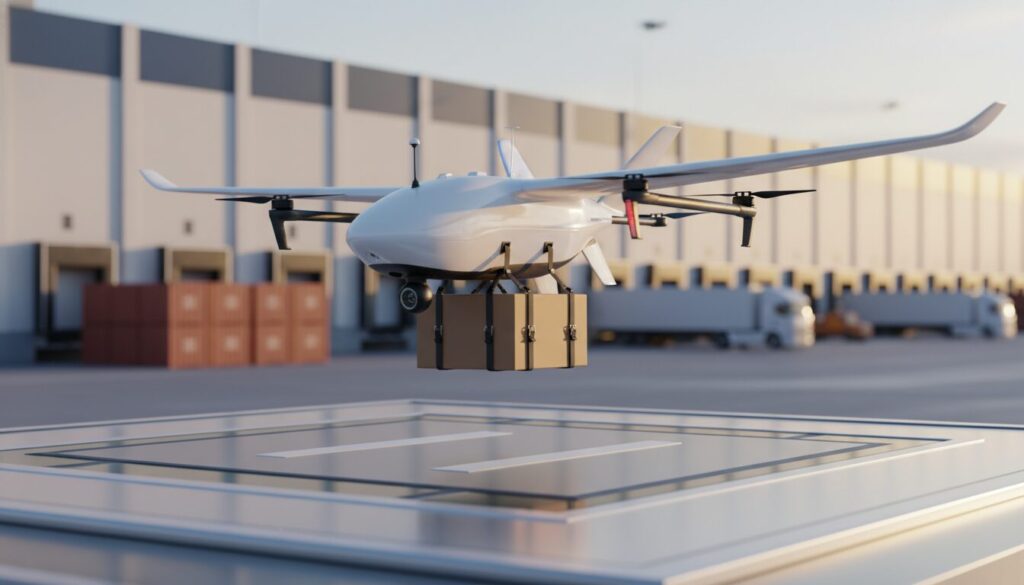
The physical footprint of the supply chain must adapt to accommodate drone swarms. Zipline’s Platform 2 utilizes a docking station that looks less like an airport and more like a modified loading dock or rooftop fixture.
- The “Micro-Fulfillment” Evolution: Retailers will need to convert parking spaces or roof sections into launch/catch pads.
- Inventory Positioning: To leverage 15-minute delivery, inventory must be forward-deployed at the store level, not held in regional distribution centers (DCs). This reinforces the “store-as-fulfillment-center” trend.
- Automation Integration: Zipline’s system is designed to integrate with automated picking systems. We are moving toward a touchless chain: an order is received, a robot picks it, loads it into a Zipline droid, and the drone departs—all without human intervention.
3. Impact on Shippers (Retail and Healthcare)
For retailers, the “Instant Gratification” metric is shifting. Two-day shipping was the standard; now, specific operational windows (dinner time, lunch rush) dictate logistics.
Partnerships with Panera and Chipotle suggest that food logistics will drive the volume required to lower costs, while high-margin retail (electronics, beauty) will drive profit. Shippers must now audit their SKU profiles to determine what percentage of their inventory fits the “8-pound, 10-mile” constraints of Platform 2.
See also: Wing’s 150-Store Expansion: The Era of Mass Drone Logistics for context on how competitors are driving similar density strategies.
LogiShift View: The “So What?” for Executives
The headline number is $600M, but the real story is the tipping point of regulatory and consumer normalization.
The Unit Economics Battle
Historically, drone delivery was viewed as a loss leader. However, Zipline’s Platform 2 is engineered for positive unit economics. By using a “mothership” drone that hovers high above (quietly) and lowers a small “droid” on a tether to the patio, they solve two massive problems: noise pollution and precise drop-off.
If Zipline can prove that a drone delivery costs less than a DoorDash driver or an Amazon Flex route, the shift will be swift. With 15% weekly growth, they are rapidly acquiring the volume density needed to prove this thesis.
The 2026 Horizon
Zipline’s timeline matches a broader industry trend. By 2026, we expect the Federal Aviation Administration (FAA) to have fully standardized Beyond Visual Line of Sight (BVLOS) operations, removing the need for human observers. This funding effectively builds the “runway” to get Zipline to that regulatory finish line with a fully operational fleet ready to switch from “pilot” to “profit.”
The Dual-Platform Advantage
Unlike competitors focusing solely on short-range quadcopters, Zipline’s retention of Platform 1 (fixed-wing, 120-mile range) gives them a unique hub-and-spoke capability. They can theoretically move inventory between stores (balancing stock) using Platform 1, and deliver to customers using Platform 2. This dynamic inventory rebalancing is a capability traditional courier networks simply do not possess.
Strategic Takeaway
For logistics leaders, the expansion of Zipline is a call to action to rethink last-mile strategies. Waiting for the technology to “mature” is no longer a viable strategy; the technology is here, and the capital is deployed.
Actionable Steps:
- Analyze SKU Weight/Size: Conduct a comprehensive audit of your product catalog. Identify which SKUs fall under the 8lb threshold and are high-velocity items. These are your candidates for future drone fulfillment.
- Assess Real Estate Assets: If you operate retail locations or micro-fulfillment centers in Houston, Phoenix, or Detroit, evaluate their structural readiness for drone docking stations.
- Monitor Carrier Mix: Do not lock into long-term, exclusive contracts with traditional ground carriers for local delivery without a carve-out for alternative/autonomous delivery methods.
- Watch the Regulation: Keep a close eye on FAA Part 135 certifications and BVLOS waivers. Zipline’s progress here will set the precedent for the entire industry.
The $600M investment in Zipline is not just a bet on a company; it is a bet that the future of urban logistics is airborne, automated, and immediate. As 2026 approaches, the sky is no longer the limit—it’s the new highway.