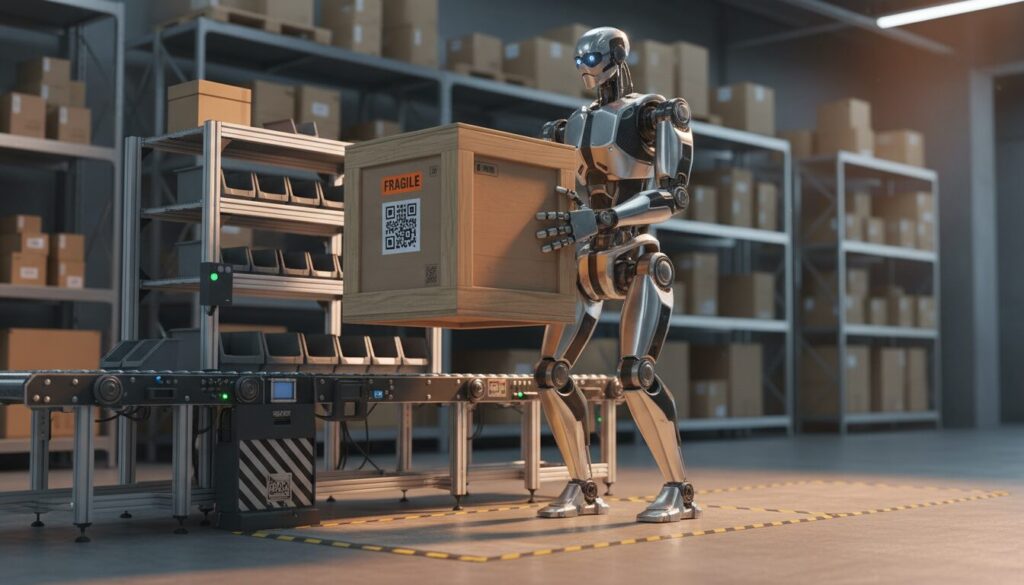
The era of “science experiments” in the warehouse is ending. For years, general-purpose humanoid robots were fascinating but fundamentally disconnected from the grim reality of industrial operations. They were agile but fragile, intelligent but unmanageable within a standard Warehouse Management System (WMS) or PLC environment.
However, a recent breakthrough has changed the landscape. The Humanoid and Siemens proof of concept shows the way to industrial deployments, bridging the gap between advanced AI robotics and established operational technology (OT).
For warehouse managers facing labor shortages and rigid automation silos, this is the blueprint for the future. This guide details how to move from “cool demo” to scalable, profitable deployment using the methods established by Siemens and its humanoid partners.
The Operational Pain: The “Island of Automation” Trap
Before diving into the solution, we must address why previous attempts at deploying advanced robotics often fail. It is rarely a mechanical failure; it is an integration failure.
In a traditional setup, buying an advanced AI robot creates an “island.” The robot runs on its own proprietary operating system (often ROS-based), requires specialized Python engineers to maintain, and does not communicate natively with the facility’s safety controllers or WMS.
Common Logistics Pain Points
- Integration Bottlenecks: Connecting an AI robot to a PLC usually requires months of custom coding.
- Safety Gaps: AI models are probabilistic; industrial safety must be deterministic.
- Skill Mismatch: Warehouse technicians know Ladder Logic, not Neural Networks.
- Scalability Issues: What works for one robot fails when you add fifty.
As noted in the industry analysis, the market is shifting. See also: IFR Names Top 5 Global Robotics Trends of 2026 for Logistics.
The Solution: The Siemens Industrial Edge Architecture
The solution lies in the methodology demonstrated in recent Proof of Concepts (PoC), specifically the collaboration between Siemens and humanoid manufacturers (such as Sanctuary AI).
The core of this solution is IT/OT Convergence. Instead of the humanoid operating as a black box, its AI control loop is integrated directly into the Siemens SIMATIC S7-1500 controller and the Siemens Industrial Edge platform.
What This Architecture Does
- Orchestration: The PLC (Programmable Logic Controller) acts as the “conductor,” managing the robot’s tasks alongside conveyors, sensors, and other machinery.
- AI Processing: The AI “brain” (grasping, path planning) runs on the Industrial Edge device, but sends commands through the PLC.
- Standardization: The interface allows warehouse staff to control the humanoid using standard HMI (Human-Machine Interface) panels, just like a conveyor belt.
This approach mirrors similar advancements in other robotics sectors. For context on how AI is shifting standard palletizing, read: UR, Robotiq & Siemens: The AI Shift in Smart Palletizing.
Process: 5 Steps to Implement the Siemens PoC Model
To replicate the success of the Humanoid and Siemens proof of concept shows the way to industrial deployments, warehouse managers should follow this five-step implementation framework.
Step 1: Digital Twin Validation
Before purchasing a single robot, you must validate the deployment in a virtual environment. The Siemens PoC heavily relies on Tecnomatix Process Simulate.
- Action: Create a Digital Twin of your picking or packing station.
- Objective: Import the humanoid’s kinematics and simulate reachability, cycle time, and collision risks within your existing layout.
- Why: This eliminates the “it doesn’t fit” risk. You can prove ROI virtually before capital expenditure.
Step 2: Establish the PLC-to-AI Bridge
This is the technical heart of the strategy. You must decouple the robot’s high-level AI from its low-level execution.
- The Challenge: AI speaks Python/C++; PLCs speak Ladder Logic/Structured Text.
- The Fix: Use the SIMATIC Robot Integrator. This software module allows the PLC to send simple commands (e.g., “Pick Item A”) to the robot’s AI controller. The AI handles the “how” (calculating the grip), while the PLC handles the “when” (integration with the line).
Table: Architecture Comparison
| Feature | Traditional Deployment | Siemens PoC Method |
|---|---|---|
| Controller | Robot-specific proprietary controller | SIMATIC S7-1500 (Unified) |
| Language | Python / ROS / Vendor Script | TIA Portal / Structured Text |
| Maintenance | Requires Robotics Specialist | Manageable by onsite Electrician |
| Data Flow | Isolated (Local Logs) | Integrated (Industrial Edge) |
Step 3: Implement Layered Safety Protocols
Humanoids are mobile and unpredictable compared to caged arms. Safety cannot be an afterthought.
- Hard Safety: Utilize standard emergency stops and light curtains linked to the PLC Safety Integrated module.
- Soft Safety: The AI model running on the Edge device processes visual data to detect human proximity, slowing the robot down before a hard stop is triggered.
Critical Note: With new regulations emerging, compliance is mandatory. Ensure your deployment adheres to the latest standards.
See also: A3 R15.06-2025: Critical Alert for Robot Safety.
Step 4: Deploy Industrial Edge for AI Inference
The robot needs to “see” and “think.” In the Siemens PoC, this computation is offloaded or managed via the Industrial Edge ecosystem.
- Deploy AI Apps: Install the grasping and vision apps on the Edge device, not just the robot’s internal PC.
- Update Cycle: This allows you to update the AI model (making the robot smarter) without stopping the PLC production line. IT can push updates remotely; OT keeps the line running.
Step 5: Scale via “Copy-Exact”
Once the first station is running under the control of a SIMATIC controller, scaling becomes a “Copy-Exact” operation.
- Because the logic resides in the PLC (not just the robot), adding a second robot is simply a matter of copying the TIA Portal project and assigning a new IP address.
- Major players are already proving this scalability. For a case study on massive deployment, refer to: Schaeffler Deploys Hundreds of Humanoids: Innovation Case.
Results: The “After” State
Implementing the Humanoid and Siemens proof of concept shows the way to industrial deployments strategy yields measurable operational improvements.
Operational Metrics Comparison
| Metric | Before (Manual/Isolated Robot) | After (Siemens Integrated Humanoid) |
|---|---|---|
| Engineering Time | 4-6 weeks per robot setup | < 1 week (after initial template) |
| Downtime Recovery | Hours (requires specialist) | Minutes (handled by line staff) |
| Data Visibility | Zero (Black box) | 100% (Real-time OEE tracking) |
| Flexibility | High cost to reprogram | Drag-and-drop task changes |
Qualitative Benefits
- Resilience: If a robot fails, it can be swapped out like a motor. The “intelligence” remains in your Edge/PLC architecture.
- Workforce Buy-in: Maintenance teams are less hostile to robots when they can troubleshoot them using the same tablets and tools they use for conveyors.
Summary: Keys to Success
The days of treating humanoid robots as novelties are over. To survive the labor crisis of the late 2020s, logistics hubs must industrialize their approach to AI.
The key takeaways from the Siemens PoC approach are:
- Don’t Isolate: Integrate humanoids into the PLC environment immediately.
- Simulate First: Use Digital Twins to validate reach and cycle times.
- Safety First: Adhere to updated R15.06-2025 standards using integrated safety logic.
- Edge Compute: Separate the AI “brain” from the mechanical body for easier updates and management.
By following this path, warehouse managers can transform humanoids from a risky experiment into a reliable, scalable workforce.
Ready to start? Begin by auditing your current PLC infrastructure to see if it is “Edge-ready.” The future of logistics is humanoid, but the backbone is industrial silicon.