
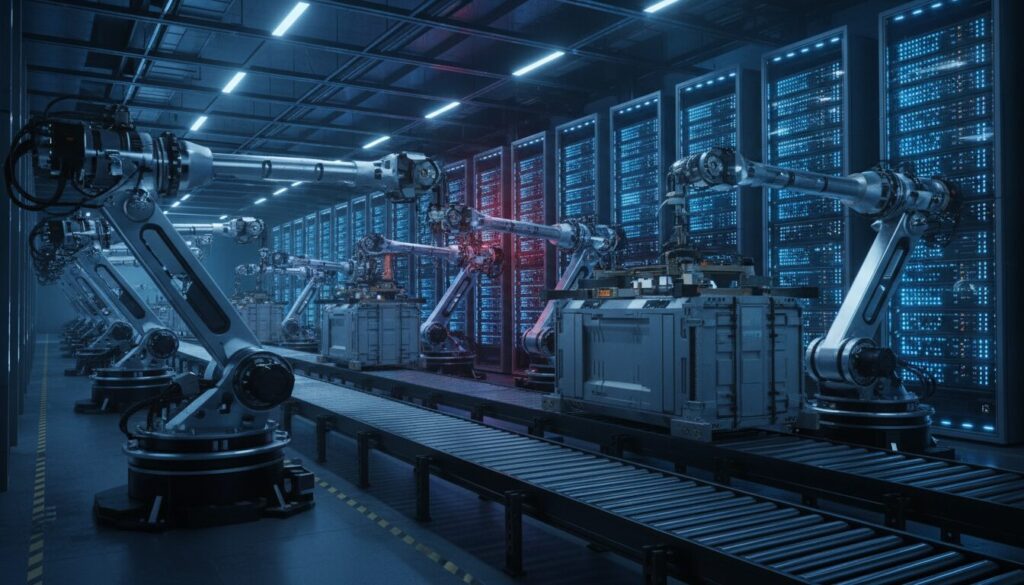
The intersection of Industry 4.0 and legacy infrastructure has created a paradox in global logistics and manufacturing. While the race to digitize supply chains promises unprecedented efficiency, it has simultaneously opened the door to unprecedented vulnerability. The narrative for 2025 is clear: Cyber risks grow as manufacturers turn to AI and cloud systems, transforming the factory floor into the new frontline of digital warfare.
For strategy executives and innovation leaders, the calculation has shifted. It is no longer just about the ROI of automation; it is about the ROE (Return on Existence). When a single vulnerability can halt global production for a month and cost nearly a billion dollars, cybersecurity ceases to be an IT ticket and becomes a boardroom imperative.
This article explores the mechanics of this growing threat, analyzes the global landscape of industrial cyber risks, and dissects the catastrophic financial impact of recent breaches to provide a roadmap for resilience.
Why It Matters: The Convergence of OT and IT
For decades, Operational Technology (OT)—the machines, conveyers, and sensors that run factories—was “air-gapped,” meaning it was physically disconnected from the internet. Today, that gap has vanished. To feed AI algorithms and Cloud analytics, manufacturers are plugging 30-year-old legacy machines into 21st-century networks.
This convergence creates a volatile environment where “security-by-obscurity” no longer works. According to the IBM X-Force Report 2025, manufacturing has held the dubious title of the #1 most-attacked industry for four consecutive years.
The High Stakes of Interconnectivity
The logic behind the attacks is predatory but rational. Unlike financial services, where a hack might steal data, a hack in manufacturing stops physical movement. In a Just-In-Time (JIT) global economy, downtime is the ultimate leverage for ransomware gangs.
-
Legacy Blind Spots:
Many production lines run on outdated operating systems (e.g., Windows XP or proprietary embedded systems) that cannot be patched. When connected to the cloud, these become open doors for attackers. -
Shadow AI Expansion:
Engineers and logistics planners, eager to optimize workflows, often bypass IT protocols. They upload sensitive schematics or supply chain data to public GenAI tools, creating “Shadow AI” vulnerabilities where proprietary data leaks into the public domain. -
Supply Chain Contagion:
A breach in a Tier 1 supplier’s cloud system can paralyze an OEM’s assembly line in a different continent within hours.
Global Trend: The Race for Smart Manufacturing vs. Cyber Resilience
The push for AI and Cloud adoption varies by region, but the resulting vulnerability is a shared global crisis. As of 2025, 57% of large U.S. manufacturers utilize cloud systems, yet the integration of these systems with legacy hardware remains a massive security blind spot.
United States: The Cloud Rush and Regulatory Catch-up
In the US, the drive is heavily focused on “Re-shoring” and modernizing the industrial base. The adoption of Cloud ERPs and AI-driven demand forecasting is high. However, the speed of adoption has outpaced security governance.
- Trend: Rapid integration of third-party SaaS platforms to manage logistics.
- Risk: Third-party integrators often have lower security standards than the manufacturers they serve, acting as Trojan horses for malware.
- Response: The SEC and CISA are pushing for stricter disclosure rules, forcing Boards to quantify cyber risk in financial terms.
Europe: Regulation First, Innovation Second?
Europe faces a similar threat landscape but approaches it through the lens of strict compliance, specifically the NIS2 Directive (Network and Information Security).
- Trend: EU manufacturers are focusing on “Sovereign Clouds” and data localization to protect industrial secrets.
- Risk: While compliance is high, the fragmentation of supply chains across Eastern and Western Europe creates gaps in enforcement.
- Response: A heavy focus on “Cyber Resilience” rather than just prevention, mandating business continuity plans for when—not if—attacks occur.
Asia-Pacific: The IoT Explosion
China and Japan lead the world in industrial robotics density. The “Made in China 2025” initiative has connected millions of devices to the industrial internet.
- Trend: Massive deployment of IoT sensors for predictive maintenance.
- Risk: These millions of endpoints are often shipped with default passwords and minimal encryption, creating massive botnets that can be weaponized.
- Response: Developing proprietary, closed-loop industrial AI models to reduce reliance on western public cloud infrastructure.
Regional Comparison of Industrial Cyber Posture
The following table outlines how different regions are balancing the adoption of AI/Cloud with the inherent cyber risks.
| Feature | United States | European Union | Asia-Pacific (China/Japan) |
|---|---|---|---|
| Primary Driver | Speed to Market & Efficiency | Compliance & Data Sovereignty | Automation Volume & Scale |
| Dominant Tech | Public Cloud & GenAI | Hybrid Cloud & Edge Computing | Industrial IoT (IIoT) |
| Top Risk Factor | Shadow AI & Third-Party Vendors | Supply Chain Fragmentation | Unsecured IoT Endpoints |
| Regulation | SEC Disclosure Rules | NIS2 Directive / GDPR | State-Driven Cyber Standards |
| Cloud Adoption | High (57%+) | Moderate (Focus on Private Cloud) | High (Government-backed Clouds) |
Case Study: The $910 Million Silence at Jaguar Land Rover
To understand the tangible cost of these risks, we must look at the recent catastrophic event involving Jaguar Land Rover (JLR). This case serves not as a success story of prevention, but as the definitive “lessons learned” success story for the rest of the industry—a wake-up call that quantified the price of vulnerability.
The Context: A rush to Digital Transformation
Like many automotive giants, JLR has been aggressively pivoting toward electric vehicles (EVs) and smart manufacturing. This transition required deep integration between their corporate networks (IT), their factory floor controls (OT), and cloud-based supply chain management systems.
The Incident: The One-Month Halt
A sophisticated cyberattack breached the perimeter of JLR’s network. Unlike a simple data theft, this attack targeted the operational backbone. To contain the spread and prevent the malware from infecting the vehicles themselves (which could lead to safety recalls), JLR made the difficult decision to shut down production.
- Duration: Production was halted for a full month.
- Scope: The shutdown affected key assembly plants, disrupting the flow of high-margin luxury vehicles to global markets.
The Financial Impact
The costs associated with this incident were staggering, breaking down into direct remediation costs and lost opportunity.
- Cyber Costs: $260 million. This included forensic investigation, system rebuilding, legal fees, and overtime for IT staff to scrub the network.
- Operational Losses: $650 million. This represents the value of lost production, delayed deliveries, and penalty clauses triggered by supply chain failures.
- Total Impact: $910 million.
The Root Cause Analysis
Post-incident analysis revealed a scenario typical of the current global trend:
- Legacy Vulnerability: The entry point was traced to a legacy system that had been connected to the cloud without adequate segmentation.
- Lack of “Secure-by-Design”: The speed of digital transformation meant that security was an overlay, not a foundational element of the new network architecture.
This incident proves that in the modern logistics landscape, a cyber strategy is a solvency strategy.
Key Takeaways for Logistics and Innovation Leaders
The JLR incident and the wider IBM X-Force data provide critical lessons. Innovation leaders must pivot from a “prevention” mindset to a “resilience” mindset.
1. Adopt a “Secure-by-Design” Philosophy
You cannot patch security into an AI project after it is launched.
- Action: Involve CISO teams in the ideation phase of any AI or Cloud project.
- Standard: Ensure that all legacy equipment connected to the cloud is buffered by secure gateways or “Data Diodes” that allow data to flow out for analysis but prevent commands from flowing in.
2. Govern “Shadow AI” Aggressively
The use of unauthorized AI tools is the new “Shadow IT.”
- Action: Instead of banning AI, provide sanctioned, enterprise-grade private instances of Large Language Models (LLMs).
- Policy: Implement strict data governance policies that flag when proprietary data (like CAD drawings or shipping manifests) is being uploaded to external servers.
3. Vet Third-Party Integrators
Your supply chain is only as secure as its weakest digital link.
- Action: Audit the security posture of cloud vendors and logistics partners.
- Requirement: Mandate that suppliers adhere to the same cybersecurity frameworks (e.g., NIST or ISO 27001) that your organization follows.
4. Implement Zero Trust Architecture (ZTA)
The old model of “Castle and Moat” (hard perimeter, soft interior) is dead.
- Action: Assume the breach has already happened.
- Technique: Segment networks so that if a hacker compromises the cloud ERP, they cannot laterally move to the robotic assembly arm on the factory floor.
Future Outlook: The Era of Cyber-Physical Resilience
As we look toward 2026 and beyond, the trend of cyber risks growing as manufacturers turn to AI and cloud systems will evolve into an arms race between AI-driven attackers and AI-driven defenders.
AI vs. AI Security
Future cyberattacks will be automated by AI, capable of scanning millions of IP addresses for legacy vulnerabilities faster than any human. Conversely, manufacturers will rely on “Agentic AI”—autonomous software agents that patrol the network 24/7, patching vulnerabilities in real-time without human intervention.
The Rise of the “Digital Twin” as a Security Sandbox
Logistics leaders will increasingly use Digital Twins not just for efficiency, but for security stress-testing. By simulating a ransomware attack on a Digital Twin of the supply chain, companies can identify choke points and backup failures before a real crisis hits.
Conclusion
The $910 million cost incurred by Jaguar Land Rover is a tuition fee that the entire industry can learn from without paying. As the manufacturing and logistics sectors embrace the cloud and AI, they must recognize that connectivity is a double-edged sword. True innovation is not just about making things faster; it is about making them resilient enough to survive the speed of the modern world.