
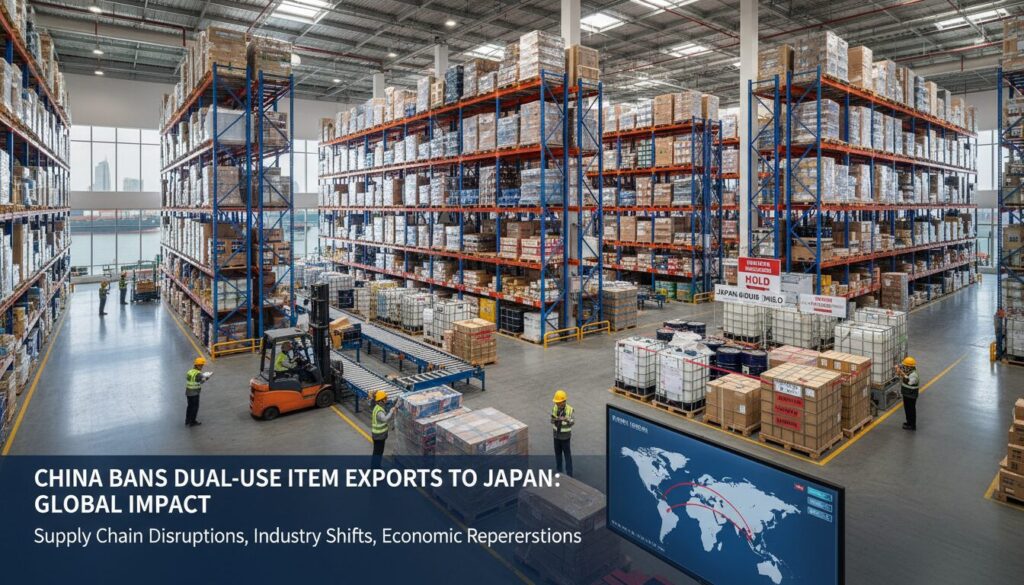
The dawn of 2026 has brought a seismic shift to global trade dynamics. On January 6, 2026, the geopolitical landscape of supply chain logistics was fundamentally altered when China announced an immediate ban on the export of dual-use items to Japan. Following remarks regarding Taiwan by Japanese Prime Minister Sanae Takaichi in November 2025, Beijing’s retaliatory measure targets critical inputs including rare earth elements (REEs), advanced electronics, aerospace components, and drone technology.
For innovation leaders and strategy executives, this is not merely a regional diplomatic spat; it is a definitive signal that the weaponization of trade has entered a new, more volatile phase. The “China Bans Dual-Use Item Exports to Japan” policy threatens to sever the arteries of high-tech manufacturing, impacting everything from smartphone production to aerospace engineering.
This article explores the global ramifications of this ban, analyzes how major economic blocs are reacting, and presents a case study of supply chain resilience in the face of sudden geopolitical embargoes.
Why It Matters: The Weaponization of Supply Chains
The scope of the ban—covering “dual-use” goods that serve both civilian and military purposes—is deliberately broad. While the headline focuses on Japan, the shockwaves are global. Japan serves as a critical node in the global technology value chain. It imports raw materials and intermediate goods from China, processes them into high-value components (sensors, capacitors, precision motors), and exports them to the US, EU, and Asia for final assembly.
The Domino Effect
When China bans exports to Japan, the disruption does not stop in Tokyo. It cascades downstream:
- Aerospace: Japanese carbon fiber and avionics manufacturers rely on Chinese precursors. A shortage here impacts Boeing and Airbus delivery timelines.
- Electronics: Gallium and Germanium, essential for semiconductor manufacturing, are central to this ban. Japan’s inability to source these affects the global supply of chips used in US and European automotive sectors.
- Green Tech: Rare earth magnets (Neodymium/Dysprosium) are vital for EV motors and wind turbines. Japan is a leading producer of these magnets, but China controls the refining of the raw ore.
This event marks the definitive end of the “efficiency-first” era of globalization. We have entered the era of “security-first” logistics, where geopolitical alignment dictates trade routes more than cost or speed.
Global Trend: Fragmentation and Response
The implementation of the ban has accelerated trends that were already visible in 2024 and 2025: the decoupling of supply chains and the rise of “Friend-shoring.”
United States: Acceleration of the Mineral Security Partnership (MSP)
In response to the ban, the United States has activated emergency protocols within the Mineral Security Partnership (MSP). Washington views the restriction on Japan as a direct threat to allied defense capabilities.
- Strategic Action: The US Department of Commerce has expedited funding from the 2026 Defense Production Act extension to subsidize logistics costs for Japanese firms sourcing raw materials from Australia and Canada.
- Logistics Shift: Trans-Pacific eastbound freight volumes are expected to shift. Instead of raw materials flowing China -> Japan, we are seeing a surge in bulk carriers moving form Australia -> Japan, and processed oxides moving USA -> Japan.
Europe: The Critical Raw Materials Act (CRMA) in Action
For the European Union, this crisis validates the Critical Raw Materials Act passed earlier in the decade. European manufacturers heavily reliant on Japanese robotics (e.g., Fanuc, Yaskawa) are scrambling to secure inventory.
- Inventory Hoarding: European logistics hubs in Rotterdam and Hamburg are reporting a 40% spike in warehousing demand for industrial spare parts as companies attempt to stockpile Japanese machinery components before production lines stall.
- Diversification: The EU is fast-tracking trade agreements with Chile and Vietnam to create alternative supply corridors for critical minerals, bypassing the Asian processing nexus entirely.
China: Domestic Consolidation (Dual Circulation)
Domestically, China is using the ban to reinforce its “Dual Circulation” strategy. By restricting exports, China is forcing domestic consumption of these high-tech inputs, aiming to boost its own aerospace and advanced manufacturing sectors (COMAC, DJl) by lowering domestic input costs while starving foreign competitors.
Comparative Analysis of Supply Chain Vulnerability
The following table illustrates the dependency levels of major regions on Chinese dual-use inputs prior to the 2026 ban, highlighting the severity of the shock to Japan.
| Region | Dependence on Chinese Rare Earths (2025) | Critical Vulnerability Sector | Immediate Logistics Response |
|---|---|---|---|
| Japan | 78% | Industrial Magnets, Semiconductors | Emergency rerouting; State-backed stockpiling |
| USA | 55% | Defense Electronics, EVs | Activating MSP corridors; domestic mining subsidies |
| EU | 65% | Robotics, Green Energy | Diversifying to Africa/LatAm; Recycling acceleration |
| ASEAN | 40% | Consumer Electronics Assembly | Positioning Vietnam as alternative processing hub |
Case Study: How Sony Group Defied the Disruption
While many Japanese manufacturers faced immediate paralysis following the January 6 announcement, Sony Group Corporation emerged as a paragon of resilience. Their success offers a blueprint for navigating geopolitical trade bans.
The Challenge
Sony’s image sensor division (essential for Apple’s iPhone and global automotive cameras) heavily relies on rare earth dopants and specialized resins historically sourced from Southern China. A total cut-off threatened to halt production at their Nagasaki Technology Center within 6 weeks.
The Strategy: “Project Arowana”
Anticipating rising tensions in late 2024, Sony launched a covert supply chain restructuring initiative named “Project Arowana.” This strategy focused on three pillars:
-
Multi-Tier Mapping:
Sony did not just map Tier 1 suppliers. They utilized AI-driven supply chain visibility tools (partnering with logistics tech firm Project44) to map Tier 3 and Tier 4 suppliers. They identified that while their resin supplier was Japanese, the raw chemical precursors came from a specific factory in Guangdong. -
Pre-Emptive Buffer Stocking in Free Trade Zones:
Instead of holding inventory in Japan (which is expensive) or China (risky), Sony leased bonded warehouse space in Singapore and Kaohsiung, Taiwan. throughout 2025. They stockpiled six months’ worth of critical “dual-use” classified materials outside of Chinese jurisdiction before the ban hit. -
Alternative Supplier Qualification:
Sony accelerated the qualification of a Vietnamese rare earth refiner and a Brazilian polymer manufacturer. While these suppliers were initially 15% more expensive, Sony integrated them into the supply chain at a 20% volume mix in 2025.
The Execution (Jan 2026)
When China announced the ban on Jan 6, 2026:
- Competitors: Panicked, attempting to buy spot cargo that was already locked inside Chinese ports.
- Sony: Immediately activated the Singapore stockpile. Logistics teams chartered air freight from Singapore to Kyushu, ensuring zero downtime. Simultaneously, they ramped up the Vietnamese supplier to 80% capacity.
The Result
- Operational Impact: Sony maintained 100% production continuity in Q1 2026.
- Financial Impact: While logistics costs rose by 12% due to air freight, Sony captured market share from competitors who faced delivery delays of 3-4 months.
- Stock Market: Sony’s share price remained stable, outperforming the Nikkei 225 index which dipped 5% on the news of the ban.
Key Takeaways for Logistics Leaders
The “China Bans Dual-Use Item Exports to Japan” scenario provides critical lessons for C-suite executives globally.
1. Compliance is a Logistics Function
Export controls are no longer just a legal issue; they are a physical logistics constraint. Logistics providers (3PLs) must now integrate geopolitical compliance checking into their WMS (Warehouse Management Systems). If a component is flagged as “dual-use” under Chinese law, it cannot move through traditional Sino-Japanese lanes.
2. The Rise of “Just-in-Case” Inventory
The Lean Manufacturing model of “Just-in-Time” (JIT) is effectively dead for cross-border critical components.
- New Standard: Companies must maintain “strategic buffers” in neutral territories (Singapore, Dubai, Panama) to weather sudden bans.
- Cost vs. Risk: The cost of carrying inventory is now viewed as an insurance premium against total shutdown.
3. Data Transparency is the New Oil
You cannot mitigate what you cannot see.
- Action: Invest in multi-tier supply chain mapping. Knowing who supplies your supplier is the only way to predict the impact of upstream bans.
- Tech Stack: Utilization of Blockchain for provenance ensures that materials sourced from “safe” regions (e.g., Australia) are not tainted by commingling with banned origins, ensuring smooth customs clearance in Japan.
4. Diversification Requires Logistics Engineering
Moving sourcing from China to Vietnam or India is not a simple “copy-paste.”
- Infrastructure Gaps: Vietnam has port congestion issues; India has inland infrastructure challenges.
- Solution: Strategies must include infrastructure assessments. Logistics partners must be capable of multimodal solutions (Sea-Air, Rail-Truck) to navigate these developing markets.
Future Outlook: The Era of Circular Logistics
Looking beyond 2026, the ban on dual-use exports to Japan will likely trigger a fundamental transformation in how resources are acquired: the shift from Extraction to Circulation.
The Urban Mining Boom
With access to virgin rare earths restricted, Japan and its allies will aggressively industrialize “Urban Mining”—recovering critical minerals from e-waste.
- Logistics Opportunity: A new reverse-logistics vertical will emerge. The movement of spent EV batteries and old electronics to recycling hubs will become as lucrative as moving finished goods. Companies like Redwood Materials and Li-Cycle will become critical supply chain partners.
Supply Chain Balkanization
We expect the global trade map to fracture into three distinct blocs:
- The China Bloc: China, Russia, Central Asia (Belt and Road Initiative).
- The Tech Alliance: US, Japan, EU, UK, Korea (Mineral Security Partnership).
- The Non-Aligned Manufacturers: India, Vietnam, Mexico, Brazil (playing both sides).
Logistics networks will need to be bifurcated. Global companies may need two completely separate supply chains—one for China-centric products and one for the rest of the world—to avoid cross-contamination of sanctions and bans.
Conclusion
The keyword “China Bans Dual-Use Item Exports to Japan” will be remembered not just as a headline of 2026, but as the catalyst that forced the global logistics industry to mature. It is a wake-up call that efficiency without resilience is fragility. For strategy executives, the path forward involves rigorous multi-tier mapping, strategic stockpiling in neutral zones, and a rapid pivot toward circular economy logistics to reduce dependence on volatile extraction nodes. The future belongs to those who can navigate the invisible borders of geopolitics as skillfully as they navigate physical oceans.