
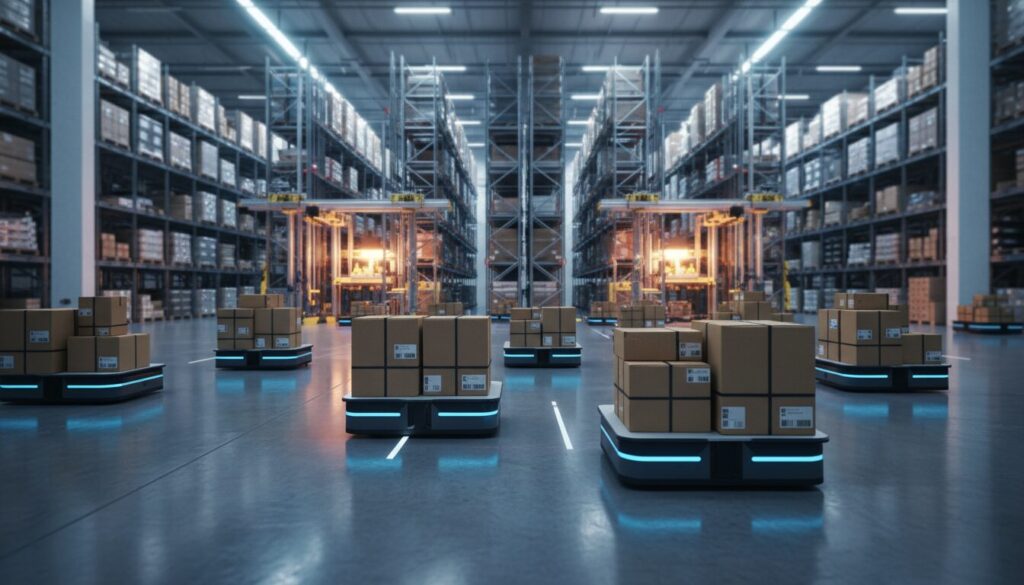
The logistics industry is currently witnessing a dangerous trend. I call it “The Shiny Toy Syndrome.”
Warehouse managers, under immense pressure to modernize, rush to acquire the latest Autonomous Mobile Robots (AMRs) or Automated Storage and Retrieval Systems (AS/RS). They implement the technology, celebrate the “Go-Live,” and then face a harsh reality: Customer complaints do not decrease.
Why? Because they automated their problems instead of their solutions.
They focused on internal efficiency (walking distance, fuel costs) rather than external effectiveness (order accuracy, delivery speed, packaging quality).
To truly transform your operations, you must reverse your thinking. You need to adopt The Customer-Centered Path to Warehouse Automation. This approach does not start with “What robot can we buy?” It starts with “What promise did we make to the customer?”
In this guide, I will walk you through a practical, 5-step methodology to implement this strategy, ensuring that every piece of hardware you install directly contributes to customer retention and growth.
As discussed in our previous article, Automation — A Strategic Growth Enabler: 5 Steps to Scale, moving from firefighting to strategic growth requires a shift in mindset. This guide provides the tactical roadmap for that shift.
The Disconnect: Why Tech-First Failures Happen
Before we dive into the solution, we must understand the pain points of the traditional “Tech-First” approach. Many warehouses implement automation in silos. For example, a company might automate picking to increase speed but fails to automate packing. The result? A massive bottleneck at the packing station, leading to missed shipping cut-offs despite faster picking.
This creates a chaotic environment where metrics look good on paper (e.g., “Picking Productivity +30%”), but the customer experience remains poor (e.g., “Late Delivery”).
Common Pain Points (Tech-First Approach)
- Siloed Efficiency: One department speeds up, choking the next downstream process.
- Rigidity: Fixed infrastructure (conveyors) cannot adapt to changing customer order profiles.
- ROI Mismatch: High capital expenditure does not translate to higher customer lifetime value.
- Integration Nightmares: New robots don’t “talk” to the legacy WMS, leading to manual data entry workarounds.
The Solution: The Customer-Centered Path to Warehouse Automation
The solution is to design your warehouse workflows backward, starting from the customer’s doorstep. The Customer-Centered Path to Warehouse Automation creates a direct line of sight between the robotic arm in your facility and the smile on your customer’s face.
This methodology prioritizes Service Level Agreements (SLAs) over raw throughput. It asks: “What technology allows us to extend the order cut-off time by one hour?” rather than “What technology moves the most boxes?”
By aligning automation with customer expectations, you achieve what we call “Zero-Touch Fulfillment”—where the system is so reliable that human intervention is only needed for exceptions.
See also: Master Zero-Touch Automation with Locus Array: 5 Steps
Process: Implementing the Path in 5 Steps
Below is the step-by-step framework for implementing this customer-centric methodology.
Step 1: Map the “Customer Promise” to Operational Metrics
Do not buy a single sensor until you have defined exactly what your customer values most. Is it speed? Is it perfect accuracy? Is it sustainable packaging?
You must translate vague marketing promises into hard operational numbers.
| Customer Value | The “Marketing Promise” | The Operational Hard Metric |
|---|---|---|
| Speed | “Order by 10 PM, get it tomorrow.” | Cut-off time extended from 6 PM to 10 PM. |
| Accuracy | “Always the right item.” | Picking Error Rate < 0.01%. |
| Flexibility | “Add to order before it ships.” | Order modification window open until 30 mins pre-dispatch. |
| Sustainability | “Eco-friendly shipping.” | Cartonization accuracy (minimized air in boxes). |
Step 2: Identify the “Value Gap”
Analyze your current manual or semi-automated processes. Where do they fail the metrics defined in Step 1?
If your goal is to extend cut-off times, but your manual pickers walk 15km a day, the “Value Gap” is Travel Time.
If your goal is 100% accuracy, but your return rate is 5% due to mis-picks, the “Value Gap” is Verification.
- Action Item: Conduct a “Gap Analysis” audit. Track an order from receipt to dispatch and flag every instance where the process jeopardizes the Customer Promise.
Step 3: Select Technology Based on the Gap (Not the Hype)
Now that you know the gap, select the specific automation technology that bridges it. This is where the “Customer-Centered” aspect shines. You avoid over-engineering.
Scenario A: The Speed Gap
If your customers demand speed and you handle high-velocity items, walking is the enemy.
- Solution: Goods-to-Person (GTP) systems or Autonomous Mobile Robots (AMRs).
- Case Reference: As noted in Master Zero-Touch Automation with Locus Array: 5 Steps, using AMRs for sorting and transport allows you to process orders faster without changing your infrastructure significantly.
Scenario B: The Accuracy Gap (The Picking Paradox)
If your inventory is complex (thousands of SKUs) and accuracy is paramount, manual picking is risky.
- Solution: Robotic Picking Cells with computer vision.
- Case Reference: In our analysis of How to Scale Picking: The Nowaste & Cognibotics Method, we explored how combining industrial robotics with smart vision systems solves the “Picking Paradox”—balancing speed with handling delicate or complex items.
Scenario C: The Budget/Flexibility Gap
If your customers are volatile (seasonal spikes) and you cannot afford a massive CapEx upfront, traditional automation is a risk.
- Solution: Robotics as a Service (RaaS).
- Case Reference: Democratizing Automation: NEOintralogistics RaaS Case Study highlights how smaller warehouses can implement high-end automation with low entry barriers, ensuring they can scale up during peak seasons to keep customer promises without going bankrupt.
Step 4: Integrate and Synchronize
The fourth step is crucial: Integration. The Customer-Centered Path dictates that data must flow as smoothly as the physical goods.
If you install an AutoStore system (like the one discussed in Boozt & Cognibotics: Advanced AutoStore Automation), it must be fully integrated with your WMS to prioritize orders based on customer urgency, not just bin location.
Key Integration Checkpoints:
- Real-Time Inventory Sync: Prevent selling items that are damaged or missing.
- Dynamic Prioritization: The system should automatically reshuffle pick queues if a customer pays for express shipping at the last minute.
- Carrier Integration: Label generation should happen instantly at the packing station to prevent bottlenecks.
Step 5: The Feedback Loop (Continuous Optimization)
Automation is not a “set it and forget it” project. It is a living ecosystem.
You must establish a feedback loop where customer service data informs warehouse parameters.
- Complaint: “My potato chips arrived crushed.”
- Warehouse Action: Adjust the robotic packing force parameters or change the slotting logic to ensure heavy items aren’t picked after fragile ones.
This step closes the loop, ensuring your warehouse remains customer-centered permanently.
Results: What to Expect
When you follow The Customer-Centered Path to Warehouse Automation, the results go beyond simple cost savings. You transform your logistics from a cost center into a competitive advantage.
Here is a comparison of a typical “Tech-First” warehouse versus a “Customer-Centered” warehouse after 12 months.
| Metric | Tech-First Approach (Old Way) | Customer-Centered Path (New Way) |
|---|---|---|
| Primary Goal | Maximize machine utilization. | Maximize perfect order rate. |
| Picking Errors | Reduced, but packing errors remain. | Near Zero (Holistic validation). |
| Order Cut-Off | Static (e.g., 5:00 PM). | Dynamic (Extended to 10:00 PM). |
| Scalability | Hard limits based on hardware. | Elastic (Via RaaS and modularity). |
| Customer Impact | Invisible to the customer. | Tangible (Faster, reliable, customized). |
| ROI Timeline | 3-5 Years (Hard Cost savings only). | 18-24 Months (Includes retention/growth). |
Real-World Success Indicators
- Reduction in Returns: By solving the root cause of picking errors through vision-based automation (like Cognibotics), returns due to “wrong item sent” often drop by 90%.
- Peak Season Stability: Using scalable solutions allows you to handle Black Friday volumes without the chaos that usually degrades customer trust.
Summary: Keys to Success
The era of automating for the sake of innovation is over. In a hyper-competitive logistics landscape, The Customer-Centered Path to Warehouse Automation is the only sustainable strategy.
To succeed, remember these three keys:
- Define the Promise First: Never buy hardware until you know exactly how it improves the customer’s life.
- Solve the Bottleneck, Not the Symptom: Use data to find where your promise is being broken (Pick? Pack? Sort?).
- Democratize Your Tech: Don’t fear advanced robotics because of cost. Models like RaaS make high-end tech accessible, as seen with NEOintralogistics.
By aligning your steel and silicon with the needs of your customers, you don’t just build a smarter warehouse; you build a loyal customer base.
Start mapping your path today.
Recommended Reading: