The conversation surrounding Artificial Intelligence has largely been dominated by Generative AI—chatbots, code generation, and image synthesis. However, a significant pivot is underway in the industrial sector. The expansion of the partnership between Deloitte and Nvidia signals the aggressive maturation of “Physical AI”—where algorithms leave the screen and start moving physical objects.
For supply chain executives, this is the transition point where digital experiments turn into operational necessities. With Physical AI adoption projected to jump from 58% to 80% of enterprises within just two years, the era of “pilot purgatory” in robotics and automation is effectively ending. This analysis explores why this partnership matters, the specific technologies involved, and the implications for the logistics landscape.
The Shift from Digital to Physical
The core of the announcement is not just about two giants working together; it is about the specific application of technology to solve the “Sim-to-Real” gap. Historically, robots worked well in simulations but struggled with the chaotic variables of a real warehouse or factory floor.
Deloitte and Nvidia are combining deep industry consulting with the Nvidia Omniverse platform to create accurate digital twins. These virtual environments allow robots to learn tasks thousands of times in simulation before ever attempting them in the physical world.
Key Facts: The Deloitte-Nvidia Expansion
To understand the scope of this development, we must look at the specific components of the collaboration.
| Component | Description | Relevance to Logistics |
|---|---|---|
| Nvidia Omniverse | A platform for developing OpenUSD-based 3D workflows and digital twins. | Allows warehouses to simulate layout changes and robot flows virtually before physical implementation. |
| Isaac Sim | A reference application for designing and testing AI-based robots. | Accelerates the training of AGVs and arms, reducing deployment time from months to weeks. |
| Jetson Thor | An advanced computing platform designed for humanoid robots and complex edge AI. | Provides the “brain” for mobile robots that need to process data locally without latency. |
| Expansion Hubs | New Centers of Excellence, including a specific Industrial AI hub in Shanghai. | Indicates a global rollout strategy rather than a localized US experiment. |
A tangible example of this partnership’s efficacy is the deployment at Horse Powertrain in Spain. There, the collaboration successfully implemented AI solutions for anomaly detection and equipment fault prediction on the production line. This moves beyond theoretical ROI to proven operational uptime.
Industry Impact: The Logistics Ecosystem
The ripple effects of scaling Physical AI will be felt across three primary verticals: Warehousing, Manufacturing, and Carrier Operations.
1. The Warehouse: From Automation to Orchestration
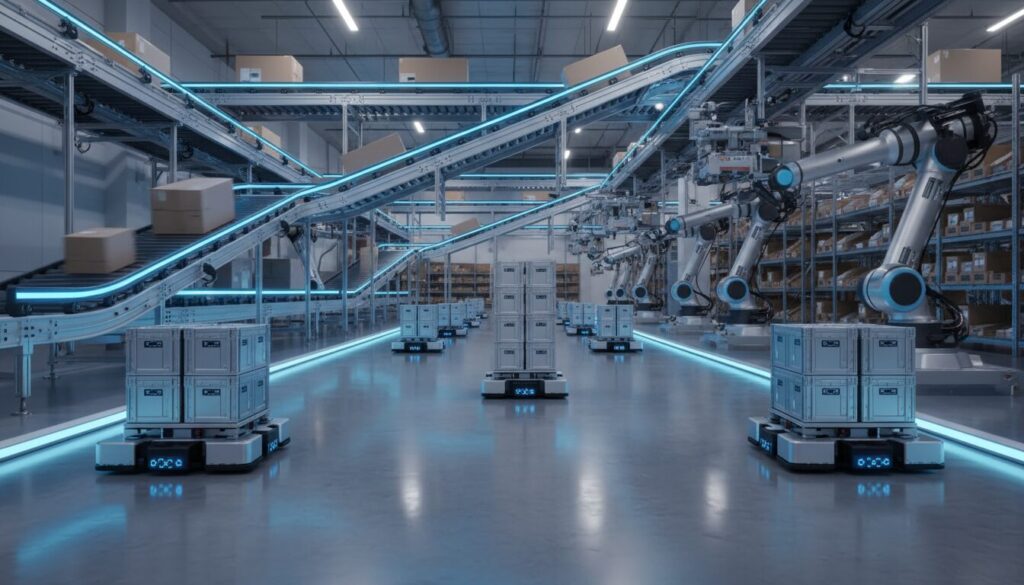
Traditional automation (conveyors, standard AGVs) is rigid. Physical AI introduces adaptability. By utilizing the Nvidia Isaac platform, warehouse operators can deploy robots that understand their environment rather than just following magnetic tape.
- Digital Twins as Operational Standards: Managers will no longer guess if a new racking layout will improve throughput. They will simulate it in Omniverse using real operational data.
- Dynamic Orchestration: Instead of isolated silos of automation, Physical AI allows for a unified “nervous system” where forklifts, arms, and conveyors adjust in real-time to bottlenecks.
2. Manufacturing and Shippers: The Flexible Factory
For shippers, particularly in manufacturing, the integration of Physical AI means production lines that can reconfigure themselves.
- Predictive Maintenance 2.0: As seen with Horse Powertrain, the focus shifts from “fixing it fast” to “fixing it before it breaks.” This drastically reduces supply chain disruptions caused by production halts.
-
Human-Robot Collaboration: This partnership paves the way for safe interaction between humans and machines.
See also: BMW Physical AI: Humanoids Enter German Production
3. Validation of the “Sim-to-Real” Model
The biggest barrier to adopting autonomous systems has been the risk of failure during deployment. If a robot drops a pallet in a simulation, you reset the code. If it drops a pallet in a warehouse, you lose inventory and risk safety.
The Deloitte-Nvidia alliance creates a validated pipeline where the simulation is so physically accurate (physics-compliant) that the transfer to reality is seamless. This de-risks investment for CFOs.
LogiShift View: The “So What?” for Executives
While the press release focuses on the partnership, the underlying trend is more critical: The commoditization of advanced robotics software.
The End of Proprietary Moats
Previously, building a “smart” warehouse required proprietary software from hardware vendors, locking companies into specific ecosystems. Nvidia’s platform approach (Isaac Sim, Omniverse) combined with Deloitte’s integration services suggests a future where software is hardware-agnostic. You might run robots from different manufacturers on a single AI brain.
This aligns with broader industry trends where software abstraction is becoming key to scalability.
See also: Intrinsic Joins Google: The Physical AI Shift in Logistics
Data Infrastructure is the New Concrete
Physical AI requires massive amounts of data to function—video feeds, sensor telemetry, and historical WMS data. The bottleneck for most logistics companies will not be buying the robots; it will be having the data infrastructure to feed them.
This move by Deloitte validates the need for “Edge AI”—processing data on the device (robot or camera) rather than sending it all to the cloud. This is essential for the split-second decision-making required in autonomous systems, similar to the technology powering the next generation of autonomous trucks.
See also: Wayve Case Study: $1.2B Shift to Mapless Autonomous Driving
Strategic Takeaway
The scaling of Physical AI is not a 10-year horizon event; it is a 24-month implementation cycle. Companies that treat digital twins and edge AI as “science projects” risk falling behind competitors who use them to drive down cost-per-unit metrics.
Actionable Steps for Logistics Leaders:
- Audit Your Data: Before buying robots, ensure your operational data (WMS/ERP) is clean and accessible. Physical AI cannot learn from chaotic data.
- Start with Simulation: Use digital twin technology to audit your current facility’s efficiency. You do not need a robot to benefit from Physical AI software; simulation alone can reveal 10-20% efficiency gains.
- Evaluate Edge Readiness: Assess if your facility has the network bandwidth (5G/Wi-Fi 6) and edge computing capabilities to support autonomous decisions on the floor.
The Deloitte and Nvidia expansion confirms that the industry is moving from “automating tasks” to “automating intelligence.” The winners will be those who can bridge the gap between the digital plan and the physical reality.