
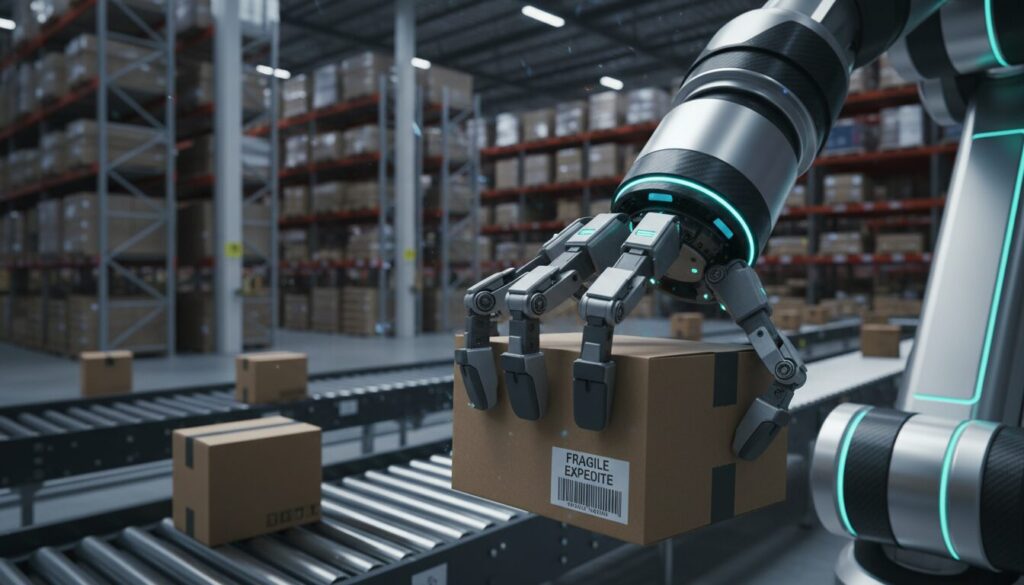
The era of rigid, single-task automation is rapidly ending. For decades, the logistics and manufacturing sectors relied on “hard automation”—robots designed to do one thing, at high speed, for millions of cycles. However, the post-pandemic market has shifted decisively toward High-Mix, Low-Volume (HMLV) production. Consumers demand customization, and supply chains require resilience against disruption.
In this landscape, the bottleneck is no longer the robot arm itself, but the “end-effector”—the hand that grasps the object.
A significant breakthrough has emerged from the partnership between Techman Robot, a leader in collaborative robots (cobots) with integrated vision, and Tesollo, a pioneer in robotic dexterity. Their recently unveiled adaptive gripper solution represents a paradigm shift for global logistics managers and strategy executives. By combining the safety and ease of Techman’s cobots with Tesollo’s 12-degree-of-freedom grippers, this solution addresses one of the industry’s most expensive inefficiencies: the changeover time.
This article explores why this technological convergence matters, analyzes the global trend toward adaptive automation, and dissects the specific case study of the Techman-Tesollo alliance to offer actionable insights for supply chain leaders.
Why It Matters: The “Batch of One” Challenge
In the global logistics context, the “Batch of One” refers to the ultimate goal of manufacturing and fulfillment: the ability to process a single unique item as efficiently as a batch of one thousand.
Traditionally, handling irregular or heterogeneous parts required complex tooling. Engineers had to design specific “jigs” (fixtures) and grippers for every different part shape. If a production line needed to switch from assembling rectangular battery packs to cylindrical motors, the line had to stop. Technicians would manually swap out the grippers and reprogram the robot coordinates.
The Cost of Rigidity
This downtime is the enemy of modern logistics. In a Just-in-Time (JIT) environment, 30 minutes of downtime for a tool change can ripple into hours of delay downstream.
- Inventory Costs: Facilities hold excess stock to buffer against changeover times.
- Labor Dependency: Manual jig changes require skilled labor, which is increasingly scarce in developed markets like the US and Japan.
- Space Inefficiency: Storing hundreds of custom grippers consumes valuable warehouse real estate.
The Techman and Tesollo partnership directly targets these inefficiencies. By utilizing a “shape-adaptive” gripper, a single robot station can handle a chaotic mix of inventory—from delicate electronics to heavy automotive castings—without stopping.
See also: Watch: The ROI of Automating Brownfield Facilities Unlocked
Global Trend: The Rise of Adaptive Manipulation
The shift toward adaptive manipulation is not isolated to one region; it is a global phenomenon driven by distinct regional pressures in the US, Europe, and Asia.
United States: Reshoring and Warehousing
In the United States, the “Reshoring” initiative is driving manufacturers to bring production back from overseas. However, US labor costs are high. To compete, factories must be highly automated yet flexible enough to handle shorter product life cycles. Furthermore, the explosion of e-commerce has made “bin picking” (grabbing random items from a bin) a holy grail for logistics giants like Amazon and FedEx. Adaptive grippers are essential here, as the variety of SKUs (Stock Keeping Units) is infinite.
Europe: Industry 5.0 and Human-Centricity
Europe is transitioning from Industry 4.0 to Industry 5.0, which prioritizes human-robot collaboration. The European market favors cobots (like Techman’s TM series) that can work safely alongside humans. The focus here is on ergonomics—having robots take over the repetitive, strain-inducing task of grasping heavy or awkward objects, allowing humans to focus on quality control.
Asia: Upgrading the “Factory of the World”
China and Southeast Asia are moving up the value chain. The electronics sector, in particular, deals with components of wildly varying shapes and fragility. The trend here is automating the “kitting” process—gathering all parts required for a final assembly into a single tray. This requires a gripper that can pick up a heavy housing and then immediately pick up a tiny PCB without crushing it.
Comparison: Traditional vs. Adaptive Grippers
To understand the magnitude of this shift, we must compare the prevailing technology with the new adaptive solution.
| Feature | Traditional Parallel Gripper | Adaptive Multi-Jointed Gripper (Tesollo/Techman) |
|---|---|---|
| Mechanism | 2 rigid fingers (Open/Close) | 3 fingers, multiple joints (Human-like) |
| Flexibility | Low (Requires custom fingertips) | High (Molds to object shape) |
| Changeover | Manual swap required for new shapes | Instant (Software-driven) |
| Payload | Fixed capacity | Dynamic (e.g., 5kg Pinch vs. 15kg Envelop) |
| Main Use Case | Mass Production (High Volume, Low Mix) | HMLV, Bin Picking, Kitting |
| Software | Simple coordinate logic | Advanced grasping algorithms |
Case Study: Techman Robot x Tesollo
The core of this innovation lies in the integration of Techman Robot’s TM Series cobots with Tesollo’s DG-3F-M gripper. This is not merely a hardware compatibility update; it is a strategic solution for the High-Mix Low-Volume (HMLV) sector.
The Technology Stack
1. The Arm: Techman Robot (TM5S, TM12, TM14, TM16)
Techman, a Taiwan-based leader, is distinct for its built-in vision system. Unlike other cobots that require third-party cameras, the TM series can “see” the workspace out of the box. This vision capability is critical for identifying the orientation of irregular parts before the gripper attempts to grab them.
2. The Hand: Tesollo DG-3F-M
Tesollo, a South Korean robotics innovator, developed the DG-3F-M as a direct answer to the limitations of rigid grippers.
- Structure: It features three fingers with 12 degrees of freedom. This allows it to manipulate objects much like a human hand.
- Grasping Modes:
- Pinching Mode: Uses fingertips for precision (up to 5kg). Ideal for small electronics or thin plates.
- Enveloping Mode: Wraps all fingers around the object for stability (up to 15kg). Ideal for heavy cylinders, bottles, or irregular castings.
- Direct Control: The system supports “Direct Teaching,” allowing operators to manually pose the gripper fingers around an object to “teach” the robot how to hold it, drastically reducing programming time.
Real-World Application: Automotive “One-Kit” Assembly
A primary target for this solution is the automotive “One-Kit” process.
The Challenge: In modern car manufacturing, parts for a specific vehicle (e.g., a door handle, a window switch, and a speaker grill) are often collected into a “kit” box before being sent to the assembly line. These parts have vastly different geometries, materials, and weights.
The Old Way: A human worker walks the aisles, picking parts. Or, multiple robots with different grippers are used, consuming massive floor space and capital.
The Techman x Tesollo Way:
A single TM12 cobot mounted on an AMR (Autonomous Mobile Robot) or a fixed station uses the DG-3F-M gripper.
- Vision Scan: The TM cobot’s camera identifies the door handle in a bin.
- Adaptive Grasp: The Tesollo gripper approaches. Because the handle is curved, the gripper activates “Enveloping Mode,” wrapping its fingers around the curve to secure a 2kg payload.
- Placement: The part is placed in the kit.
- Mode Switch: The next item is a small fuse box. The gripper switches to “Pinching Mode” without any hardware change, picking up the small square object precisely.
This eliminates the need for tool changers and reduces the cycle time between different picks to zero.
Safety and Compliance
Deploying such powerful grippers in a collaborative environment requires strict adherence to safety standards. The combined solution creates a workspace where humans can interact with the robot to replenish bins without safety cages, provided the correct risk assessments are in place.
See also: A3 R15.06-2025: Critical Alert for Robot Safety
Key Takeaways for Logistics Leaders
For strategy executives evaluating this technology, the Techman and Tesollo partnership offers three critical lessons for modernizing supply chains.
1. Decouple Hardware from Product Design
Stop building production lines that break whenever the product design changes. By investing in adaptive grippers, you decouple the automation hardware from the specific geometry of the SKU. This future-proofs the facility against market volatility and rapid product iteration.
2. Brownfield Optimization
You do not need to build a new “Dark Factory” to see ROI. This solution is specifically designed for retrofitting existing facilities (Brownfields). Replacing a standard industrial arm with a cobot-plus-adaptive-gripper setup can modernize a manual picking station with minimal infrastructure changes.
3. The End of the “Jig Economy”
The hidden costs of manufacturing—designing, machining, storing, and maintaining jigs—are often overlooked in CapEx calculations. By eliminating jigs for 80% of part variations, the OpEx savings over 2-3 years can exceed the initial cost of the robot system.
Future Outlook: The Era of Physical AI
The collaboration between Techman and Tesollo is a precursor to a larger trend: the integration of Physical AI into logistics.
While the current solution relies on advanced mechanics and vision, the next generation will integrate tactile sensing and AI-driven grasp planning. We are moving toward systems where the robot looks at an object it has never seen before, understands its physics (weight, friction, fragility), and autonomously decides the best way to pick it up using a multi-fingered hand.
Companies like Google (via Intrinsic) are already building the software layer to make this hardware even more intelligent, democratizing access to advanced manipulation for smaller logistics players.
See also: Intrinsic Joins Google: The Physical AI Shift in Logistics
The Techman-Tesollo solution is available now, and for HMLV manufacturers, it represents the bridge between the rigid past and the fluid, adaptive future of global supply chains.

」、25年調達額が1億ドル超え。物流コスト半減、170都市で2000台稼働_hero-300x171.jpg)