
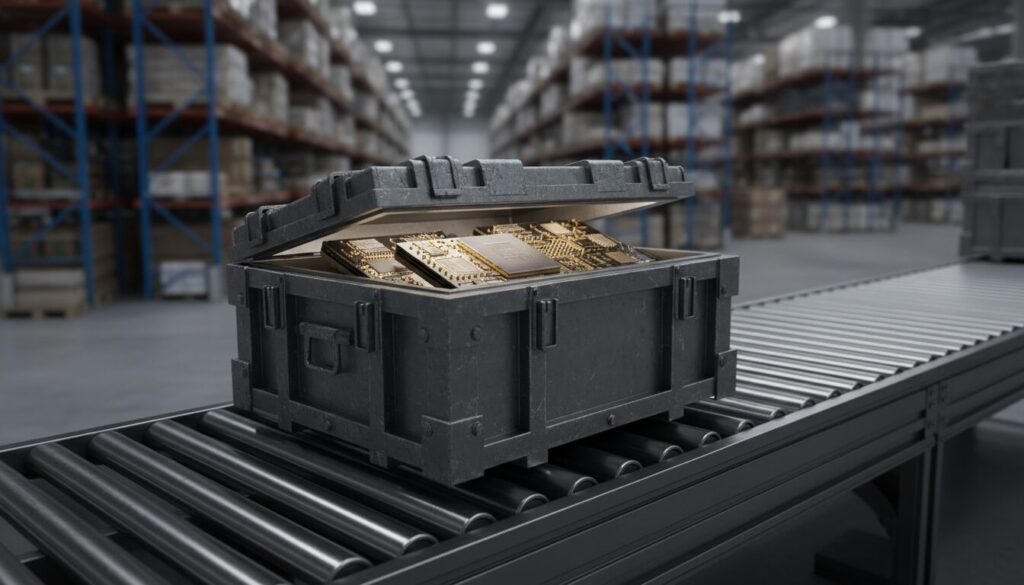
The era of frictionless global technology trade is ending. The US is reportedly considering sweeping new chip export controls, a move that fundamentally shifts the regulatory landscape from targeted sanctions to universal oversight.
For innovation leaders and logistics strategists, this represents a pivotal change. The Trump administration is drafting rules that would require U.S. government approval for AI chip exports to any destination worldwide, not just geopolitical rivals like China. This broad oversight aims to secure the American tech stack but introduces unprecedented procurement friction that threatens to drive global buyers toward non-U.S. suppliers.
Why It Matters: The End of “Permissionless Innovation”
Historically, U.S. export controls were negative lists: you could ship anywhere except to specific embargoed entities. The emerging doctrine flips this logic. The default answer for high-performance AI silicon is becoming “No,” pending a specific license approval.
This shift expands the regulatory perimeter from the “China containment” strategy to a global “American Approval” system. The U.S. Department of Commerce is moving to become the de facto gatekeeper of global AI development.
The Logistics of Bureaucracy
For supply chain executives, regulatory compliance is no longer a checklist item—it is a critical bottleneck. The proposed rules suggest that review intensity will scale with order size. Large purchases of GPUs (Graphics Processing Units) by data centers in neutral regions—such as the Middle East, Southeast Asia, or even Europe—may now require foreign government involvement and U.S. validation.
As we observed in recent trade policy shifts, protectionism creates immediate logistical drag.
See also: Trump Boosts Tariff to 15%: Global Logistics Case Study
Global Trend: The Friction of “Universal Oversight”
The global semiconductor landscape is bifurcating. While the U.S. attempts to lock down its intellectual property (IP), other nations are accelerating their own decoupling strategies.
1. The United States: From Targeted Bans to Global Nets
The Trump administration’s proposal represents significantly more direct government intervention than previous measures, including the rescinded Biden-era AI Diffusion rule. The goal is to prevent “transshipment”—where a chip is sold to a compliant country (e.g., Singapore or UAE) and then re-exported to China.
However, the mechanism for this is a blanket requirement for export licenses. This creates a “guilty until proven innocent” environment for international logistics.
2. China: Accelerating Substitution
China is responding by aggressively replacing U.S. tech in its supply chain. With the U.S. becoming an unreliable supplier due to regulatory volatility, Chinese firms are pivoting to domestic alternatives like Huawei’s Ascend series.
See also: China Bans Dual-Use Item Exports to Japan: Global Impact
3. Europe and Asia: Collateral Damage
Allies are caught in the crossfire. A German automotive AI lab or a Japanese data center must now account for prolonged lead times, not due to manufacturing shortages, but due to Washington’s licensing queues.
Comparison: Old vs. New Export Control Paradigms
| Feature | Biden-Era “Small Yard, High Fence” | Proposed Trump-Era “Global Oversight” |
|---|---|---|
| Scope | Targeted specifically at China and entity-list firms. | Universal application to all non-US destinations. |
| Trigger | Specific high-end chip thresholds (e.g., A100/H100). | Order size and destination; intense review for bulk orders. |
| Logistics Impact | Friction primarily on China routes. | Global procurement delays; added compliance layers everywhere. |
| Govt Role | Monitor and sanction violators. | Direct approval required for major shipments; Gov-to-Gov talks. |
Case Study: Nvidia’s “Compliance Cliff”
The impact of these looming controls is best illustrated by Nvidia, the primary target of these regulations, and its struggle to maintain market dominance amidst regulatory chaos.
The Challenge: Uncertainty as a Deterrent
Nvidia has traditionally dominated the Chinese AI training market. However, following successive waves of restrictions, Nvidia created downgraded chips (like the H20) specifically to comply with U.S. export rules for China.
Under the new “sweeping controls” proposal, even these compliant chips face an uncertain future. Nvidia has reported that Chinese customers are not returning. The reason is not performance, but supply chain resilience. Chinese tech giants (Alibaba, Tencent, Baidu) cannot build long-term strategies on hardware that might be banned by a new executive order next week.
The Logistics Fallout
This uncertainty creates a ripple effect throughout the global supply chain:
- Inventory stagnation: Distributors hold stock of “compliant” chips that suddenly have no buyers because the buyers have moved to stable, non-US sources (like Huawei).
- Verification Bottlenecks: For shipments to “grey zone” countries (e.g., Vietnam or Saudi Arabia), logistics providers must now perform deep-tier “Know Your Customer” (KYC) checks to ensure the chips won’t be re-exported. This adds weeks to lead times.
- Hardware Shortages: As global buyers rush to secure stock before rules are finalized, we see demand spikes similar to the memory sector crisis.
See also: AI-Driven Memory Shortage: Global Supply Chain Case Study
The Outcome: Shifts to Non-US Stacks
The “Global Oversight” rule risks achieving the opposite of its intent. By making American chips difficult to buy, the U.S. is incentivizing the creation of non-American tech stacks. Huawei’s Ascend 910B is gaining traction not because it is faster than Nvidia’s best, but because it is available.
Key Takeaways for Logistics & Strategy Leaders
The era of simply ordering a component and shipping it is over for high-tech goods. Supply chain strategies must adapt to a world where geopolitics dictates lead times.
1. Compliance is the New Capacity
In the past, logistics constraints were physical (shipping containers, raw materials). Now, the constraint is legal. Companies must integrate legal trade compliance directly into their procurement software. If you cannot trace the end-user of your high-tech export, you cannot ship it.
2. Diversify the “Tech Stack”
Reliance on a single source of high-tech components (specifically U.S. silicon) is now a high-risk strategy for non-US entities. Innovation leaders must evaluate “sovereign” alternatives or open-source hardware (RISC-V) to immunize their supply chains against Washington’s policy shifts.
3. The “First Mile” Vulnerability
While we focus on the high-end chips, remember that the raw materials for these chips are also subject to retaliation. As the U.S. tightens chip exports, expect China to tighten critical mineral exports, creating a vicious cycle.
See also: Podcast: Raw Materials & Supply Chain Break
Future Outlook: A Bifurcated Digital World
The proposal for the US reportedly considering sweeping new chip export controls signals a long-term trend: the weaponization of supply chains is becoming institutionalized.
We expect the Department of Commerce to eventually require “Digital Passports” for high-end chips—blockchain-enabled tracking that ensures a GPU sold to a French bank doesn’t end up in a Russian drone. For logistics providers, this means building secure, traceable chains of custody will be a premium service offering.
Can governments actually manage this level of complexity without crashing the market? That remains the trillion-dollar question.
See also: Can Govts Fix Critical Material Supply? A Global Trend
Action Plan: Review your exposure to U.S. export control lists immediately. If your innovation roadmap relies on Nvidia or AMD hardware, ensure you have a “regulatory buffer” in your inventory planning. The walls are going up; make sure you are on the right side of them.