
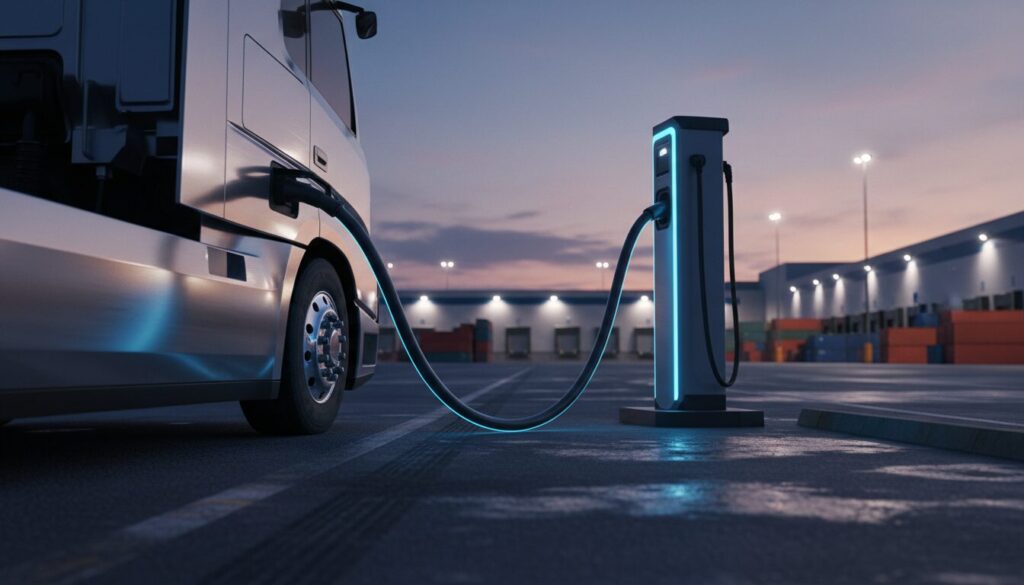
The logistics industry stands on the precipice of a new era in fleet electrification. For years, the “range anxiety” narrative has shifted toward “charging anxiety”—the operational downtime required to keep electric heavy goods vehicles (HGVs) and last-mile vans moving.
BYD rolls out EV batteries with 5-minute ‘flash charging’ — but there’s a catch. This headline is currently dominating automotive tech circles, but its implications extend far beyond consumer sedans. For global supply chain executives, this development signals a fundamental shift in fleet management strategy, warehouse energy infrastructure, and the geopolitical flow of critical components.
Why It Matters: The Downtime Dilemma
In the high-stakes world of global logistics, asset utilization is the primary KPI. An electric truck sitting at a charger for two hours is an asset that is bleeding money. While internal combustion engine (ICE) vehicles take minutes to refuel, EVs have historically required lengthy pauses that disrupt Just-In-Time (JIT) delivery windows.
The introduction of BYD’s Blade Battery 2.0 changes this calculus. By enabling a 10% to 70% charge in just 5 minutes, the refueling operational model of EVs effectively reaches parity with diesel. However, this technological leap brings significant infrastructure challenges—the “catch” mentioned in industry whispers—requiring a massive rethink of how logistics hubs consume energy.
This is not just a battery update; it is a signal that the operational cost floor for logistics fleets is about to drop, provided companies can navigate the infrastructure hurdles.
Global Trend: The Race for Ultra-Fast Energy
The push for ultra-fast charging is playing out differently across the three major economic powerhouses. We are witnessing a divergence in strategy driven by policy, grid capability, and raw material access.
China: Aggressive Integration
China is currently the undisputed leader in this space. The government’s strategy focuses on vertical integration. It is not enough to build the battery; you must build the grid to support it.
- Infrastructure: The rollout of 1.5 megawatt (MW) chargers is being treated as a public utility project.
- Adoption: Logistics providers in China are rapidly switching to LFP (Lithium Iron Phosphate) fleets due to the low cost, supported by the state-backed expansion of high-power grid nodes.
United States: The Protectionist Pivot
In the US, the Inflation Reduction Act (IRA) is driving domestic battery production, but there is a lag in high-speed charging infrastructure.
- Grid Lag: While Tesla’s Supercharger network is the gold standard, it largely tops out at 250kW. The 1.5MW required for “flash charging” is virtually non-existent outside of experimental trucking corridors.
- Chemistry Conflict: The US market still relies heavily on NMC (Nickel Manganese Cobalt) batteries for range, which are more expensive and prone to thermal issues at high charge speeds compared to the new LFP tech.
Europe: The Sustainability Paradox
Europe is enforcing strict sustainability mandates (e.g., the Battery Passport), but its grid infrastructure is aging.
- The Bottleneck: While European logistics firms are eager to decarbonize to meet ESG goals, finding real estate capable of supporting MW-scale charging is difficult.
- The Catch: The “catch” of flash charging is most acute here. A single 1.5MW charger draws as much power as a large office building. Installing a bank of these at a distribution center in Frankfurt or London requires grid upgrades that can take years to permit.
Comparative Analysis of Battery Chemistries
The shift toward LFP, as championed by BYD, is crucial for logistics due to cost and safety.
| Feature | LFP (Lithium Iron Phosphate) | NMC (Nickel Manganese Cobalt) | Logistics Implication |
|---|---|---|---|
| Cost per kWh | ~$81 | ~$128 | LFP offers significantly lower CapEx for large fleets. |
| Thermal Stability | High (Very Safe) | Moderate | LFP is safer for warehouse charging; less fire risk. |
| Cycle Life | 3,000+ Cycles | 1,000 – 2,000 Cycles | LFP vehicles last longer, improving resale value. |
| Cold Weather | Historically Poor (Now Improved) | Good | New tech allows LFP to handle -20°C effectively. |
| Energy Density | Lower | Higher | NMC is better for long-haul; LFP dominates urban/regional. |
Case Study: BYD Blade Battery 2.0
The specifics of BYD’s recent innovation provide a roadmap for where the industry is heading. This is not theoretical; the hardware is rolling out now.
The Innovation
BYD, originally a battery manufacturer that evolved into the world’s largest EV maker, has launched the Blade Battery 2.0.
- Speed: It supports 6C charging rates. In practical terms, this allows a charge from 10% to 70% in 5 minutes, and near 100% in under 9 minutes.
- Power: This is achieved using “Flash Charging” stations that deliver up to 1.5 megawatts of power.
- Chemistry: It utilizes LFP chemistry, which has traditionally been considered “low tech” compared to NMC, but BYD has engineered around the density limitations.
Solving the Cold Chain Crisis
One of the most persistent complaints from logistics managers in Northern Europe and North America is battery failure in winter. LFP batteries historically lose significant range in freezing temps.
- The Breakthrough: The Blade 2.0 claims to charge from 20% to 97% in under 12 minutes even at -20°C.
- Impact: For cold-chain logistics and northern delivery routes, this removes the need for heated garaging or idling, reducing operational overhead.
The “Catch”: Infrastructure Intensity
BYD has announced plans to deploy 16,000 Flash Charging stations across China by the end of 2026. This highlights the catch: The battery is useless without the charger.
- To achieve a 5-minute charge, the current amperage is immense.
- Existing “Fast” chargers (150kW – 350kW) will charge this battery at normal speeds, negating the 5-minute advantage.
- Logistics companies wanting to leverage this speed must invest in private 1.5MW micro-grids or wait for public infrastructure to catch up.
Key Takeaways for Logistics Leaders
For Strategy Executives and Innovation Leaders, the rise of 5-minute charging presents specific actionable insights.
1. Fleet TCO Calculation Re-alignment
The cost of LFP batteries ($81/kWh) is approaching the “magic number” where EVs are cheaper upfront than diesel trucks, even before fuel savings.
- Action: Re-evaluate fleet procurement models for 2025-2027. Shift focus from “range” to “charge speed.” A truck with a smaller (cheaper) battery that charges in 5 minutes is more valuable than a truck with a massive battery that takes 2 hours to charge.
2. The Rise of “Energy Logistics” Real Estate
Warehouse location selection criteria must change. Proximity to highways and labor is no longer enough; proximity to high-voltage substations is now critical.
- Action: When scouting new distribution centers (DCs), prioritize sites with available grid capacity of 5MW+ to support future flash-charging fleets.
3. Supply Chain Resilience
The reliance on Chinese battery tech (BYD and CATL control the LFP market) creates geopolitical risk for US/EU companies due to tariffs.
- Action: Diversify supplier contracts. While BYD leads now, monitor how Western OEMs (like Tesla or VW) respond with their own solid-state or fast-LFP solutions to avoid tariff-induced cost spikes.
4. Cold Chain Viability
The specific improvement in cold-weather charging unlocks EV adoption for routes previously deemed “diesel only.”
- Action: Pilot EV fleets in northern regions (Scandinavia, Canada, US Midwest) using next-gen LFP packs to test winter reliability.
Future Outlook
The launch of the Blade Battery 2.0 is the starting gun for the “Speed War” in EV logistics.
Short Term (1-3 Years)
We will see a bifurcation in the market. China will rapidly adopt flash charging due to state infrastructure support. The US and Europe will lag, utilizing the battery technology but charging it at slower speeds (15-20 minutes) due to grid constraints. The cost of logistics in China may drop faster than in the West as a result.
Medium Term (3-5 Years)
Grid Storage as a Buffer: To overcome the “catch” of 1.5MW power draws, logistics hubs will install large stationary batteries (BESS). These stationary batteries will trickle-charge from the grid all day and “flash dump” energy into trucks when they dock. This decouples the truck’s charging speed from the grid’s limitations.
Long Term (5+ Years)
Standardization of megawatt charging systems (MCS) will become the norm for heavy-duty transport globally. The concept of “fueling” will return to its traditional 5-10 minute window, erasing the operational distinction between ICE and EV fleets.
The Bottom Line: BYD has technically solved the downtime problem. Now, the logistics industry must solve the power delivery problem. The companies that secure high-power grid access today will control the most efficient fleets of tomorrow.