
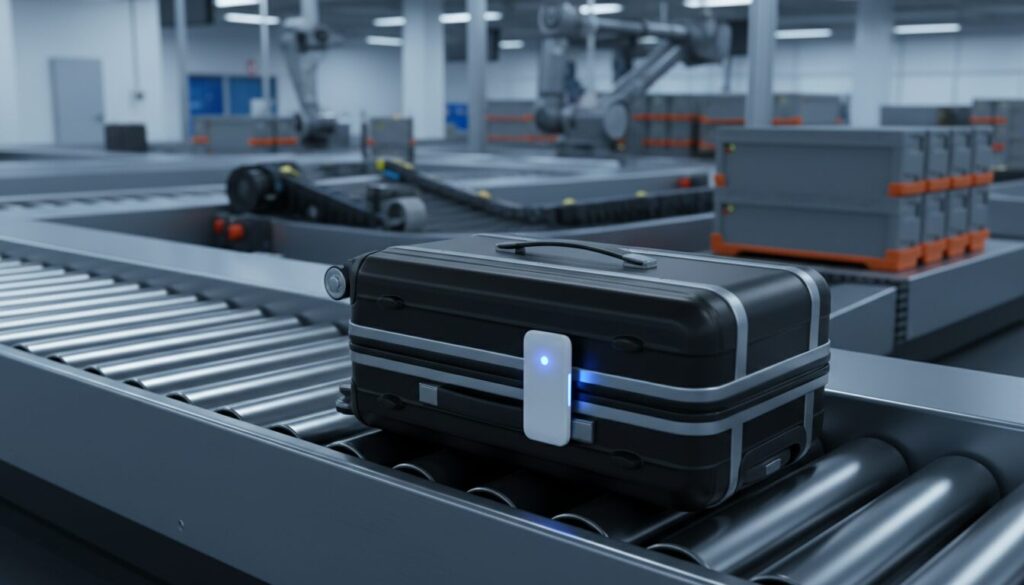
The logistics of passenger aviation is currently undergoing a radical transformation, driven not by internal enterprise upgrades, but by the democratization of data in the hands of the consumer. For decades, the “black hole” of airline baggage handling—the period between check-in and the carousel—has been a source of operational inefficiency and customer friction.
However, a recent breakthrough from Google has fundamentally altered this landscape. The Android ecosystem now allows users to share real-time tracker tag locations directly with airlines via secure, temporary URLs. This capability, already integrated by major carriers like Lufthansa and Air India, represents a pivotal shift in global supply chain visibility. It moves the industry from a reactive state of manual searching to a proactive, data-driven recovery model.
For innovation leaders and strategy executives in the logistics sector, this development is not merely a consumer feature update; it is a case study in Consumer-to-Business (C2B) Data Integration. It signals a future where consumer hardware acts as a critical node in enterprise supply chains.
Why It Matters: The Convergence of Consumer IoT and Enterprise Logistics
The global aviation industry faces a persistent challenge: mishandled baggage. According to SITA’s 2024 Baggage IT Insights, the rate of mishandled bags has remained a critical operational KPI, costing the industry billions annually in repatriation, compensation, and customer service labor.
Until now, a technological disconnect existed. Passengers often knew exactly where their lost luggage was (thanks to Bluetooth trackers like Chipolo, Pebblebee, or Moto Tags on the Find My Device network), while the airline’s legacy systems (WorldTracer) showed the bag as “missing.” Passengers would stand at counters, showing agents a map on their phones, but agents had no mechanism to input that geospatial data into their recovery workflows.
The Strategic Shift
This new Android feature bridges that gap. By allowing users to generate a “Share Item Location” link, Google has created a standardized bridge between the consumer’s “Find My Device” network and the airline’s backend systems.
This matters to global logistics leaders for three primary reasons:
- Operational Efficiency: It eliminates the manual labor of “hunting” for bags in wrong terminals or warehouses when the GPS coordinates are already known.
- Liability Reduction: Faster recovery reduces the window for “lost” bag compensation payouts.
- Data Sovereignty and Trust: The mechanism uses a privacy-first approach (7-day expiring links), solving the GDPR and data privacy hurdles that previously blocked passengers from sharing live tracking data with corporations.
Global Trend: Regional Approaches to Baggage Visibility
The adoption of this technology highlights distinct trends across major global markets—the US, Europe, and Asia. Each region approaches the integration of consumer data into logistics differently, influenced by regulatory environments and technological infrastructure.
United States: The Integrated Ecosystem
In the US, the trend has been driven by heavy carrier investment in RFID. Airlines like Delta have long led the way in proprietary tracking. However, the US market is characterized by a high volume of domestic transfers, where bags are often lost during tight connections.
The introduction of Android’s sharing capability forces US carriers, who have traditionally relied on their own internal scanning data (B2B data), to accept and integrate external consumer data (C2B data). This challenges the “walled garden” approach of US legacy carriers, pushing them toward open interoperability.
Europe: Privacy-First Logistics
Europe presents a unique challenge due to the General Data Protection Regulation (GDPR). Logistics providers in the EU are often hesitant to accept live location data from customers due to privacy liabilities.
The Google solution creates a “safe harbor” for EU carriers. Because the shared link is temporary (expiring after 7 days or upon recovery) and limits the data exposed, it aligns perfectly with EU privacy-by-design principles. This is why the Lufthansa Group (Germany, Switzerland, Austria) became one of the first global adopters.
Asia: Mobile-First Adoption
In Asia, particularly in hubs like Singapore, China, and India, mobile app integration is deeper than in the West. The expectation for “Super Apps” means passengers expect to solve problems entirely within the airline’s mobile interface.
Carriers like Air India and China Airlines are integrating this feature to leapfrog legacy infrastructure issues. Instead of investing billions in new RFID ground infrastructure immediately, they are leveraging the sensor network already carried by passengers to improve service levels.
Comparative Analysis of Regional Logistics Priorities
| Region | Primary Logistics Focus | Adoption Driver for Tracker Sharing | Key Challenges |
|---|---|---|---|
| North America | Hub-and-Spoke Efficiency | Reducing labor costs associated with manual baggage hunting. | Integrating external data into legacy mainframes. |
| Europe | GDPR Compliance & Sustainability | Reducing the carbon footprint of courier repatriation services. | Strict data privacy laws regarding customer location. |
| Asia-Pacific | Customer Experience (CX) & Scale | Managing massive passenger volume growth and mobile-first expectations. | Fragmented ground handling standards across borders. |
Case Study: Lufthansa Group and the SITA WorldTracer Integration
The most compelling evidence of this trend’s viability is the immediate adoption by the Lufthansa Group, leveraging the backend infrastructure of SITA (Société Internationale de Télécommunications Aéronautiques).
The Challenge
Lufthansa, operating out of complex hubs in Frankfurt and Munich, faced the post-pandemic travel surge which severely strained baggage handling systems. While they had internal tracking, it stopped once a bag left the automated belt system (e.g., if it fell off a cart on the tarmac or was misloaded).
The Solution: Baggage DX and Find My Device
Lufthansa partnered with SITA to integrate the “Share Item Location” feature directly into the baggage recovery workflow, known as WorldTracer. WorldTracer is the industry standard system used by over 500 airlines and ground handlers globally to track lost bags.
How It Works:
- Passenger Action: A passenger lands in Munich, but their bag does not. They open Google’s “Find My Device” app, select their tracker tag, and tap “Share item location.”
- Secure Handshake: The app generates a unique, time-sensitive web link. The passenger pastes this link into the Delayed Baggage Report on the Lufthansa mobile app or website.
- System Integration: The link is ingested by SITA’s WorldTracer system.
- Operational View: The airline’s central baggage team and ground handlers receive the link. Crucially, they do not need a Google account or the passenger’s password. They simply click the link to see the bag’s precise location on a map (e.g., “Terminal 2, Gate H, Storage Room B”).
- Recovery: Ground staff go directly to the pinpointed location, recover the bag, and re-inject it into the delivery stream.
The Results
While the rollout is recent, early indicators from the pilot phase suggest a transformative impact:
- Drastic Reduction in “Ghost” Bags: Bags that were technically “lost” (location unknown) became “delayed” (location known, awaiting retrieval).
- Cost Avoidance: Every bag located via tracker avoids the potential $1,700+ (Montreal Convention limit) compensation payout for a lost bag.
- Workflow Optimization: Ground staff spent less time searching vast storage areas and more time retrieving specific targets.
Expanding the Coalition
Following Lufthansa’s lead, a coalition of carriers has committed to or implemented this standard, including:
- Air India
- Turkish Airlines
- China Airlines
- Aegean Airlines
- Swiss International Air Lines
- Austrian Airlines
This rapid adoption across diverse alliances (Star Alliance, SkyTeam) indicates that C2B data sharing is becoming an industry standard, not just a competitive differentiator.
Strategic Imperatives for Logistics Leaders
For executives observing this shift, the lessons extend beyond aviation into broader supply chain and logistics management.
1. The Rise of “Bring Your Own Sensor” (BYOS)
Historically, logistics visibility relied on enterprise-owned sensors (RFID, GPS on trucks). This case study proves that the supply chain can—and should—leverage sensors owned by the end customer.
- Action Item: Evaluate where your customers (B2B or B2C) already possess data about your shipments that your internal systems cannot see. Build API bridges to ingest that data.
2. Temporal Security Tokens are the Future of Data Exchange
The success of this rollout hinges on the 7-day expiring link. It solves the stalemate between utility and privacy.
- Action Item: When designing supply chain visibility tools for partners, move away from permanent account integrations toward ephemeral, token-based access. This reduces security friction and encourages ad-hoc collaboration.
3. Interoperability Over Proprietary Walled Gardens
Google did not build a proprietary “Airline Portal.” They built a simple URL structure that fits into any existing field (like a text box in a claim form). SITA then adapted their backend to interpret it.
- Action Item: Do not over-engineer the connection. Simple, web-standard links are often superior to complex API integrations for ad-hoc exception handling.
4. From “Search” to “Retrieval”
The fundamental shift here is eliminating the “Search” phase of logistics recovery. In a traditional warehouse or transit hub, 80% of the time is spent locating a missing item, and 20% moving it.
- Action Item: Invest in technologies that provide precise micro-location (UWB, Bluetooth finding) to invert this ratio, ensuring labor is spent on value-added movement, not non-value-added searching.
Future Outlook: The Autonomous Recovery Chain
The integration of Android tracker tags with airline systems is merely step one. The future outlook suggests a rapid evolution toward fully automated recovery.
The “Self-Healing” Supply Chain
In the near future, we expect the “copy-paste” element to disappear. When a passenger reports a bag missing, the airline app will request permission to auto-poll the Find My Device API.
Furthermore, this data will likely be fed directly to Autonomous Ground Vehicles (AGVs). Imagine a scenario where a bag is detected in a remote corner of the tarmac. The location is shared via the Google API to the airline’s ground handling system, which dispatches an autonomous tug to that GPS coordinate to retrieve the bag without human intervention.
Universal Standardization
Currently, this is an Android-led initiative. However, the pressure is now on Apple to provide a similar, open-standard “Share Location” API for AirTags that integrates with enterprise systems like WorldTracer, rather than keeping the data locked in the “Find My” app.
Conclusion
The ability for Android users to share tracker tag info with airlines is a triumph of open ecosystems over information silos. For the global logistics industry, it serves as a powerful reminder: the most valuable data in your supply chain might be sitting in your customer’s pocket. The companies that build the bridges to access that data will define the next era of supply chain resilience.