Logistics operations leaders today face a paradox: the pressure to modernize is higher than ever, yet moving to a brand-new “greenfield” facility is often prohibitively expensive or logistically impossible. You are likely dealing with rising labor costs, a shrinking workforce, and equipment that struggles to keep up with e-commerce velocity—all within a building designed twenty years ago.
You do not need a new building to achieve modern efficiency. The solution lies in optimizing what you already have.
This guide explores Watch: The ROI of Automating Brownfield Facilities, breaking down how retrofitting legacy sites with smart automation generates significant returns. We will analyze how to calculate this value, why it is crucial now, and how global giants are already succeeding.
The Basics: What is Brownfield Automation?
To understand the return on investment (ROI), we must first define the environment. In logistics and manufacturing, facilities are categorized into two main types:
- Greenfield: A new facility built from scratch on undeveloped land. Automation is designed into the building’s DNA.
- Brownfield: An existing facility with established workflows, legacy IT systems, and physical constraints (pillars, narrow aisles, mezzanines).
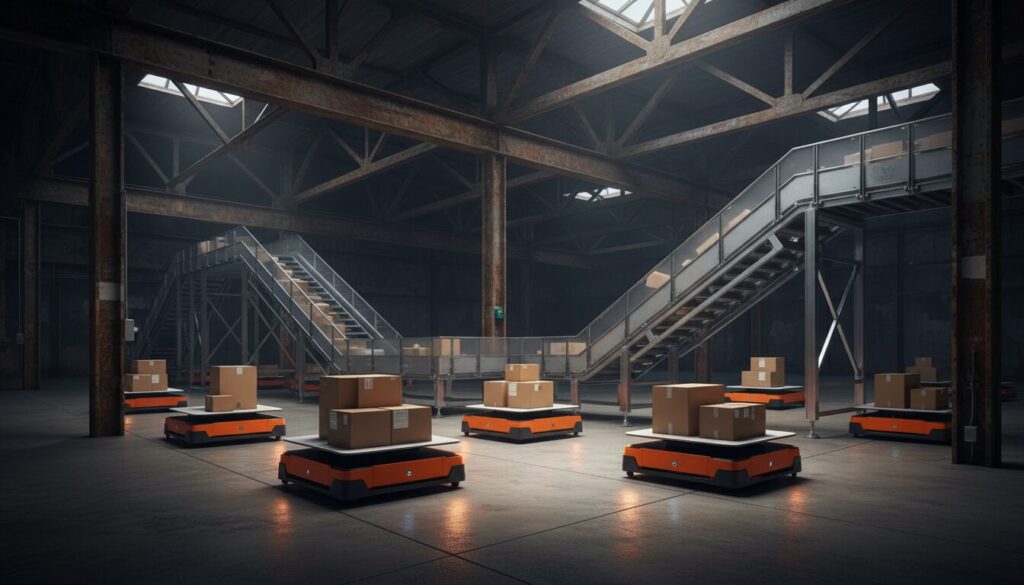
“Automating Brownfield Facilities” involves introducing modern technologies—such as Autonomous Mobile Robots (AMRs), Automated Guided Vehicles (AGVs), or cobots—into these existing operational footprints.
The ROI Equation
When we say “Watch: The ROI of Automating Brownfield Facilities,” we are looking at the ratio of net profit to the cost of the retrofit investment. Unlike greenfield projects, which require massive upfront capital for construction, brownfield automation focuses on surgical improvements.
The ROI is typically calculated using:
- Direct Labor Savings: Reduction in overtime and temporary staff.
- Throughput Velocity: Revenue gained from faster processing.
- Space Utilization: Reclaiming vertical space or narrowing aisles via precision robotics.
Why Now? The Urgency of Retrofitting
The luxury of waiting for the “perfect time” to automate has vanished. Several market forces are making brownfield automation not just an option, but a necessity for survival.
1. The Global Labor Crisis
Labor shortages are no longer a seasonal issue; they are structural. In high-demand markets, finding staff willing to walk 15 kilometers a day picking orders is becoming impossible. Automation fills this gap without requiring a facility relocation.
For instance, major players are turning to robotic solutions to handle repetitive tasks. As discussed in our report on Toyota Contracts 7 Agility Humanoids: Global Innovation Case, companies are using humanoid robots to bridge critical labor gaps directly on existing assembly lines, proving that advanced tech fits into legacy spaces.
2. Resilience Over Efficiency
Post-pandemic supply chains value resilience. Consolidating operations into existing hubs is faster than building new ones.
See also: ANA Cargo Base+: Scaling Air Freight via AGV Automation. This case illustrates how automating within an existing cargo base enhances resilience and scalability without expanding the physical footprint.
Quantitative Benefits: Analyzing the Numbers
When operations managers “Watch: The ROI of Automating Brownfield Facilities,” they often see faster payback periods compared to greenfield projects.
Lower Capital Expenditure (CapEx)
Building a new warehouse involves land acquisition, construction, and permitting. Retrofitting leverages the existing shell.
| Cost Factor | Greenfield Automation | Brownfield Retrofit |
|---|---|---|
| Construction | High (New Building) | Low (Minor Mods) |
| Implementation Time | 18–36 Months | 3–9 Months |
| Disruption Risk | Low (Offline build) | High (Live ops) |
| ROI Horizon | 5–7 Years | 1.5–3 Years |
Increased Throughput Density
Brownfield automation allows you to do more with the same square footage. By deploying AMRs that optimize pick paths or Goods-to-Person (GTP) systems that eliminate walking, facilities often see a 20% to 40% increase in throughput capacity without adding a single square meter of space.
Flexibility and Scalability
Modern robots (AMRs/Humanoids) do not require bolted-down conveyors. This is critical for brownfield sites where space is tight. If business needs change, the robots can be reprogrammed or moved.
For a real-world example of scaling from pilot to full operation, read Case Study: Toyota Scales Agility Humanoid Deployment. This demonstrates how flexible automation allows for incremental investment, protecting cash flow while proving ROI.
Qualitative Benefits: Beyond the Balance Sheet
While financial ROI is king, the qualitative returns are what sustain the operation long-term.
- Employee Safety: Automation takes over the “Dull, Dirty, and Dangerous” tasks, reducing injury rates and workers’ comp claims.
- Data Visibility: Retrofitting usually involves upgrading to a modern Warehouse Execution System (WES). This shines a light on “dark data”—operational inefficiencies that were previously unmeasured.
- Customer Satisfaction: Faster processing times lead to later cut-off times for shipping, directly improving the customer experience.
Implementation: How to Introduce Automation in Brownfields
Successfully realizing the promise of “Watch: The ROI of Automating Brownfield Facilities” requires a strategic approach. You cannot simply drop robots into a chaotic warehouse and expect efficiency.
Step 1: The Brownfield Audit
Before buying hardware, audit your current infrastructure.
- Floor Quality: Is the concrete level enough for AMRs?
- Connectivity: Are there Wi-Fi dead zones caused by metal racking?
- Layout: Can aisles be navigated by safety-rated robots?
Step 2: Start Small (The Pilot)
Do not automate the entire facility overnight. Identify a specific bottleneck—such as long-distance transport from receiving to storage—and automate that single process.
Success Tip: Choose flexible solutions. AMRs are generally better for brownfields than fixed conveyors because they navigate around existing pillars and obstacles without requiring permanent infrastructure changes.
Step 3: Integrate, Don’t Isolate
The robots must talk to your WMS (Warehouse Management System). If your WMS is 15 years old, you may need a middleware layer or a WES to bridge the gap between legacy software and modern hardware.
Step 4: Change Management
Brownfield automation often scares existing employees. Frame the technology as a tool to assist them, not replace them. Involve shift leaders in the testing phase to gain buy-in.
Conclusion: The Path Forward
The data is clear: you do not need a new zip code to achieve next-generation efficiency. By focusing on the concept of Watch: The ROI of Automating Brownfield Facilities, logistics leaders can uncover hidden value in their current assets.
The ROI is driven by lower upfront costs compared to new construction, rapid deployment times, and the ability to solve labor shortages immediately.
Recommended Next Steps:
- Conduct an Infrastructure Audit: Assess your floor flatness and network connectivity.
- Identify Low-Hanging Fruit: Find the process with the highest travel time and lowest value-add (usually material transport).
- Review Case Studies: Look at how industry leaders like Toyota and ANA Cargo are retrofitting their operations to stay competitive.
The future of logistics isn’t just about building bigger; it’s about building smarter, right where you stand.