The era of speculative “vaporware” in autonomous logistics is effectively over. In its place, a new phase of pragmatic scaling and capital-intensive infrastructure building has begun. This shift was starkly validated this week as Swedish freight technology company Einride successfully raised $113 million in an oversubscribed PIPE (Private Investment in Public Equity) financing.
This funding is not merely a financial transaction; it is a strategic signal. Securing oversubscribed capital ahead of a SPAC merger with Legato Merger Corp. III—valuing the entity at $1.35 billion—demonstrates institutional confidence in a specific type of logistics model: one that combines autonomous electric transport (AET) with a proprietary digital operating system.
For innovation leaders and strategy executives, Einride’s move to list on the NYSE in H1 2026 (Ticker: ENRD) offers a blueprint for the future of global supply chains. It highlights a pivot from testing technology to deploying integrated ecosystems across North America, Europe, and the Middle East.
Why It Matters: The Shift to “Infrastructure-First” Logistics
The global logistics sector has watched the SPAC (Special Purpose Acquisition Company) market cool significantly since the highs of 2020-2021. Many mobility startups that went public during that boom struggled to deliver on ambitious promises.
Einride’s ability to secure $113 million in fresh capital—contributing to expected gross proceeds of $333 million—suggests a renewed investor appetite for companies with tangible assets and operational density.
The “Full-Stack” Valuation Driver
Why are investors valuing Einride at $1.35 billion pre-money? The answer lies in the “full-stack” approach. Unlike competitors focusing solely on self-driving software or solely on manufacturing electric trucks, Einride sells “Freight Mobility as a Service.” This includes:
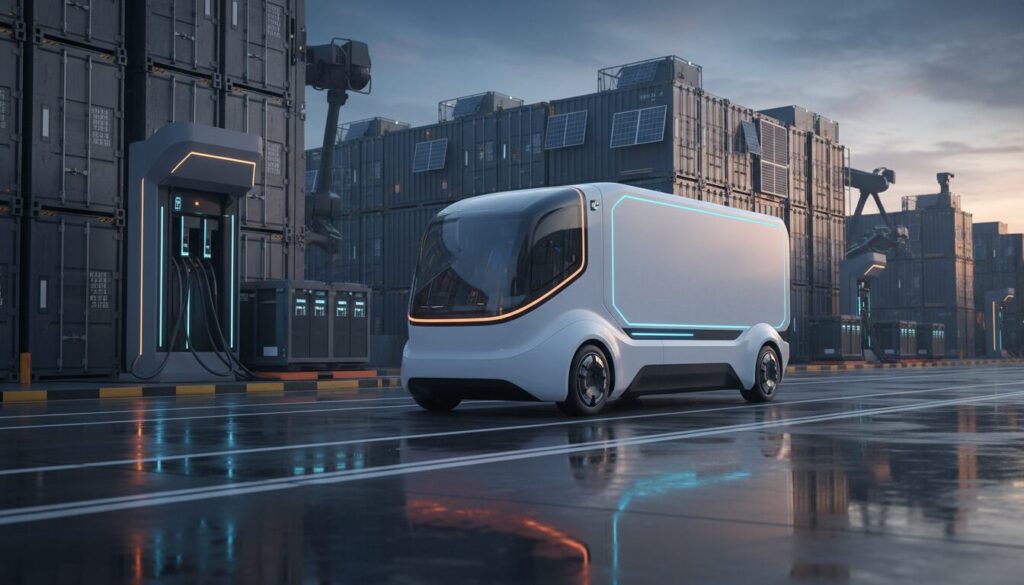
- The Vehicle: Autonomous electric pods (cab-less) and electric trucks.
- The Infrastructure: Charging stations tailored for heavy freight.
- The Brain: The “Saga” platform, an AI-driven operating system that optimizes routing, energy consumption, and fleet utilization.
This integrated approach reduces the risk for shippers (like Maersk or GE Appliances) who do not want to piece together disparate solutions.
See also: Einride $113M PIPE Funding: A Global AV Logistics Case Study
Global Trend: The Tri-Polar Race for Autonomous Freight
Einride’s success must be viewed within the context of a global race for autonomous freight dominance. The strategies in the US, Europe, and China are diverging based on regulatory environments and infrastructure density.
United States: The Middle-Mile Battleground
In the US, the focus is heavily on the “middle mile” and interstate highway autonomy. Companies are racing to remove the driver from long-haul routes (e.g., Texas to California). The challenge here is speed and distance.
- Key Trend: Partnerships between legacy carriers and tech startups to retrofit Class 8 trucks.
- Competitor Note: As discussed in our analysis of Bot Auto Driverless Freight: Impact on Logistics Capacity, new entrants are aggressively targeting capacity constraints on specific lanes like Houston-Dallas.
Europe: Cross-Border Green Corridors
Europe presents a different challenge: stricter emissions regulations, higher fuel costs, and complex cross-border logistics. Here, autonomy is often paired strictly with electrification (AET).
- Key Trend: Short-haul, heavy-frequency loops (e.g., Port-to-Warehouse) where electric range is sufficient and autonomy solves driver shortages.
- Einride’s Position: This is Einride’s home turf, where they have pioneered the “remote operator” model—one human overseeing multiple pods remotely.
China: The Scale of Unicorns
China is moving rapidly from closed-loop environments (ports/mines) to open road networks. The capital injection in this region is massive, focusing on Level 4 (L4) autonomy scale.
- Key Trend: Massive funding rounds for L4 logistics providers targeting urban delivery and trunk logistics.
- Comparison: Recently, Zelos secured over $300M, achieving unicorn status. This highlights that while the US/EU focus on public listing (SPACs), China is seeing massive private equity inflows.
See also: Zelos $300M Funding: A Global Logistics Unicorn Case Study
Regional Strategy Comparison Table
| Feature | United States | Europe | China |
|---|---|---|---|
| Primary Focus | Long-haul Interstate (Highway) | Short-haul / Regional (Green Corridors) | Urban Density & Industrial Zones |
| Energy Source | Mixed (Diesel/Electric/Hydrogen) | Heavy Electric Focus (Green Deal) | Electric & Hydrogen |
| Key Driver | Labor Shortage / Cost Reduction | Sustainability / Labor Shortage | Efficiency / Technological Sovereignty |
| Capital Trend | M&A and Strategic Partnerships | Public Grants & Green Bonds | High-Volume VC/PE Funding |
Case Study: Einride’s Path to the NYSE
The narrative of “Einride raises $113M in oversubscribed PIPE ahead of SPAC merger” is a masterclass in strategic timing and market positioning. Here is how they are executing their scaling strategy.
1. The Financial Structure
The merger with Legato Merger Corp. III provides the vehicle for public listing. However, the PIPE (Private Investment in Public Equity) is the fuel. Raising $113M in a high-interest-rate environment indicates that sophisticated investors (including existing backers like AMF, EQT Ventures, and Northzone) see a clear path to profitability.
- Gross Proceeds: Expected $333M.
- Use of Funds: Global scaling through 2026.
- Valuation: $1.35 Billion.
2. The Operational Ecosystem: Saga
Einride’s “moat” is not just the truck; it is the data. Their proprietary operating system, Saga, governs the fleet.
- Function: Saga predicts battery usage, optimizes charging times based on electricity prices, and coordinates the hand-off between autonomous mode and remote operators.
- Revenue Model: This shifts logistics from a CAPEX model (buying trucks) to an OPEX model (paying for capacity and intelligence), aligning with modern SaaS metrics.
3. Expansion Targets
With the fresh capital, Einride is targeting three specific regions for commercial deployment:
- North America: Expanding beyond pilots with GE Appliances to wider commercial grids.
- Europe: Deepening density in Scandinavia and the UK/Germany corridor.
- Middle East: A growing market for smart infrastructure projects (e.g., NEOM, UAE logistics hubs) where greenfield infrastructure favors AV adoption.
4. Hardware Innovation: The Cab-less Pod
Unlike Uber’s approach to robotaxis which adapts passenger vehicles, or standard autonomous trucks that retrofit a sleeper cab, Einride’s autonomous Pod has no driver’s seat.
- Impact: This reduces weight, improves aerodynamics, and lowers manufacturing costs. However, it relies entirely on Level 4 capabilities and remote monitoring, making the network more important than the individual unit.
Key Takeaways for Logistics Leaders
For C-Suite executives observing this transaction, the lessons extend beyond finance:
1. Decarbonization is no longer optional
Einride’s valuation is tied inextricably to its electric nature. Investors are betting that future logistics must be green. Companies relying solely on diesel efficiency improvements risk becoming “stranded assets” in the 2030s.
2. The “Software-Defined” Supply Chain
The truck is just a node in the network. The value lies in the orchestration layer (Saga). Logistics providers must ask: Do we have the digital infrastructure to manage autonomous assets, or are we just buying hardware?
3. Infrastructure Partnerships are Critical
You cannot deploy electric autonomous freight without charging infrastructure. Einride builds its own “Smartcharger” stations. Leaders must plan for energy infrastructure as part of their logistics strategy, not as an afterthought.
Future Outlook: The Road to 2026
As Einride prepares for its NYSE listing in the first half of 2026, the industry should expect a consolidation of the “autonomous middle class.” Companies that cannot raise capital or lack a defined commercial ecosystem will likely be acquired or fold.
What to watch in the next 12 months:
- Regulatory Harmonization: Will the EU and US align on safety standards for cab-less vehicles?
- The “Remote Pod” Ratio: Can Einride prove one remote operator can safely manage 10+ pods simultaneously? This metric is the key to unit economics.
- Grid Capacity: As electric freight scales, pressure on local power grids will intensify, requiring closer collaboration with utilities.
The $113M raised by Einride is a green light for the sector. It signals that for the right mix of technology, sustainability, and operational pragmatism, the global markets are open for business.
Related Reading: