For global logistics leaders, the modernization of air cargo hubs is no longer a “nice-to-have”—it is a survival imperative. As cross-border e-commerce volumes surge and supply chains demand unprecedented resilience, the bottlenecks at major international airports have become critical vulnerabilities.
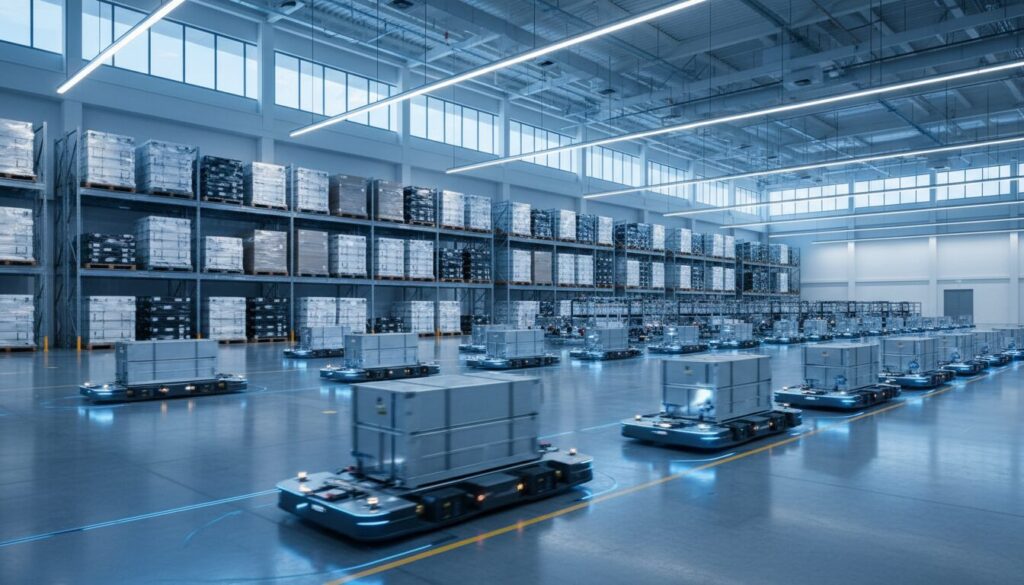
In a move that sets a new benchmark for brownfield innovation, ANA Cargo has unveiled its transformed hub at Narita Airport: ANA Cargo Base+. By consolidating six fragmented facilities into one massive, automated operation powered by 60 Phoxter AGVs and the ‘eve auto’ management system, ANA Cargo is targeting a 25% increase in handling capacity.
This article dissects the ANA Cargo case study within the context of global logistics trends, offering actionable insights for strategy executives in the US, Europe, and Asia.
Why It Matters: The Global Air Freight Crunch
The global air cargo sector is currently navigating a “trilemma” of challenges:
- Labor Scarcity: From the ground handlers in Frankfurt to the warehouse operators in Chicago, the logistics workforce is shrinking. Japan’s “2024 Problem” (strict caps on driver overtime) is merely a preview of the demographic cliff facing the entire developed world.
- Infrastructure Saturation: Major hubs like JFK, Heathrow, and Narita operate on legacy infrastructure designed decades ago. They lack the physical space to expand horizontally.
- Volatility: As seen with the Red Sea crisis and Panama Canal droughts, air freight is the fail-safe for global trade. When ocean freight falters, air hubs must absorb the shock immediately.
In this context, automation is not just about replacing forklifts; it is about densification—doing more with the same square footage.
As discussed in our analysis of Japan’s 2026 Logistics Budget: A Global Efficiency Blueprint, state-backed initiatives are accelerating these shifts. ANA Cargo’s move is a prime example of private enterprise executing on this national efficiency mandate.
Global Trend: The Race for the “Smart Hub”
While ANA Cargo is making headlines in Asia, how does this compare to the strategies deployed in other major economic zones? The approach to airport automation varies significantly by region.
United States: Brownfield Optimization
In the US, major integrators like FedEx (Memphis) and UPS (Worldport) dominate. The focus here has largely been on high-speed sortation conveyors rather than mobile robotics. However, legacy airports (like LAX or O’Hare) are increasingly looking at “island automation”—deploying AGVs in specific zones because rebuilding entire terminals is cost-prohibitive.
Europe: The ASRS Heavyweights
European hubs, particularly Lufthansa Cargo in Frankfurt and Air France-KLM in Amsterdam, have historically favored massive, fixed-infrastructure solutions like Automated Storage and Retrieval Systems (ASRS). These vertical racking systems are efficient but lack flexibility. If volumes drop or package dimensions change drastically, ASRS is hard to reconfigure.
China: Greenfield Speed
China operates with a “greenfield” advantage. Companies like Cainiao (Alibaba’s logistics arm) at Hong Kong International Airport or hubs in Hangzhou utilize massive fleets of AMRs (Autonomous Mobile Robots) from Day 1. They build the building around the robots, allowing for higher density and speed than Western counterparts can typically achieve in existing facilities.
Comparison of Regional Strategies
The following table outlines the strategic divergence in air cargo automation:
| Region | Primary Tech Focus | Key Challenge | Strategic Goal |
|---|---|---|---|
| Japan (ANA Cargo) | AGV Fleets + Consolidation | Retrofitting limited space (Brownfield) | Resilience & Labor Saving |
| Europe | Fixed ASRS / Vertical Storage | High complexity of legacy systems | Sustainability & Density |
| China | AMRs & AI Data Twins | managing massive cross-border volumes | Speed & Scalability |
| USA | High-Speed Conveyors | Aging infrastructure & Union labor | Throughput & Sorting Speed |
Case Study: ANA Cargo Base+ at Narita Airport
The “ANA Cargo Base+” project is not merely a technology deployment; it is a strategic restructuring of ANA’s cargo operations.
The Challenge: Fragmentation
Previously, ANA Cargo operated out of six different sheds at Narita Airport. This fragmentation resulted in:
- Inefficient cross-transfers between buildings.
- Redundant staffing requirements.
- Slow processing times for transshipment cargo.
The Solution: Centralization and Automation
ANA Cargo consolidated these facilities into a single hub. To manage the increased flow within this centralized space, they partnered with Fuyo General Lease and eve autonomy to deploy a massive fleet of AGVs.
1. The Hardware: Phoxter AGVs
ANA deployed 60 units of Phoxter AGVs. Unlike standard warehouse robots that move small bins, these are industrial-grade movers capable of transporting heavy air cargo pallets and ULDs (Unit Load Devices).
- Capacity: Designed to handle the heavy payloads typical of international freight (tons, not kilograms).
- Function: Automated transport of cargo from acceptance areas to build-up zones, and from breakdown zones to truck docks.
2. The Brain: ‘eve auto’
Hardware is useless without orchestration. The fleet is managed by the ‘eve auto’ system. This software acts as the traffic control tower for the warehouse, ensuring:
- Collision Avoidance: With 60 units moving simultaneously, path planning is critical.
- Dynamic Routing: The system prioritizes urgent cargo based on flight schedules.
- Interoperability: It bridges the gap between the Warehouse Management System (WMS) and the physical robots.
The Results
The impact of this DX (Digital Transformation) initiative is immediate and quantifiable:
- Capacity Boost: Handling capacity is projected to increase from roughly 400,000 tons to 500,000 tons annually (+25%).
- Labor Efficiency: The AGVs handle the repetitive, long-distance transport of heavy goods, allowing human workers to focus on complex tasks like ULD build-up (optimizing space inside the container) and customs documentation.
- Scalability: By using AGVs instead of fixed conveyors, ANA can easily add or remove robots based on seasonal peak/trough volumes.
This mirrors the trend we observed in the medical manufacturing sector, where flexibility is paramount. See also: MedTech Logistics Shift: Sysmex Insourcing with Rapyuta AMRs.
Key Takeaways for Innovation Leaders
For logistics executives looking to replicate ANA Cargo’s success, three key lessons emerge:
1. Consolidate Before You Automate
ANA Cargo did not just dump robots into six old warehouses. They consolidated first. Automation acts as a multiplier of efficiency, but if applied to a fragmented process, it only multiplies chaos. Lesson: Simplify the physical flow and facility footprint before deploying capital-intensive robotics.
2. The “Lease-to-Innovate” Model
The partnership with Fuyo General Lease is significant. Buying 60 industrial AGVs is a massive CapEx risk. Utilizing leasing structures for automation hardware allows logistics companies to shift costs to OpEx, preserving cash flow and reducing the risk of technology obsolescence. This financial engineering is as important as the mechanical engineering.
3. Software Defines the Ceiling
The limiting factor in warehouse automation is rarely the robot speed; it is the fleet management software. ANA’s success relies on the ‘eve auto’ system to prevent gridlock. Lesson: When evaluating vendors, stress-test their software’s ability to handle high-density traffic. A robot that stops every 5 minutes due to confusion is worse than a manual forklift.
Future Outlook: The Autonomous Tarmac
The deployment at “ANA Cargo Base+” is likely just Phase 1. The future of airport logistics points toward the End-to-End Autonomous Hub.
- Tarmac Integration: The next frontier is connecting the warehouse AGVs with autonomous towing tractors that bring cargo to the aircraft side. Japan is already testing driverless towing vehicles on runways.
- Predictive AI: Integrating flight data with warehouse operations. If a flight from Shanghai is delayed, the WMS should automatically deprioritize that cargo and reroute AGVs to handle an incoming flight from Los Angeles, without human intervention.
- Global Standardization: As ANA expands this model, we may see “Plug-and-Play” logistics where the data format for a ULD is identical whether it is handled by a robot in Narita, Frankfurt, or Chicago.
ANA Cargo has proven that brownfield airports can be revitalized through smart consolidation and flexible robotics. For the global logistics community, Narita has just become a lighthouse project for the future of air freight.