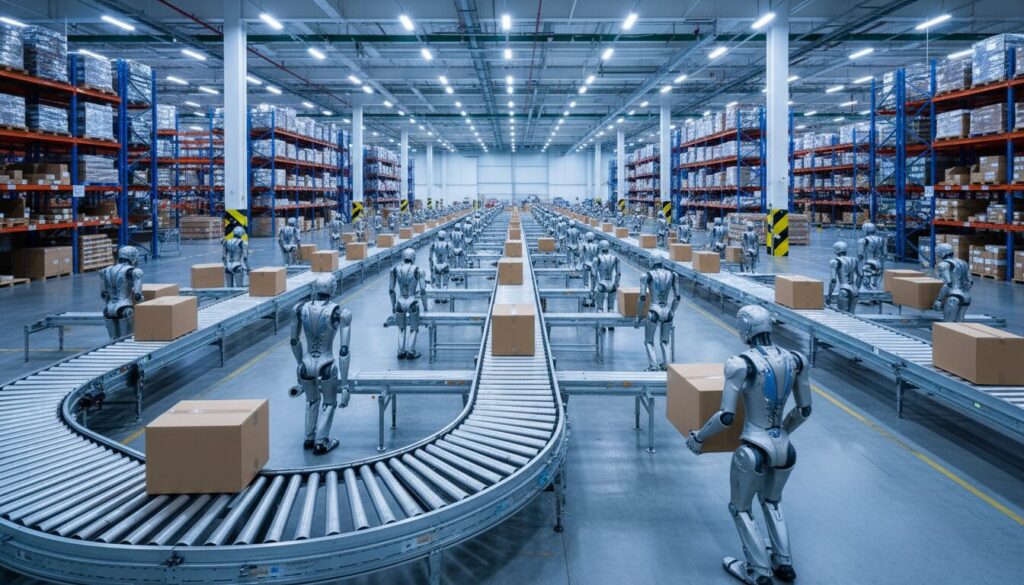
The era of the humanoid robot as a “science fair project” is over. We have entered the phase of operational deployment, and the geopolitical center of gravity for this hardware revolution is shifting unmistakably toward China.
For decades, the United States and Japan held the crown for robotic innovation—think Boston Dynamics’ Atlas doing parkour or Honda’s ASIMO waving to crowds. However, as the industry pivots from R&D spectacle to commercial viability in warehouses and factories, China is dominating the metrics that matter to supply chain executives: volume, cost, and speed to market.
Recent data reveals a startling disparity: Chinese market leader Unitree Robotics shipped approximately 36 times more units last year than its primary U.S. rivals, Tesla (Optimus) and Figure AI, combined. With global shipments projected to explode from roughly 13,000 units in 2024 to 2.6 million by 2035, understanding why China is winning the early market is critical for every logistics strategist.
This article dissects the structural advantages propelling China’s humanoid sector, contrasts global strategies, and offers actionable takeaways for logistics leaders navigating this automation wave.
Why It Matters: The Shift from Novelty to Necessity
For global logistics leaders, the humanoid robot is no longer a futuristic curiosity; it is a potential solution to a desperate macroeconomic problem. The “labor gap”—the widening chasm between the demand for logistics workers and the available workforce—is acute in the US, Europe, and parts of Asia.
However, the barrier to entry has historically been cost. A general-purpose robot costing $150,000 (the traditional price range for high-end research robots) offers a poor Return on Investment (ROI) for picking boxes in a distribution center.
China’s entry into the market changes this calculus fundamentally. By driving the unit cost down to the price of a compact car (roughly $16,000 – $30,000), Chinese manufacturers are making the “humanoid workforce” mathematically viable for the first time.
The Strategic Implications
- Supply Chain Resilience: Reducing dependency on human labor for repetitive, dangerous tasks.
- Cost Standardization: Commoditizing the hardware layer of automation.
- Speed: Moving from “pilot programs” to fleet deployment in months, not years.
As discussed in our analysis of the IFR: AI Robotics Innovation in Global Logistics, the integration of AI is crucial, but AI needs a physical body to impact the supply chain. China is providing those bodies at scale.
Global Trend: The “Brain” vs. The “Body”
To understand the market dynamics, we must look at the diverging strategies between the major global powers. While the ultimate goal is the same—a functional, intelligent humanoid—the path to get there differs significantly.
United States: The “Brain-First” Approach
The U.S. strategy, led by companies like Tesla, Figure AI, and Agility Robotics, emphasizes Embodied AI. The focus is on creating a “general-purpose brain” that can learn complex tasks. The hardware is sophisticated, but production volumes are currently low, and unit costs remain high. The value proposition is the software’s intelligence.
- See also: Toyota Contracts 7 Agility Humanoids: Global Innovation Case – A prime example of high-end US hardware entering the Japanese automotive sector.
China: The “Body-First” (Scale) Approach
China’s strategy is built on manufacturing supremacy. Leveraging its dominance in the Electric Vehicle (EV) supply chain, China is treating humanoid robots as “EVs with legs.” They focus on getting functional, durable hardware into the market quickly and cheaply, iterating based on real-world feedback.
Europe: The Specialized Niche
Europe remains a hub for high-end research and specialized industrial collaborative robots (cobots), but it currently trails in the mass-production race for general-purpose humanoids.
Regional Strategy Comparison
| Feature | United States (e.g., Tesla, Figure, Agility) | China (e.g., Unitree, Fourier, Xiaomi) |
|---|---|---|
| Primary Focus | Advanced AI, Logic, Complex Reasoning | Cost Reduction, Mass Production, Hardware Durability |
| Supply Chain Base | Tech/Software & Aerospace | Electric Vehicle (EV) & Consumer Electronics |
| Price Point (Est.) | High ($50k – $150k initially) | Aggressive ($16k – $40k) |
| Deployment Phase | Controlled Pilots (Auto plants) | Early Commercial Sales (Warehouses, Research) |
| Key Advantage | Software/AI Superiority | Manufacturing Scale & Component Cost |
Case Study: Unitree Robotics and the “EV Synergy”
The most compelling example of China’s dominance is Unitree Robotics. While Boston Dynamics spent decades perfecting the hydraulics of the Atlas robot (which is now being retired for an electric version), Unitree rapidly iterated through quadruped robots (robot dogs) before pivoting to humanoids.
The Unitree G1 and H1: Price Disruption
Unitree recently unveiled the G1, a humanoid robot priced at roughly $16,000. This price point sent shockwaves through the industry. For comparison, this is less than the annual salary of a warehouse worker in most developed nations.
How did they achieve this? The answer lies in Supply Chain Synergy.
The EV Connection
China is the world’s largest producer of Electric Vehicles and batteries. The components required for a humanoid robot overlap significantly with EVs:
- Actuators (Joint Motors): Similar to EV motors, just scaled down.
- Batteries: High-density power cells are a commodity in China.
- Sensors (LiDAR/Cameras): Mass-produced for autonomous driving systems in Chinese EVs.
By tapping into these existing supply chains, Chinese firms like Unitree, Fourier Intelligence, and Kepler do not need to reinvent the wheel. They are assembling robots from a buffet of mature, low-cost industrial parts.
Operational Deployment
Unitree reported shipping 36x more units than US competitors because they are selling to a broader base: universities, logistics R&D labs, and early-adopter factories. While U.S. companies are perfecting the software in stealth, Chinese companies are flooding the market with hardware that gathers data now.
This data collection is vital. As noted in our article on Noitom Robotics: The Data Engine for Logistics Humanoids, the “Data Factory” is essential for training robots. By having more physical units in the field, Chinese firms accelerate the feedback loop, improving mechanical reliability faster than competitors who keep their robots in the lab.
Beyond Hardware: The Software Catch-Up
It would be a mistake to assume China is only focusing on hardware. Companies like Noematrix are bridging the gap between hardware scale and intelligent software.
- See also: Noematrix Case Study: Scaling Commercial Embodied AI – This case highlights how Chinese firms are moving into the “commercial phase” with autonomous operation in pharmacies and logistics centers, proving they are rapidly closing the AI gap.
Key Takeaways for Logistics Leaders
For C-suite executives in logistics and supply chain management, the rise of China’s humanoid sector offers three critical lessons:
1. Hardware is Becoming a Commodity
Do not build your long-term automation strategy assuming robotics hardware will remain expensive. The cost curve is crashing. The differentiation in the future will not be “who has a robot,” but “whose robot has the best Warehouse Management System (WMS) integration.”
2. Supply Chain Adjacency is a Superpower
China’s success proves that innovation often comes from adjacent industries. Just as Anker-Backed Migo utilized consumer electronics expertise to enter robotics, logistics companies should look for automation partners who leverage scalable supply chains (like EV or mobile tech) rather than bespoke, boutique engineering.
3. The “Good Enough” Revolution
US robots are aiming for perfection; Chinese robots are aiming for “good enough to deploy.” In a warehouse setting, a robot that can do 80% of tasks today at 20% of the cost is often more valuable than a robot that can do 99% of tasks but won’t be available for five years.
Future Outlook: The 2035 Horizon
The projection of 2.6 million humanoid units by 2035 suggests a compound annual growth rate (CAGR) that rivals the early smartphone era.
Short Term (2024-2026)
We will see a “Hardware Flood” from China. These units will be primarily used for simple, repetitive tasks: palletizing, tote movement, and perimeter security. The primary challenge will be safety regulations and integration with legacy IT systems.
Medium Term (2027-2030)
The focus will shift from hardware to Embodied AI. As the hardware becomes standardized, the “Brain” will become the product. We expect to see partnerships where US/European AI software runs on Chinese hardware chassis—a model similar to Windows running on Asian-manufactured PCs.
Long Term (2030+)
Humanoids will become a standard labor category in logistics planning, listed alongside “Full-Time Employees” and “Contractors.” The winners will be the companies that solved the data integration challenge early.
The early market victory for China is driven by manufacturing might. However, the long-term winner of the humanoid war will be the ecosystem that best combines this mass-produced hardware with intelligent, adaptable software. For logistics leaders, the time to start testing these “blue-collar bots” is now, before the competitive advantage of early adoption evaporates.