
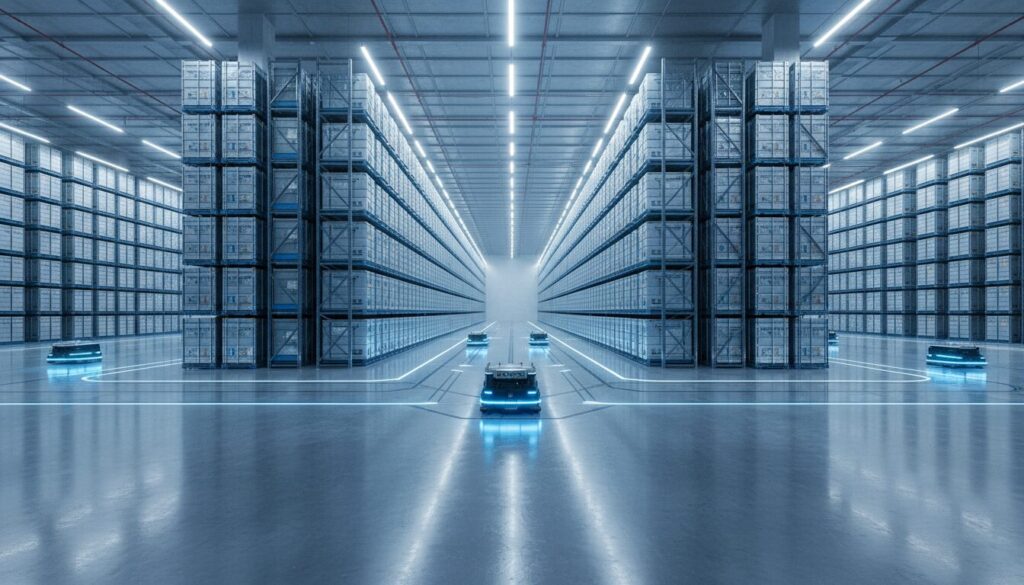
For decades, the logistics industry operated under a mandate of “growth at any cost.” Warehouse managers were tasked with pushing volume through the door, often solving bottlenecks by simply throwing more labor at the problem. However, as we move through the mid-2020s, the economic and operational landscape has shifted dramatically.
As discussed in our analysis of Walmart’s strategy, the era of unlimited supply chain spending is peaking. Leading giants are now pivoting from pure expansion to optimization and automation. For the modern warehouse manager, this signals a critical mandate: you cannot continue to manage complex fulfillment networks using static spreadsheets and reactive firefighting.
The solution lies in Reinventing Warehouse Management with an Intelligent Framework. This is not merely upgrading software; it is a fundamental shift from a “storage facility” to a “dynamic fulfillment engine” driven by data, AI, and connectivity.
This guide outlines a practical, 5-step process to implement this framework, ensuring your operations achieve zero errors and maximum agility.
The Operational Pain: The “Black Box” Warehouse
Before implementing a solution, we must diagnose the illness. Many warehouses today still operate as “Black Boxes.”
- Data Silos: Inventory data exists in the WMS, labor data in an LMS, and order data in an ERP, but they rarely speak to each other in real-time.
- Reactive Planning: Managers spend 80% of their day “firefighting”—fixing exceptions, expediting orders, and managing call-outs—rather than optimizing flow.
- Tribal Knowledge Dependency: Critical operational logic resides in the heads of veteran floor supervisors rather than in the system.
This traditional model is fragile. A single disruption (like a labor shortage or a sudden demand spike) causes the entire operation to stumble.
The Solution: What is an Intelligent Framework?
Reinventing Warehouse Management with an Intelligent Framework means moving away from linear, manual execution toward a circular, automated ecosystem.
An Intelligent Framework is composed of three synchronized layers:
- The Sensing Layer: IoT devices, scanners, and vision systems that capture reality in real-time.
- The Thinking Layer (AI): Algorithms that analyze the data to predict bottlenecks and prescribe solutions.
- The Acting Layer: Robotics, automated storage (AS/RS), and directed workflows that execute the plan.
Unlike a standard WMS which records what happened, an Intelligent Framework predicts what will happen and adjusts autonomously.
See also: Supply Chain Planning Reimagined: Embedded AI Guide
Process: 5 Steps to Implement the Framework
Implementing this framework is a journey. It requires a structured approach to avoid operational paralysis.
Step 1: Unify Data Streams (The Digital Twin Foundation)
You cannot automate what you cannot see. The first step is breaking down silos to create a “Digital Twin” of your warehouse—a virtual replica that mirrors real-time inventory and resource status.
Actionable Tactics:
- API Integration: Move away from batch file uploads (EDI/CSV) between your ERP and WMS. Implement RESTful APIs for real-time data exchange.
- Standardize Naming Conventions: Ensure SKU attributes, bin locations, and unit-of-measure definitions are identical across all platforms.
- IoT Deployment: Install sensors for environmental monitoring (if cold chain) and asset tracking (forklifts/pallets) to capture data not manually scanned.
Step 2: Shift from Reactive to Autonomous Planning
Once data is unified, you must stop relying on Excel for shift planning. Manual planning is static; intelligent planning is dynamic.
Actionable Tactics:
- Demand Sensing: Instead of planning based on last week’s average, use AI tools that ingest real-time order streams to predict picking density for the next 4 hours.
- Resource Allocation: Use algorithms to assign labor based on predicted volume rather than fixed schedules.
- Constraint Management: The system should automatically flag if the inbound volume exceeds the put-away capacity before the trucks arrive.
For a deeper dive on this shift, refer to: Autonomous Supply Chain Planning: 2025 Guide.
Step 3: Deploy Targeted Automation
Automation is the muscle of the Intelligent Framework. However, “automation” does not always mean rebuilding the entire facility. As seen in the industry, even giants like Walmart are being strategic about where they spend.
Actionable Tactics:
- Goods-to-Person (GTP): For high-velocity items, consider high-density storage systems like AutoStore. As detailed in the case of Boozt & Cognibotics, advanced robotics can solve the picking bottleneck by bringing inventory to the worker, eliminating travel time.
- AMR Integration: For lower throughput areas, Autonomous Mobile Robots (AMRs) can be deployed quickly to handle material transport without fixed infrastructure.
Step 4: Implement AI Agents for Exception Management
The most significant drain on warehouse efficiency is “Track and Trace”—figuring out where an order is or why it was delayed. In an Intelligent Framework, AI Agents handle this.
Actionable Tactics:
- Automated Status Checks: Deploy AI agents that query carrier APIs and internal WMS statuses automatically.
- Proactive Alerts: The system should email the customer about a potential delay before the customer calls the support line.
- Root Cause Analysis: Use AI to categorize error types (e.g., “Picking Error” vs. “System Inventory Error”) to identify patterns.
Learn how to execute this step specifically here: How AI Agents Solve Track and Trace: 4 Steps to Zero Errors.
Step 5: The Continuous Feedback Loop
An Intelligent Framework is never “finished.” It thrives on data. The final step is establishing a feedback loop where operational results feed back into the planning algorithms.
Actionable Tactics:
- Actual vs. Planned Analysis: Automatically compare the planned picking rate against the actual rate. If a specific zone is consistently slower, the system should adjust the difficulty rating of that zone for future planning.
- Slotting Optimization: Use the data gathered to dynamically re-slot the warehouse. Fast-moving SKUs should automatically be flagged to move closer to shipping docks based on seasonal trends detected by the AI.
Results: The Transformation
By Reinventing Warehouse Management with an Intelligent Framework, the operational metrics shift drastically. Below is a comparison of a traditional “Analog” warehouse versus one running on an Intelligent Framework.
| Metric | Traditional Warehouse (Before) | Intelligent Framework (After) |
|---|---|---|
| Decision Making | Reactive (Firefighting) | Predictive (Autonomous) |
| Inventory Accuracy | 95-98% (Cycle counts needed) | 99.9% (Real-time visibility) |
| Order Cycle Time | Hours/Days | Minutes |
| Labor Efficiency | High travel time, low value-add | High value-add, robot-assisted |
| Scalability | Linear (More volume = More people) | Exponential (More volume = Higher utilization) |
| Error Resolution | Manual investigation | Automated AI resolution |
Summary: Keys to Success
Reinventing Warehouse Management with an Intelligent Framework is not a luxury; it is a survival mechanism in a market where labor is scarce and customer expectations are instantaneous.
Key Takeaways for Managers:
- Integration First: Don’t buy robots until your data streams are unified.
- Plan Autonomously: Move away from spreadsheets to AI-driven planning tools.
- Targeted Automation: Use robotics like AutoStore or AMRs to solve specific bottlenecks, not just for show.
- Close the Loop: Ensure your execution data feeds back into your planning logic.
The transition from a cost center to a competitive advantage begins with the decision to adopt this framework. Start small, prove the value with data, and scale intelligently.