
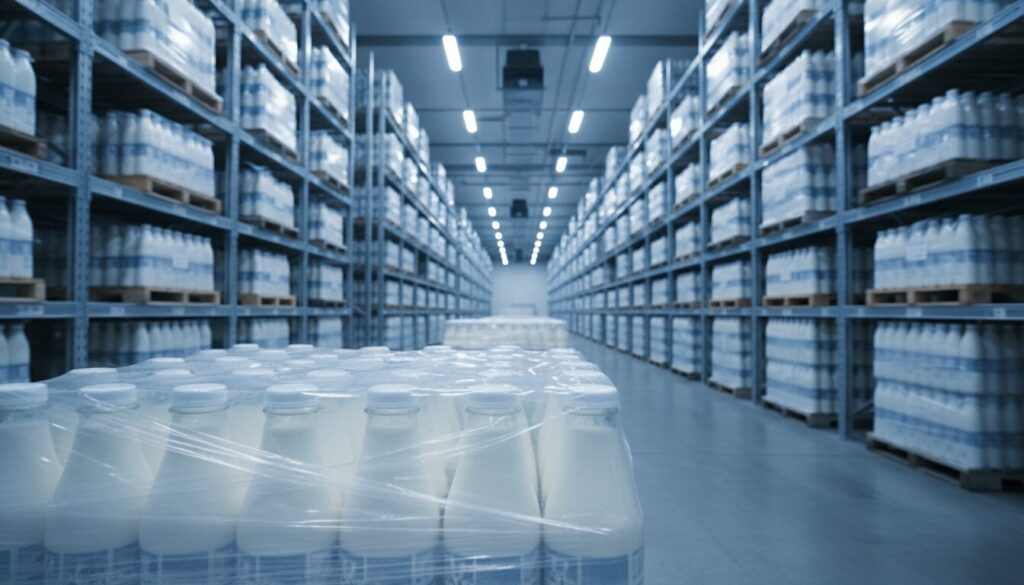
In the high-stakes world of global logistics, the perishability of inventory is often the single greatest constraint on supply chain efficiency. Nowhere is this more evident than in the dairy sector, where the “ticking clock” of expiration dates dictates transport speeds, delivery frequencies, and ultimately, profit margins.
However, a significant shift is occurring in Japan—a market historically obsessed with freshness—that offers a blueprint for global supply chain resilience. Moriyama Nyugyo, a dairy manufacturer based in Kanagawa Prefecture, has successfully extended the shelf life of its premium “A2 Hokkaido Delicious Milk” from 90 to 120 days, and its flavored variants to 150 days.
This is not merely a manufacturing triumph; it is a logistics strategy. By leveraging proprietary steam sterilization and Long-Life (LL) technology, Moriyama Nyugyo is rewriting the rules of inventory management, reducing food loss, and mitigating the severe logistical constraints facing the industry today.
Why It Matters: The Global Logistics Paradox
For strategy executives, the “Cold Chain Paradox” is a familiar headache: consumers demand fresh, preservative-free products, yet the logistics infrastructure required to deliver them is becoming increasingly expensive and fragile.
The dairy industry traditionally operates on a Just-In-Time (JIT) model, necessitating frequent, low-volume deliveries to ensure products reach shelves with sufficient remaining shelf life. This model is currently under siege due to three converging global factors:
- Labor Shortages: From the “2024 Problem” in Japan to driver shortages in the US and Europe, there is insufficient manpower to maintain high-frequency delivery schedules.
- Food Waste Regulations: Governments globally are tightening regulations on food loss. Short-shelf-life products are the primary contributors to retail waste.
- Supply Chain Volatility: Post-pandemic disruptions have proven that longer inventory buffers are necessary for resilience, but perishable goods usually cannot be buffered.
Moriyama Nyugyo’s move to extend shelf life without compromising quality represents a critical pivot: transforming a highly perishable good into a “logistics-friendly” asset.
Global Trend: The Shift to ESL and Ambient Logistics
While Japan is known for its chilled distribution network, the global trend is shifting toward Extended Shelf Life (ESL) and UHT (Ultra-High Temperature) technologies to optimize logistics. This transition varies significantly by region but shares a common goal: decoupling production time from consumption time.
The United States: The Fairlife Revolution
In the US, the market has seen a dramatic shift led by value-added dairy.
- Case Study: Fairlife (Coca-Cola): Fairlife utilized ultra-filtration and higher-heat pasteurization to extend shelf life significantly beyond standard milk.
- Logistics Impact: This allowed Fairlife to distribute nationwide from fewer production facilities, treating milk almost like a beverage stable rather than a local perishable. It reduced the pressure on rapid turnover and allowed for broader geographic reach.
Europe: The UHT Dominance
Europe presents a divided map, but the logistics efficiency of UHT is undeniable.
- Southern Europe (France, Spain): Companies like Lactalis and Danone have long utilized UHT milk, which can be stored at ambient temperatures for months.
- Logistics Impact: This eliminates the need for refrigerated trucks for the “middle mile,” drastically reducing energy consumption and carbon footprints.
China: Import Dependency and Supply Chains
China’s demand for high-quality dairy has necessitated extreme shelf-life engineering.
- Case Study: Yili and Mengniu: These giants rely on milk that can survive complex distribution networks into rural areas. Furthermore, imported milk from New Zealand or Germany requires shelf lives of 6+ months to survive ocean freight and customs clearance.
Comparative Analysis: Shelf Life Technologies
The following table outlines how different regions utilize shelf-life technology to solve specific logistics problems.
| Region | Predominant Tech | Typical Shelf Life | Primary Logistics Driver | Key Benefit |
|---|---|---|---|---|
| Japan (Traditional) | Standard Pasteurization | 7-14 Days | Freshness Perception | High consumer trust |
| Japan (New Trend) | LL / Steam Sterilization | 90-150 Days | Driver Shortage / Food Loss | Reduced delivery frequency |
| USA | ESL (Ultra-Pasteurized) | 60-90 Days | Geographic Scale | Nationwide distribution |
| Europe (South) | UHT (Aseptic) | 3-6 Months | Ambient Storage | Energy reduction (Cold Chain) |
| China | UHT (Import Grade) | 6-12 Months | Infrastructure / Import | Access to remote markets |
Case Study: Moriyama Nyugyo’s Strategic Pivot
Moriyama Nyugyo has positioned itself at the forefront of the Japanese dairy innovation wave. Their recent update to the “A2 Hokkaido Delicious Milk” line is a masterclass in aligning product engineering with logistics strategy.
The Innovation: Steam Sterilization
Unlike standard pasteurization, which kills bacteria but leaves the product vulnerable to quick spoilage, Moriyama Nyugyo utilizes a proprietary Long-Life (LL) manufacturing method involving advanced steam sterilization.
- The Change:
- Standard Milk: Extended from 90 days to 120 days.
- Flavored Variants (Cocoa, Milk Tea): Extended to 150 days.
The Logistics Implications
This extension is not arbitrary; it is calibrated to solve specific supply chain friction points.
1. Optimization of Delivery Frequency
In Japan, convenience stores and supermarkets often require daily milk deliveries. By extending the shelf life to 4-5 months, retailers can hold larger inventory buffers. This allows Moriyama Nyugyo and its distributors to shift from “frequent, small-batch” deliveries to “infrequent, bulk” deliveries.
- Result: Reduced truck trips, lower fuel costs, and alleviated pressure on the scarce driver workforce.
2. Inventory Resilience
With a 90-day limit, a delay in the supply chain (e.g., a typhoon or logistics bottleneck) could result in the product arriving with insufficient “sell-by” time, leading to automatic rejection by retailers.
- Result: A 120-day window provides a significant safety margin. Even if logistics are disrupted for a week, the product remains viable for retail acceptance, drastically reducing write-offs.
3. Enabling The “A2” Niche
The product in question uses A2 milk, a premium category containing only A2 beta-casein, believed to be easier on digestion.
- Result: Premium niche products have lower turnover rates than generic milk. A longer shelf life is critical for niche products to survive on shelves long enough to be purchased, ensuring the viability of the premium SKUs.
Key Takeaways: Lessons for the Logistics Industry
The Moriyama Nyugyo case offers actionable insights for Innovation Leaders and Strategy Executives across all perishable sectors.
1. Manufacturing is Logistics
The boundary between product development and supply chain management is dissolving. The decision to use steam sterilization was likely driven as much by the logistics director as the food scientist. Executives must encourage R&D teams to design products that are “logistics-native”—engineered to survive the modern supply chain.
2. The Shift from JIT to “Just-In-Case”
For decades, Just-In-Time (JIT) was the gold standard. However, in the face of labor shortages and climate disruptions, a slightly higher inventory buffer (enabled by longer shelf life) is more profitable than a lean supply chain that breaks under pressure. Moriyama’s extension allows for “Just-In-Case” inventory without the risk of spoilage.
3. Sustainability via Shelf Life
Sustainability strategies often focus on electric trucks or solar panels. However, reducing food waste is often the most impactful environmental action a company can take. Extending shelf life prevents the carbon cost of producing, transporting, and then destroying unsold goods.
- Strategic Note: Marketing teams must educate consumers that “Long Life” does not mean “Full of Preservatives,” but rather “Technologically Advanced Hygiene.”
Future Outlook
The move by Moriyama Nyugyo is a signal of a broader transformation in the global cold chain.
The Rise of Smart Packaging
As shelf lives extend, we expect to see the integration of smart labels (Time-Temperature Indicators or TTIs) that dynamically update based on the storage conditions. This will replace static printed dates, further optimizing logistics by allowing “First-Expired-First-Out” (FEFO) rather than “First-In-First-Out” (FIFO) management.
Global Harmonization of ESL
We predict a convergence of standards between Asia, the US, and Europe. As global trade in perishables increases, technologies like Moriyama’s steam sterilization will become the baseline requirement for export-grade dairy, creating a global market where milk can travel as easily as microchips.
Conclusion
Moriyama Nyugyo’s shelf-life extension is more than a product update; it is a strategic response to the logistical realities of the 21st century. By buying time, they are buying efficiency, resilience, and sustainability. For global logistics leaders, the lesson is clear: sometimes the most effective way to speed up your supply chain is to make your product last longer.