
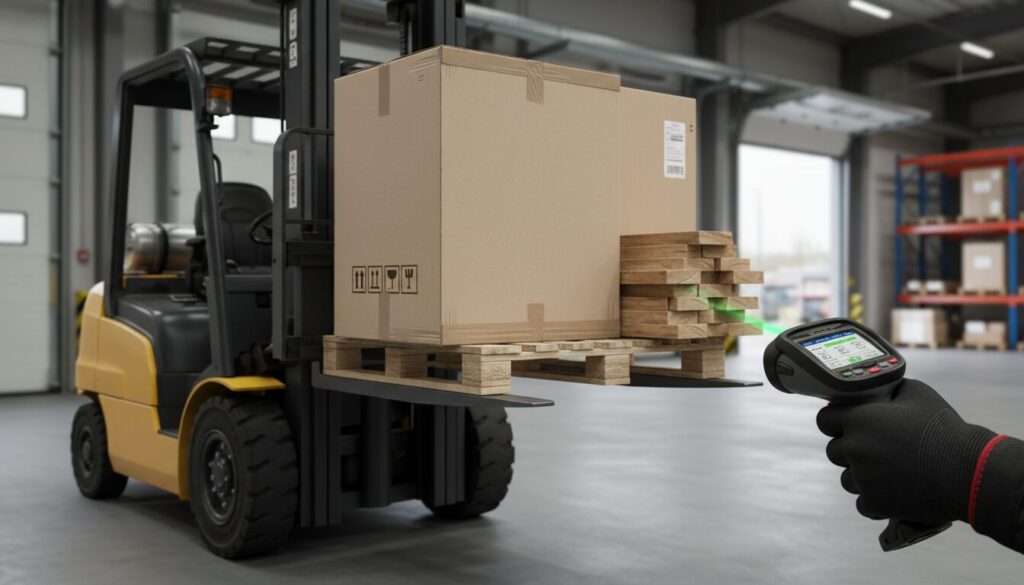
The “Amazon Effect” has long dominated small parcel delivery, training consumers to expect minute-by-minute updates on everything from toothpaste to phone chargers. However, the heavy goods sector—appliances, furniture, and construction materials—has historically lagged behind, often relying on vague four-hour delivery windows and limited visibility.
Home Depot has just shattered that status quo.
By rolling out real-time tracking across its “big and bulky” categories, the retail giant is not merely updating an app; they are fundamentally redefining the operational standard for heavy logistics. This move signals the end of the “delivery black hole” for large items and places immense pressure on carriers, 3PLs, and competitors to modernize their last-mile infrastructure immediately.
For logistics executives, this is a critical pivot point: the expectation for granular visibility has officially migrated from the courier van to the flatbed truck.
The News: Closing the Visibility Gap
Home Depot’s initiative addresses a notorious pain point in the supply chain: the lack of transparency in heavy freight. Unlike parcels, which pass through highly automated sortation centers with frequent scan points, big and bulky items often involve manual handling, multi-person teams, and non-conveyorized environments, leading to data fragmentation.
Key Facts at a Glance
The following table summarizes the core components of Home Depot’s new logistics capability:
| Feature | Description |
|---|---|
| Scope | Real-time tracking for all “big and bulky” categories, including appliances, lumber, and large fixtures. |
| Consumer Demand | 41% of consumers demand exact real-time tracking for large items; 50% require general status updates. |
| Technology | Driver-based handheld devices generate “digital breadcrumbs” and time-stamped checkpoints. |
| Infrastructure | Supported by the addition of nearly 200 distribution facilities over the last 8 years to enable proximity. |
| Objective | Reduce customer anxiety (friction) and drive incremental sales through reliability. |
The Mechanism: Digital Breadcrumbs
The technical backbone of this rollout relies on “digital breadcrumbs.” Rather than relying solely on telematics from the truck (which tracks the vehicle, not necessarily the status of the delivery workflow), Home Depot is leveraging handheld devices used by drivers.
These devices create time-stamped checkpoints at critical intervals—loading, departure, route progress, and arrival. This data is fed into Home Depot’s “ship from best location” algorithm, creating a synchronization between inventory position and last-mile execution.
Industry Impact: The Ripple Effect
The implications of this shift extend far beyond Home Depot’s customer service department. It creates a domino effect across the logistics ecosystem.
1. The New Standard for LTL and Last-Mile Carriers
Carriers specializing in white-glove and heavy delivery can no longer treat visibility as a value-added service. It is now a baseline requirement. Retailers competing with Home Depot will demand similar capabilities from their 3PL partners.
- The Pressure: Small to mid-sized carriers without robust API integrations or driver mobile apps risk being cut from major retail vendor lists.
- The Shift: We will see a rapid consolidation or tech-upgrading phase in the “two-man lift” carrier market.
2. Infrastructure Decentralization
Home Depot did not achieve this solely through software. The addition of nearly 200 facilities over eight years highlights a crucial logistics truth: Visibility requires proximity. To offer precise tracking and tighter windows, inventory must be moved closer to the end consumer.
- Trend: The hub-and-spoke model for heavy goods is evolving into a mesh network of Forward Stocking Locations (FSLs) and Market Delivery Operations (MDOs).
3. Customer Service Cost Reduction
While this is framed as a consumer benefit, the operational savings are massive. “Where is my order?” (WISMO) calls are the most expensive type of customer interaction in logistics.
- Analysis: By providing the map and the timeline, Home Depot deflects thousands of call center hours. For heavy items, where anxiety is higher (e.g., a customer waiting for a fridge so their food doesn’t spoil), the ROI on tracking tech is significantly higher than for small parcels.
For a deeper look at how automation reduces these manual touchpoints, see our analysis on How AI Agents Solve Track and Trace: 4 Steps to Zero Errors, which details the backend tech required to support such visibility.
LogiShift View: The Data Moat Strategy
While the industry focuses on the consumer-facing app, the real value for Home Depot lies in the data aggregation. This is the “So What?” for the strategic executive.
The “Installation” Variable
Tracking a box is easy. Tracking a delivery that involves installation, haul-away, or construction site drop-off is incredibly complex. The time-on-site variable is highly volatile.
- The Insight: By forcing digital inputs via handhelds for big and bulky items, Home Depot is gathering a proprietary dataset on service times. They will learn exactly how long it takes to install a dishwasher in a walk-up apartment versus a suburban home.
- The Prediction: This data will feed back into their delivery promise engine, allowing them to offer even tighter, dynamic windows that competitors cannot match because they lack the historical data to predict service duration accurately.
The Algorithm of “Best Location”
The news highlights the “ship from best location” algorithm. This is critical. Real-time tracking is useless if the sourcing logic is flawed. Home Depot is effectively treating its stores and new distribution centers as a unified, fluid inventory pool.
- The Warning: Retailers attempting to copy the tracking feature without upgrading their Order Management System (OMS) sourcing logic will fail. You cannot track chaos; you can only track a structured process.
This level of last-mile sophistication mirrors trends we are seeing in other sectors. For instance, in the residential sector, secure access is becoming just as important as the tracking itself. As discussed in Relo Partners’ Smart Access: Global Last-Mile Innovation, the convergence of digital tracking and physical access control is the next frontier.
Strategic Takeaway
Home Depot’s move is a signal flare. The “heavy” supply chain is undergoing the same digital transformation that the “light” supply chain went through a decade ago.
For Retail Executives:
- Audit your OMS: Can your system dynamically route orders to the closest node to enable precise tracking?
- Review Carrier Contracts: mandate real-time API connectivity and driver app usage for all heavy goods providers.
For Logistics Providers (3PLs):
- Tech Stack Investment: If you haul big and bulky, your driver app interface is now your primary sales tool.
- Data Transparency: Stop hiding dwell times. Share the “digital breadcrumbs” with shippers to build trust and stickiness.
Real-time visibility for a 50-cent bolt is convenience. Real-time visibility for a $3,000 refrigerator is risk mitigation. The market has spoken: the heavy lifting now includes heavy data.