
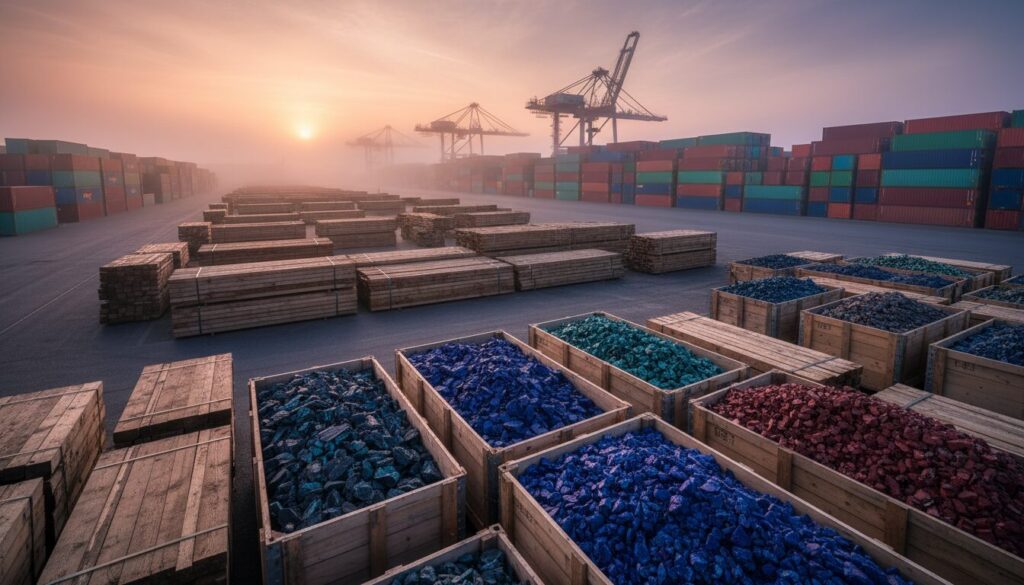
The era of cheap, reliable, and invisible sourcing is over. For the past three decades, Global Logistics Trend Watchers have observed a singular focus on “Just-in-Time” efficiency. However, a new consensus is emerging among strategy executives and innovation leaders: the greatest threat to global business continuity is no longer the final mile—it is the very first.
Recent industry discussions, including insights from experts like Amy Julian at Armanino, highlight a critical oversight in modern manufacturing. While companies have aggressively pursued “nearshoring” strategies to diversify assembly, they often neglect the raw material dependencies that feed these factories.
This article explores why raw materials have become the ultimate “breaking point” in global supply chains, analyzing the geopolitical shifts in the US, EU, and Asia, and offering a strategic roadmap for resilience.
Why It Matters: The Illusion of Diversification
In the wake of the pandemic, the “China Plus One” strategy became a boardroom mantra. Manufacturers moved final assembly to Vietnam, India, and Mexico to mitigate risk. However, this diversification often creates a false sense of security.
If a US automotive company moves assembly to Mexico but still relies on a single Chinese refinery for 90% of its processed lithium or specialized steel, the risk has not been reduced—it has merely been obscured.
The “First Mile” Vulnerability
The supply chain does not begin at the factory loading dock; it begins in the mine, the refinery, and the chemical plant.
- The Hidden Choke Point: Most “diversified” suppliers in Southeast Asia or Latin America still source their feedstocks from the same dominant global players.
- The “Breaking Point” Theory: As noted in recent industry podcasts and analyses, raw materials are the least flexible link in the chain. You can move a factory in two years; opening a new mine takes ten.
As discussed in our previous analysis, Can Govts Fix Critical Material Supply? A Global Trend, the dominance of specific nations in processing critical minerals means that geopolitical friction upstream can halt production downstream, regardless of where the final assembly occurs.
Global Trend: The Race for Upstream Sovereignty
The recognition of this raw material fragility has triggered a race for “Material Sovereignty” across the major economic blocs. The free market approach to raw materials is being replaced by state-sponsored strategic sourcing.
1. The United States: Subsidizing Independence
The US approach, driven by the Inflation Reduction Act (IRA), ties consumer subsidies directly to the origin of raw materials. This forces automakers and tech firms to audit their supply chains down to the molecular level. The goal is to decouple the battery supply chain from adversaries.
2. China: Weaponizing The Monopoly
China has moved from simply supplying materials to leveraging its dominance as a diplomatic tool. The recent restrictions on gallium, germanium, and antimony exports demonstrate that raw materials are now part of the geopolitical arsenal.
See also: China Bans Dual-Use Item Exports to Japan: Global Impact
3. Europe: Regulating Transparency
The EU’s Critical Raw Materials Act focuses on monitoring and circularity. Unlike the US’s incentive-heavy approach, the EU mandates strict “Digital Product Passports” (DPP) to track material provenance and carbon footprints.
Comparative Strategy Table
| Feature | United States (IRA/Chips Act) | European Union (CRMA/DPP) | China (Export Control Law) |
|---|---|---|---|
| Primary Goal | Decoupling & Domestic Security | Sustainability & Strategic Autonomy | Geopolitical Leverage & Market Dominance |
| Mechanism | Tax Credits & Direct Subsidies | Regulation & Passporting | Export Licenses & Quotas |
| Impact on Biz | Forced to source from FTA partners | Compliance costs for traceability | Supply volatility for tech/defense |
| Key Risk | High cost of local production | Regulatory fragmentation | Sudden “turn-off” of supply |
Case Study: General Motors (GM) & The Vertical Integration Pivot
To understand how innovation leaders are addressing this “breaking point,” we look at General Motors (GM). Historically, automakers purchased parts (Tier 1). They rarely interacted with the mines (Tier 4 or 5).
However, recognizing that electric vehicle (EV) scalability is entirely dependent on lithium availability, GM radically altered its strategy.
The Thacker Pass Investment
In a landmark move, GM invested $650 million directly into Lithium Americas Corp to develop the Thacker Pass mine in Nevada.
- The Strategy: GM bypassed the traditional supply chain tiers to secure the “beginning of the chain.”
- The Outcome: This grants GM exclusive access to Phase 1 production, ensuring a steady flow of lithium carbonate for its Ultium battery cells.
- The Lesson: Resilience requires ownership (or binding partnership) of the raw material source, not just the component supplier.
Contrast: The Visibility Gap
While GM secures mines, other industries struggle with visibility. Companies utilizing “Nearshoring 2.0” in Mexico often fail to realize that their Tier 2 suppliers are importing raw plastics and metals from across the Pacific, negating the speed advantages of nearshoring.
For a deeper dive on evaluating regional labor and supply depth, refer to: Mexico Nearshoring: 3 Ways to Evaluate Regional Labor ROI.
Key Takeaways: Lessons for Logistics Leaders
Innovation leaders must accept that the era of “hands-off” sourcing is over. To fix the breaking point, you must extend your vision.
1. The Cost-Resilience Trade-off
Diversification is expensive. Executives must perform a calculated risk assessment. As Amy Julian suggests, you cannot diversify everything.
- Strategic Choice: Identify the materials where a supply shock would be fatal (e.g., semiconductors, specialized alloys). Accept higher costs to diversify these.
- Acceptable Risk: For commoditized materials with multiple global sources (e.g., standard packaging cardboard), single-sourcing for cost efficiency may still be viable.
2. Radical Visibility (Tier N Tracking)
You cannot manage what you do not see. Companies are adopting RFID and blockchain technologies not just for inventory, but for provenance.
- Action: Implement requirements for Tier 1 suppliers to disclose their suppliers.
- Tech Enabler: RFID vs. Tariffs: Supply Chain Visibility Case Study explores how tracking tech helps navigate trade barriers.
3. Localize the “Heavy” Supply Chain
If you move assembly to the US or EU to avoid tariffs, you must ensure the heavy/energy-intensive components (like battery cells) are also localized.
See also: Chinese Energy Storage: Localization vs. Tariffs
Future Outlook
The definition of “Logistics” is expanding. It now encompasses geology and diplomacy.
The Rise of “Urban Mining”
As raw material scarcity increases, the “beginning of the chain” may move from the mine to the recycling center. Circular supply chains—where end-of-life products are harvested for cobalt, copper, and gold—will become a primary source of raw materials. This shifts the “breaking point” from a foreign mine to a domestic recycling facility, drastically improving resilience.
Executive Call to Action
The hidden breaking point at the start of your supply chain is a ticking clock. The most successful companies of 2030 will be those that treat raw materials not as a commodity to be bought, but as a strategic asset to be secured, managed, and recycled.
Is your visibility extended to the mine, or does it stop at the factory? The answer to that question will define your resilience in the coming decade.