For years, the autonomous vehicle (AV) narrative was dominated by robotaxis and long-haul trucking promises that perpetually seemed “five years away.” However, the landscape of 2024–2026 has shifted dramatically toward operational pragmatism.
The latest signal of this maturity is Swedish freight technology company Einride, which has secured an oversubscribed $113 million PIPE (Private Investment in Public Equity) financing. This capital injection serves as a bridge to its expected public listing on the New York Stock Exchange (NYSE) in early 2026 via a merger with Legato Merger Corp.
Despite a valuation adjustment to $1.35 billion—a figure that reflects a market correction from the exuberant highs of 2021—this funding is a critical validation. It confirms that institutional investors are still willing to back companies that offer tangible, sustainable freight solutions rather than just theoretical technology.
For logistics innovation leaders and strategy executives, Einride’s move is not just financial news; it is a case study in scaling electric and autonomous freight across the fragmented markets of Europe, North America, and the Middle East.
Why It Matters: The Era of “Real” Logistics Automation
The global supply chain is currently navigating a “trilemma” of challenges: labor shortages, decarbonization mandates (ESG), and supply chain resilience.
Einride’s recent funding highlights a pivotal trend: the decoupling of “autonomy” from “science fiction.” Unlike earlier startups that promised Level 5 autonomy everywhere immediately, the winners of this cycle are focusing on closed-loop environments, hub-to-hub transport, and the immediate deployment of electric fleets that can be upgraded to autonomous capabilities later.
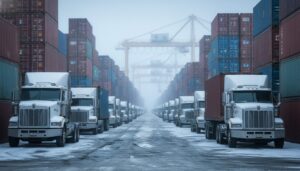
The $113 million PIPE is part of an expected $333 million in total gross proceeds from the SPAC deal. This liquidity is not for R&D; it is for deployment. With a fleet of 200 heavy-duty electric trucks already operating for clients like PepsiCo, Heineken, and DP World, Einride represents the transition from “testing” to “hauling.”
As discussed in our previous analysis of regulatory hurdles, the industry is moving at different speeds. For a deeper understanding of the regulatory friction points slowing down broader adoption, see:
Why Trucking Reform Lags Your Timeline: Essential Strategies
Global Trend: The Divergence of AV Strategies
To understand Einride’s position, one must look at the global geopolitical divide in autonomous logistics. The US, Europe, and Asia are adopting distinctly different architectures for driverless freight.
1. United States: The Long-Haul Highway Model
In the US, the vast interstate highway system favors “Middle Mile” autonomy. Companies like Aurora and Kodiak—and new entrants like Bot Auto—are focusing on Class 8 trucks that retain the traditional cab but replace the driver for long stretches of highway driving. The goal here is capacity expansion to combat the severe driver shortage.
2. China: The High-Volume Closed Loop
China is rapidly commercializing L4 autonomy in ports, mines, and industrial parks. The regulatory environment allows for faster iteration in geofenced areas. Companies like Zelos have achieved “Unicorn” status by dominating last-mile and industrial campus logistics, proving that low-speed autonomy scales faster than highway autonomy.
3. Europe (and Einride): The Cab-less, Sustainable Approach
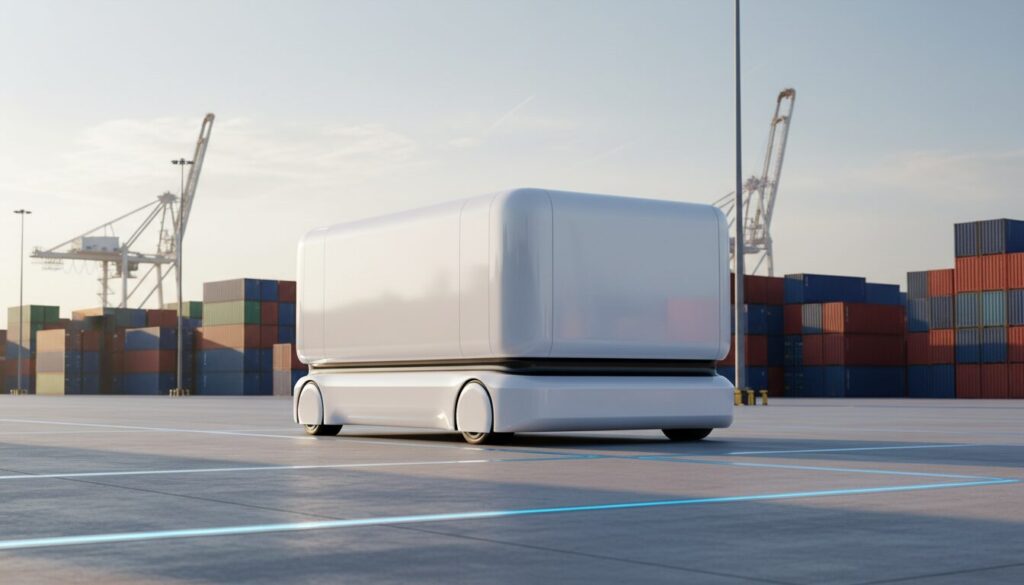
Europe’s shorter distances and stricter environmental regulations have birthed a hybrid model. Einride’s approach is unique: it combines immediate electrification (human-driven electric trucks) with a futuristic “Pod” design that completely removes the driver’s cabin. This design choice targets high-density, repetitive flows (like port-to-warehouse) rather than cross-continent trekking.
Regional Comparison of Autonomous Freight Strategies
| Feature | United States (e.g., Bot Auto, Aurora) | China (e.g., Zelos, Pony.ai) | Europe/Einride Model |
|---|---|---|---|
| Primary Use Case | Long-haul Interstate (Hub-to-Hub) | Urban Delivery & Industrial Ports | Regional Loop & Heavy Industry |
| Vehicle Design | Traditional Retrofit (Cab retained) | Purpose-built Delivery Bots & Trucks | Cab-less “Pods” + Electric Trucks |
| Regulation Focus | State-by-state highway approval | Centralized pilot zones | Strict EU safety & Carbon mandates |
| Energy Source | Diesel / Hybrid / EV | Electric | 100% Electric (Core differentiator) |
| Commercial Driver | Driver Shortage Cost | Delivery Speed | Sustainability (CO2 reduction) |
Case Study: Einride’s Strategic Pivot and Expansion
Einride’s path to its 2026 public debut offers specific lessons for strategy executives. The company did not rely solely on the promise of self-driving tech; it built a business model around Freight Mobility as a Service (FaaS).
The Technology: Removing the Human Element entirely
Most competitors are retrofitting sensors onto Volvos or Peterbilts. Einride built the “Pod” from the ground up without a cockpit.
- Design Advantage: Without a cab, the vehicle is more aerodynamic and lighter, increasing the range of the electric battery—a critical factor for EV trucking viability.
- Remote Operation: Instead of onboard drivers, Einride utilizes remote operators who monitor multiple pods simultaneously via the Saga platform. This shifts the labor model from “one driver per truck” to “one operator per fleet.”
The Financials: Valuation Reality Check
The valuation set for the SPAC merger is $1.35 billion. While significant, this is a correction from earlier venture capital valuations.
- Why this is positive: It resets investor expectations. By accepting a realistic valuation, Einride secured the $113M PIPE (over-subscribed), proving that smart money prefers realistic entry points over inflated hype.
- Capital Allocation: The funds are earmarked for expanding the Saga software platform and deploying fleets in the US, UK, Germany, Norway, and the Middle East.
Strategic Focus: The Middle East Connection
A standout detail in Einride’s expansion is its focus on the UAE and Saudi Arabia (via partnerships like DP World).
- Infrastructure: The Middle East is building smart cities (e.g., NEOM) from scratch, offering ideal infrastructure for cab-less autonomous pods that struggle on chaotic, centuries-old European roads.
- Energy Transition: The region is aggressively investing in non-oil logistics resilience, making them prime customers for Einride’s electric-first ecosystem.
Fleet Orchestration Strategy
Einride mirrors the strategy of global tech giants by focusing on the network rather than just the vehicle. Similar to how Uber pivoted to become a platform for various modalities, Einride’s Saga platform manages charging, routing, and remote monitoring, making the software as valuable as the hardware.
Key Takeaways for the Logistics Industry
For executives observing Einride’s trajectory, three core lessons emerge regarding the future of supply chain innovation:
1. Electrification is the Trojan Horse for Autonomy
Einride does not sell “autonomy” as the primary product; it sells “decarbonized freight capacity.” By leading with electric trucks (some human-driven, some autonomous), they secure contracts with ESG-conscious giants like PepsiCo today, rather than waiting for regulatory approval for full autonomy tomorrow.
- Actionable Insight: Do not wait for Level 4 autonomy to modernize your fleet. Use electrification as the entry point to upgrade your digital infrastructure.
2. Design for the Use Case, Not the Legacy
The decision to remove the cabin is bold. It limits the vehicle’s versatility (a Pod cannot easily navigate a chaotic construction site manually) but maximizes efficiency for specific lanes.
- Actionable Insight: Analyze your freight lanes. 80% of complexity often comes from 20% of the routes. Automating the predictable, high-volume “boring” lanes yields higher ROI than trying to automate complex, variable routes.
3. Software is the Constraint, Not Hardware
The $113M funding is heavily directed toward the Saga digital platform. In a future where trucks are commodities, the intelligence that optimizes charging schedules, route planning, and remote intervention will be the differentiator.
- Actionable Insight: Invest in Transport Management Systems (TMS) that are “AV-ready”—capable of handling real-time data streams and remote command protocols.
Future Outlook: 2026 and Beyond
As Einride prepares for its public debut in 2026, the logistics sector is watching closely. The success of this SPAC merger will act as a bellwether for other late-stage logistics startups.
What to watch in the next 18-24 months:
- The “Middle East Corridor”: Expect rapid deployment of cab-less pods in UAE ports, potentially outpacing deployments in the heavily regulated US/EU markets.
- Regulatory Harmonization: Will the EU allow cab-less vehicles on public highways beyond pilot zones? The data Einride collects in 2025 will likely form the basis of this legislation.
- Consolidation: With valuations compressing, expect companies with strong balance sheets to acquire struggling AV startups to consolidate IP.
Einride’s $113M PIPE is more than just fundraising; it is a declaration that the future of logistics is electric, digital, and eventually, driverless. For global supply chains, the time to prepare for this integration is now.