The dividing line between “generative AI” and “industrial robotics” has just been erased. In a strategic maneuver that signals the next era of supply chain automation, Alphabet has announced that its robotics software subsidiary, Intrinsic, will formally integrate into Google.
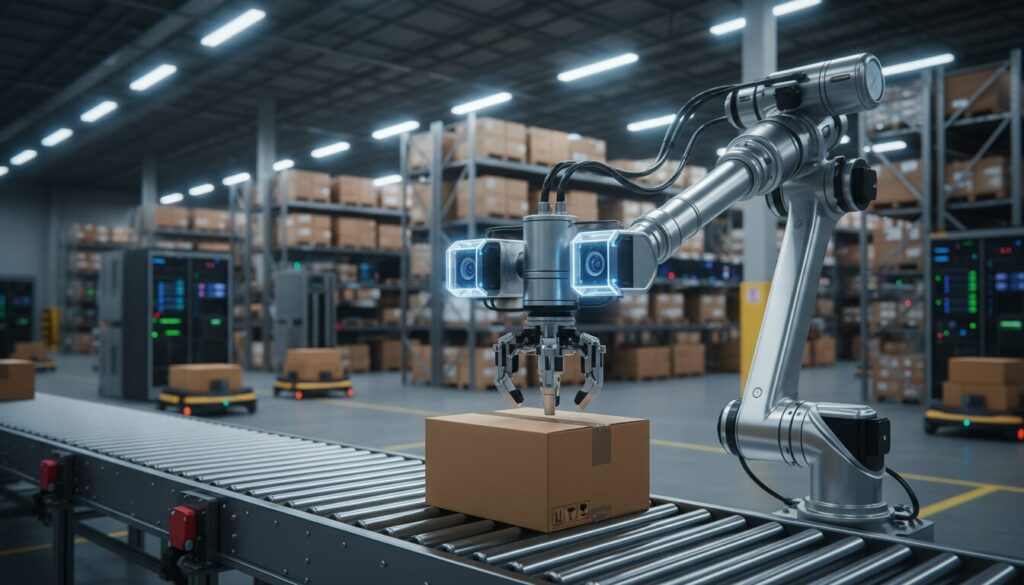
For logistics executives, this is not merely an internal corporate restructuring. It is a declaration that the era of “Physical AI”—where Large Language Models (LLMs) and advanced vision systems drive physical hardware—has arrived. By combining Intrinsic’s “Flowstate” robotics platform with Google’s DeepMind research and Gemini AI infrastructure, Alphabet is moving to solve the single biggest bottleneck in warehouse automation: the high cost and complexity of programming robots.
This analysis breaks down the implications of this merger, why it matters for your 2025 roadmap, and how it aligns with the broader shift toward Embodied AI.
The Facts: Intrinsic Integrates with Google
Intrinsic, originally a moonshot project within Alphabet’s “X” division, launched as an independent Alphabet company in 2021. Its mission was to democratize access to robotics. By moving directly under the Google umbrella, Intrinsic gains unfettered access to the computational power and AI research necessary to scale industrial automation.
Below is the breakdown of the integration:
| Component | Detail |
|---|---|
| The Move | Intrinsic shifts from a standalone Alphabet company to a division within Google. |
| Key Objective | Accelerate “Physical AI”—applying foundation models (like Gemini) to robotic control. |
| Technology Stack | Integration of Flowstate (application platform) with Google’s Gemini models and DeepMind research. |
| Strategic Partner | A joint venture with Foxconn is set for 2025 to achieve fully autonomous electronics manufacturing. |
| Past Consolidation | Intrinsic previously acquired Vicarious (AI robotics) and the commercial arm of Open Robotics (ROS developers). |
| Goal | Make industrial robots as easy to program and manage as software applications. |
This move consolidates the fragmented robotics software stack. As discussed in our analysis of the IFR: AI Robotics Innovation in Global Logistics, the industry is pivoting from pre-programmed automation to AI-driven adaptability. Intrinsic’s integration is the practical engine behind this trend.
Industry Impact: The Democratization of Automation
The integration of Intrinsic into Google will have ripple effects across the supply chain, specifically affecting how carriers, warehouse operators, and manufacturers deploy hardware.
1. From Rigid Scripts to “Flowstate” Adaptability
Historically, industrial robots required highly specialized engineers to hard-code every movement. If a SKU changed size by a millimeter, the line often had to stop for reprogramming.
Intrinsic’s Flowstate platform, now powered by Google’s Gemini, aims to eliminate this. By utilizing multimodal AI (vision + language), robots can “understand” a workflow rather than just executing coordinates.
- For Warehouses: This means picking arms can handle infinite SKU variations without retraining.
- For 3PLs: The barrier to entry drops. You no longer need a PhD in robotics to deploy a cell; you need a developer who can use high-level APIs.
This aligns with the breakthroughs seen in the GigaBrain-0.5M Case Study: World-Model VLA Innovation, where robots utilize “world models” to predict physics and interactions, effectively creating a “ChatGPT moment” for mechanical arms.
2. The Manufacturing Proving Ground (Foxconn JV)
The planned 2025 joint venture with Foxconn is critical. Foxconn is the ultimate stress test for precision and speed. If Intrinsic’s software can automate the high-mix, high-precision environment of electronics assembly, transferring that capability to the relatively coarser tasks of logistics (palletizing, box moving) will be seamless.
Logistics leaders should view the Foxconn project as the beta test for the software that will likely run their fulfillment centers in 2027.
3. Software as the Differentiator
This move reinforces a growing trend: hardware is becoming a commodity, while software becomes the value driver. Google does not manufacture the robot arm; they manufacture the intelligence that runs it.
This mirrors the strategic pivot we analyzed in Amazon Blue Jay Halt: Future of Warehouse Robotics. Amazon halted specific hardware projects to focus on broader, scalable systems. Similarly, Google is positioning itself to be the “Android of Robotics”—providing the universal OS that runs on hardware from KUKA, Fanuc, or Universal Robots.
LogiShift View: The “Physical AI” Era
The term “Physical AI” is not just marketing jargon; it represents the missing link in supply chain automation.
Until now, we have had Physical Automation (strong but dumb robots) and Digital AI (smart but disembodied algorithms). The Intrinsic-Google merger bridges this gap.
The “So What?” for Logistics Managers:
- The End of Vendor Lock-in: Intrinsic’s history (Open Robotics acquisition) suggests a push for interoperability. Google likely wants its AI to run on every robot, forcing hardware vendors to open their ecosystems. This gives logistics buyers more leverage.
- Generative AI Hits the Floor: We will soon see interfaces where warehouse managers can prompt a robot fleet in natural language: “Prioritize the red conveyer line for the next hour” or “Identify and sort damaged packaging.” The AI translates this intent into robot code instantly.
- Global Scalability: Just as Noematrix Case Study: Scaling Commercial Embodied AI highlighted the rapid deployment of embodied AI in retail settings, Google’s cloud infrastructure ensures that learnings from one warehouse can be instantly propagated to a global fleet. A corner case encountered in Ohio teaches the robots in Osaka immediately.
However, a word of caution is necessary. As noted in China’s Humanoid Surge: 28k Units & Supply Chain Shift, hardware production is ramping up massively in Asia. Google’s software dominance will depend on its ability to integrate seamlessly with this flood of new, affordable hardware.
Takeaway: How to Prepare
The integration of Intrinsic into Google signals that the technology for “adaptable automation” is maturing faster than anticipated. Logistics companies can no longer rely on static ROI models based on rigid robotics.
Actionable Steps for Executives:
- Audit Your Robotics Software Stack: Are you locked into proprietary, “black box” systems? Begin favoring hardware vendors that support open standards (ROS 2) or have announced partnerships with Intrinsic/Google.
- Data Readiness: Physical AI requires data. Ensure your WMS and edge devices are capable of capturing high-fidelity data (video, force feedback logs) to feed these future models.
- Rethink Talent: The skill set for maintenance is shifting. You will need fewer PLC programmers and more “Robotics Reliability Engineers” who understand how to manage AI-driven workflows and prompt-based troubleshooting.
The “Physical AI” revolution is here. Google has just made its move to own the operating system of the automated world. For logistics, this means the future is less about the metal arm you buy, and more about the mind you plug into it.