
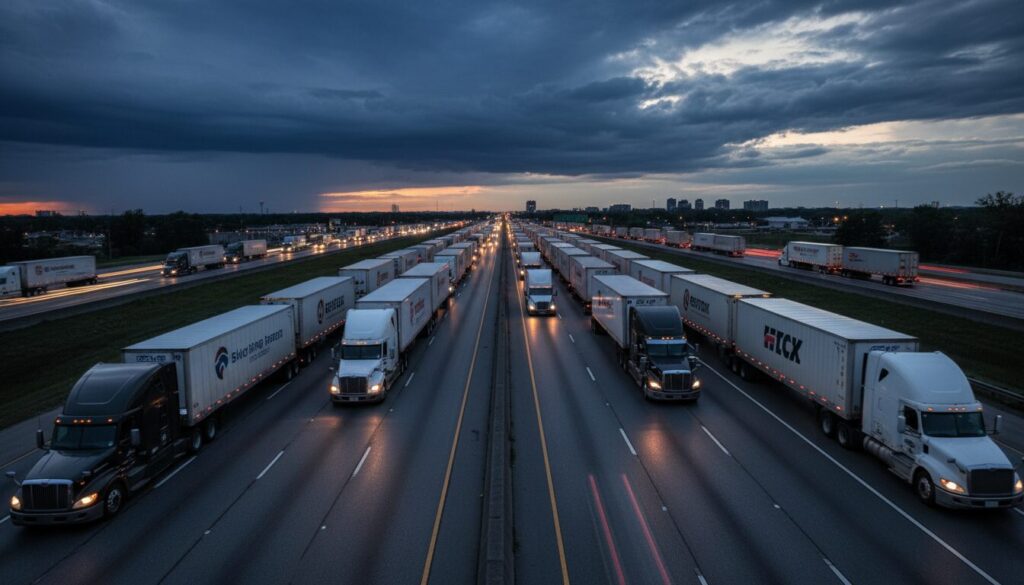
The U.S. logistics sector is currently monitoring a legislative development that threatens to disrupt the equilibrium of the North American freight market more severely than any economic downturn or pandemic-era surge. The proposed “Dalilah Law” is not merely a tightening of regulations; it represents a potential cliff-edge event for trucking capacity.
While the industry has been preparing for a gradual tightening of the market, as discussed in our analysis of 2026 Trucking Capacity: Why It Tightens & Who Wins, the introduction of this statutory law changes the timeline from “gradual” to “immediate.” By restricting Commercial Driver’s Licenses (CDLs) exclusively to U.S. citizens and holders of specific, narrow visa categories, the law threatens to disqualify approximately 614,000 drivers—roughly 16% of the total driver workforce—almost overnight.
For supply chain executives, the implications are clear: we are looking at the potential for a “super cycle” in rates, characterized by a massive, structural supply deficit that could drive spot and contract rates up by 50–100% in heavily impacted lanes.
The Facts: Understanding the Dalilah Law
To navigate this disruption, executives must first understand the mechanics of the legislation. Unlike agency guidelines from the FMCSA or DOT, which are subject to administrative review and delays, the Dalilah Law is proposed as statutory federal law. This distinction makes it highly resistant to immediate legal challenges or bureaucratic pauses.
Key Provisions and Mechanisms
The law operates through a “carrot and stick” mechanism targeting state governments to enforce federal immigration strictures via CDL issuance.
| Feature | Detail |
|---|---|
| Target Demographic | Non-citizen drivers, specifically those without permanent residency or specific authorized visa statuses. |
| The “Purge” Number | Estimated 614,000 drivers currently holding valid CDLs could be disqualified. |
| Requirements | Proof of citizenship/legal status and strictly enforced English-only proficiency testing. |
| Timeline | A strict 180-day recertification window post-enactment. |
| Enforcement | States failing to comply face the forfeiture of federal highway funding—a penalty no state DOT can afford. |
This 180-day window is critical. It creates a definitive “event horizon” where capacity will drop sharply, rather than eroding slowly over time.
Industry Impact: A Structural Shock to the System
The removal of nearly one-sixth of the driving workforce will not be felt evenly across the board. Specific regions, sectors, and carriers will bear the brunt of the chaos, forcing a realignment of supply chain strategies.
Impact on Carriers: The Compliance Cliff
For carriers, particularly long-haul truckload fleets, the Dalilah Law presents an existential personnel crisis. Many fleets rely heavily on immigrant labor, particularly in long-haul lanes that domestic drivers frequently shun.
- Vetting Liability: Carriers will face immediate pressure to audit their current driver pools. As noted in our report on ICE Sweeps & Trucking: 287(g) Risks & Hiring Alert, the burden of verification is shifting to the employer. Under the Dalilah Law, a driver who fails to recertify within 180 days becomes illegal to operate a commercial vehicle instantly, turning a compliant load into a liability risk mid-transit.
- Recruitment Wars: With the driver pool shrinking by 16%, the competition for the remaining eligible drivers will drive wage inflation aggressively. This cost will inevitably be passed to shippers.
Impact on Shippers: The Rate Super Cycle
Shippers accustomed to the “Shipper’s Market” of recent years are facing a rude awakening. The projected disqualification of drivers creates a supply shock that defies standard forecasting models.
- Spot Market Explosion: Analysts predict rate hikes of 50–100% in lanes heavily serviced by immigrant drivers (e.g., border crossings, agricultural corridors, and port drayage).
- Contract Failure: We recently analyzed the gap between carrier and shipper expectations in 2026 Pricing Disconnect: Impact on Future Logistics Rates. The Dalilah Law widens this gap into a canyon. Existing contracts may suffer widely from “tender rejection,” as carriers move capacity to the lucrative spot market or simply lack the drivers to service committed lanes.
Impact on Warehousing and Operations
The shockwave extends to the warehouse dock.
- Schedule Reliability: As capacity tightens, on-time performance usually degrades. Warehouses should expect missed appointments and rolled loads, leading to inventory swells and detention fee disputes.
- English-Only Friction: The strict enforcement of English-only testing may also impact operational communication at shipping and receiving desks, potentially slowing down gate processing times for drivers who remain but struggle with fluency hurdles.
LogiShift View: The Structural “So What?”
While the immediate reaction is panic regarding rates, the LogiShift view looks at the permanent structural changes this law will force upon the industry. This is not a temporary tightening; it is a capacity reset.
1. The End of “Cheap” Trucking
For decades, the U.S. freight market has relied on a sub-segment of the driver population willing to work for lower wages in difficult conditions. The Dalilah Law effectively sets a new, significantly higher floor for freight rates. The “super cycle” mentioned in market projections is likely to establish a “new normal” where transportation costs occupy a larger percentage of COGS (Cost of Goods Sold) permanently.
2. Accelerated Modal Shift to Rail
When truck capacity vanishes, intermodal rail is the primary beneficiary. However, rail capacity is not infinite. Shippers who have not already integrated rail into their strategy will find themselves at the back of the line.
- Strategic Pivot: As detailed in Rail in Future-Proof Supply Chains: Expert Guide, moving long-haul freight to rail reduces dependency on the specific labor pool targeted by the Dalilah Law. We predict a massive surge in intermodal volume 90 days into the 180-day recertification window.
3. The Automation Catalyst
Perhaps the most profound long-term impact will be the acceleration of autonomous trucking. If human drivers are legislated out of existence, the ROI for driverless technology improves drastically.
- Tech Adoption: We are already seeing moves in this space, such as the partnership discussed in Bot Auto Driverless Freight: Impact on Logistics Capacity. The Dalilah Law creates the political and economic environment necessary for regulators to fast-track autonomous corridors, viewing technology not as a job-killer, but as a supply chain savior.
Takeaway: Strategic Action Plan
The Dalilah Law is a statutory threat that requires immediate boardroom attention. Waiting for the law to pass before acting is a failed strategy.
Executive Checklist:
- Audit Your Carrier Base: Do not ask generic questions. Demand data on the percentage of drivers in your dedicated fleets who may be affected by new citizenship or visa requirements.
- Diversify Modes Immediately: If your network is 90% Over-the-Road (OTR) truck, you are exposed. Begin shifting non-urgent long-haul freight to intermodal rail now to secure capacity allocations.
- Renegotiate for Capacity, Not Price: In a super cycle, the cheapest rate is worthless if the truck doesn’t show up. Shift procurement KPIs from “Cost Savings” to “Tender Acceptance” and “Capacity Assurance.”
- Prepare for Force Majeure: Review contracts with legal counsel. Understand if a federal change in driver eligibility constitutes a force majeure event that releases carriers from volume commitments, leaving you exposed to spot market rates.
The Dalilah Law represents a turning point. The era of abundant, low-cost capacity is ending. The companies that survive the coming “super cycle” will be those that treat transportation capacity as a scarce, strategic asset rather than a commodity.
が約23億円調達_hero-300x171.jpg)