
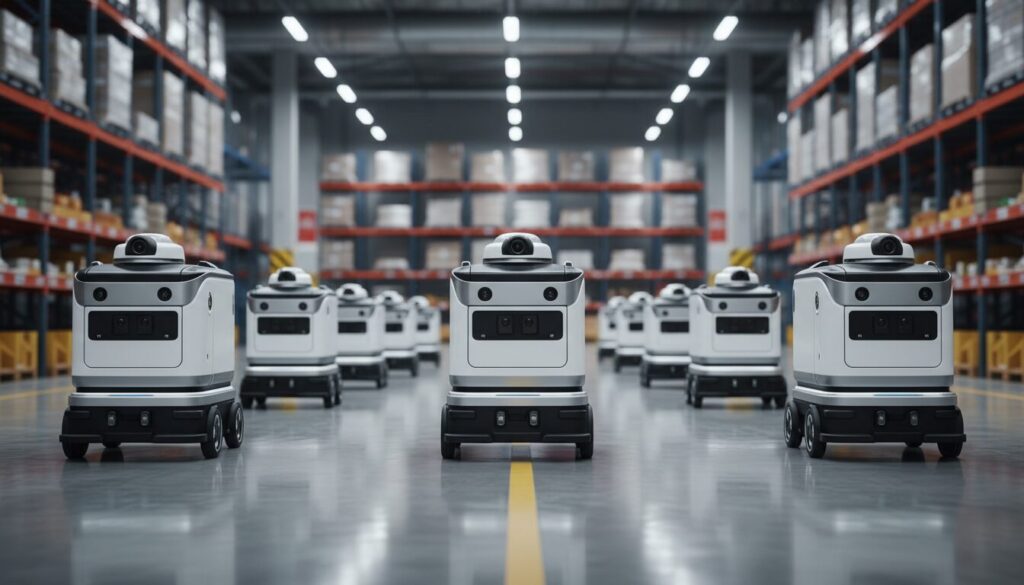
In a financial landscape characterized by cautious capital allocation, a massive signal has emerged from the autonomous logistics sector. Zelos (Zhulu) Technology, a leader in L4 autonomous driving for urban logistics, has secured over USD 300 million in new funding, pushing its valuation past the USD 1 billion mark.
For innovation leaders and strategy executives in the US, Europe, and Asia, this is not just a fundraising headline. It represents a pivotal shift in the “Capital Winter” of autonomous driving. Investors are no longer chasing the distant dream of ubiquitous robotaxis; they are doubling down on the immediate, pragmatic ROI of autonomous urban logistics.
This article breaks down the global implications of Zelos’s rise, compares the trend across major markets, and extracts strategic lessons for supply chain resilience.
Why It Matters: The Pragmatic Turn in Autonomy
For the past five years, the narrative around autonomous vehicles (AV) has been dominated by passenger transport (Robotaxis). However, technical complexity and regulatory deadlock in the US and EU have slowed scaling.
The Zelos funding round signifies a “Pragmatic Turn.” Capital is flowing toward logistics-first autonomy—specifically, last-mile and neighborhood delivery.
Three Drivers of Valuation
Why is Zelos worth $1 billion now?
- Labor Arbitrage to Labor Necessity: In China, it is about scale. In the US and Europe, it is about survival. With driver shortages crippling supply chains globally, autonomous delivery vehicles (ADVs) are transitioning from “experimental” to “essential.”
- Proven Unit Economics: Unlike passenger AVs, logistics vehicles operate at lower speeds (reducing liability), on repeatable routes, and can run 24/7. Zelos has demonstrated that the cost per delivery via ADV is now competitive with, or lower than, human couriers in high-density areas.
- Technological Maturity: The transition from L3 to L4 in controlled urban environments is largely solved. The focus has shifted from “Can it drive?” to “Can it integrate with the Warehouse Management System (WMS) seamlessly?”
As discussed in our previous analysis of the Wayve Case Study: $1.2B Shift to Mapless Autonomous Driving, the industry is bifurcating. While companies like Wayve focus on AI architectures for passenger cars, logistics players like Zelos are mastering the operational hardware for goods movement.
Global Trend: The Divergence of US, China, and EU Markets
While Zelos is the headline, the trend manifests differently across the globe. Understanding these regional nuances is critical for multinational strategy executives planning their logistics roadmap.
The “Middle Mile” vs. “Last Mile” Divide
- United States: The focus remains heavily on the Middle Mile (highway trucking). Companies like Gatik and Aurora are prioritizing hub-to-hub autonomy due to the sprawling geography of US infrastructure. Last-mile sidewalk bots (e.g., Starship) exist but face municipal regulatory friction.
- China: The undisputed leader in Last Mile density. High-population urban centers allow ADVs to deliver massive volumes in small radii. The regulatory environment is highly supportive of road-legal delivery pods.
- Europe: A hybrid market focused on Industrial & Campus logistics. Strict road regulations limit public street deployment, but labor laws make autonomy attractive for closed environments (ports, campuses, factories).
Comparative Analysis of Global Autonomous Logistics
The following table contrasts the adoption maturity and focus areas across key regions:
| Feature | China (e.g., Zelos, Neolix) | United States (e.g., Gatik, Nuro) | Europe (e.g., Einride, Fernride) |
|---|---|---|---|
| Primary Focus | Urban Last-Mile (B2C/B2B) | Middle-Mile (B2B Hub-to-Hub) | Short-Haul / Closed Site |
| Regulatory Status | High Permissibility (Road Legal) | Fragmented (State by State) | Strict (High Safety Standards) |
| Key Driver | Delivery Volume Scalability | Driver Cost Reduction | Green Logistics & Labor Shortage |
| Vehicle Type | Small/Mid-sized Pods (L4) | Class 8 Trucks / Box Trucks | Electric Heavy Trucks / Pods |
| Commercial Stage | Commercial Scale | Pilot to Early Commercial | Early Commercial |
As we observed in the deployment of massive fleets in Human-less Logistics Scale: Qingdao’s 1,200 ADV Fleet, China is rapidly moving from pilot phases to massive, integrated production fleets, a trend now financially validated by the Zelos unicorn status.
Case Study: Zelos Technology’s Path to Unicorn Status
Company: Zelos (Zhulu) Technology
Founded: 2021
Key Milestone: Series B Funding >$300M (Cumulative/Recent rounds), Valuation >$1B.
Core Product: L4 Autonomous Delivery Vehicles (Z5 Series).
The Scale of Operation
Unlike many Western counterparts stuck in “pilot purgatory” (running 10-20 vehicles), Zelos has achieved industrial scale.
- Fleet Size: Deploying thousands of vehicles across major Chinese cities.
- Volume: Handling millions of parcels, effectively relieving pressure on human couriers during peak seasons (like Double 11 or Lunar New Year).
- Integration: The vehicles are not standalone; they are fully integrated into the logistics providers’ TMS (Transport Management Systems), allowing for dynamic routing and automated loading.
Technological Differentiation
Zelos succeeded where others failed by focusing on the operational stack, not just the tech stack.
- Hardware-Software Integration: They design their own chassis and sensor suites, drastically lowering the Bill of Materials (BOM). This allows them to deploy a vehicle for a fraction of the cost of US-based competitors.
- Hybrid Operations: Zelos vehicles are designed to work alongside humans. In high-density office parks, the vehicle acts as a mobile locker, waiting for recipients to unlock it via app, rather than attempting door-to-door drop-off which remains robotically difficult.
- Battery Swapping: To maintain 24/7 uptime, Zelos utilizes rapid battery swapping technology, eliminating long charging downtimes that plague electric delivery fleets.
The “City-First” Strategy
Zelos did not attempt to map the entire country. They selected specific high-density zones (campuses, office districts) and mapped them with high-definition (HD) precision. By conquering these “operational design domains” (ODDs) completely, they achieved profitability in specific zones before expanding.
Key Takeaways for Logistics Executives
The rise of Zelos offers critical lessons for Strategy Executives in the US and EU, regardless of whether they operate in Asia.
1. Shift from “Tech” to “Operations”
The time for Proof of Concept (PoC) is over. Zelos became a unicorn because it demonstrated operational metrics (cost per parcel), not just driving capability.
- Action: When evaluating automation partners, ignore the “cool factor” of the AI. Ask for operational uptime, maintenance cycles, and integration with existing WMS/ERP systems.
2. The Rise of “Robo-as-a-Service” (RaaS)
Zelos’s valuation supports the RaaS model. Logistics companies do not want to own depreciating assets (robots). They want to pay for the outcome (delivery).
- Action: Look for partners offering flexible RaaS contracts rather than heavy CAPEX investments in hardware.
3. Supply Chain Resilience via Hybrid Fleets
The ultimate lesson is resilience. Zelos fleets provided continuity during labor shortages and health crises.
- Action: Strategy leaders must view autonomous fleets not just as a cost-cutting measure, but as a Business Continuity Plan (BCP). A fleet that doesn’t get sick or tired is an insurance policy against global supply chain disruptions.
Future Outlook: The Export of Autonomy
The Zelos funding round is a prelude to global expansion. With the Chinese domestic market validating the technology, the next phase involves exporting this hardware and operational know-how to the Middle East (NEOM project), Southeast Asia, and eventually Europe.
What to Watch in 2025-2026:
- Hardware commoditization: As Zelos and peers scale, the cost of LiDAR and chassis will drop, making adoption in the US/EU more financially viable despite higher labor costs.
- Regulatory Harmonization: We expect to see global ISO standards for L4 delivery vehicles emerge, driven by the sheer volume of vehicles hitting the road in Asia.
- Cross-Border Capital: US and European funds are likely to invest heavily in similar local competitors (like Starship or Gatik) to prevent an Asian monopoly on logistics automation hardware.
Conclusion
Zelos securing over USD 300 million and achieving unicorn status is a watershed moment. It confirms that the future of logistics is not just automated inside the warehouse, but increasingly automated on the “last mile” pavement. For global leaders, the question is no longer if autonomous delivery will scale, but how quickly they can integrate these new “digital workers” into their legacy supply chains.
See also: Human-less Logistics Scale: Qingdao’s 1,200 ADV Fleet for a visual understanding of scale, and Wayve Case Study for contrast on AI methodologies.