
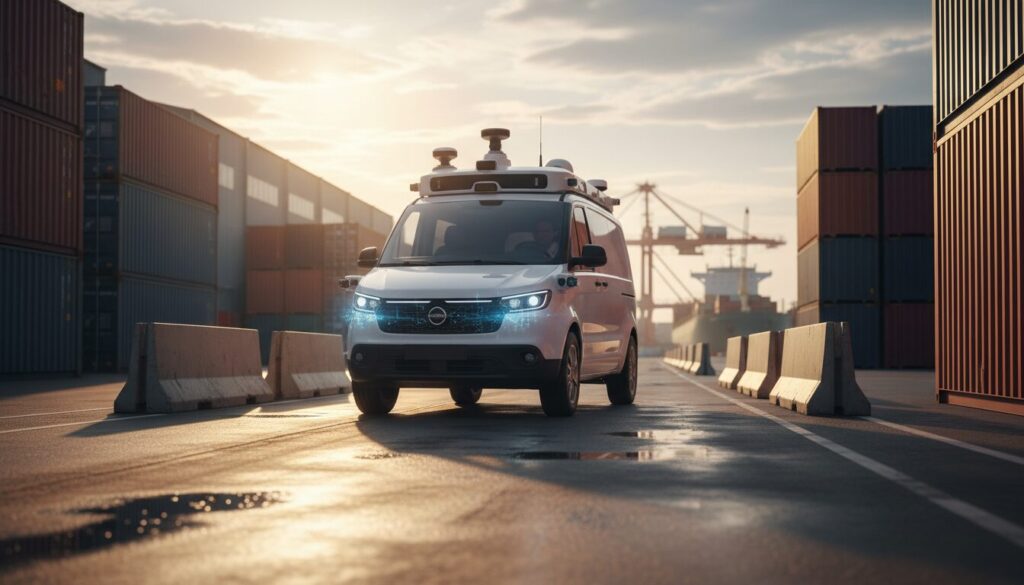
The autonomous vehicle (AV) landscape has long been dominated by a “brute force” philosophy: map every inch of the world, label every pixel, and code strict rules. However, a massive shift occurred recently in London. Wayve, a UK-based self-driving technology startup, secured a staggering $1.2 billion (approx. £800m+) in Series C funding.
Led by SoftBank Group, with participation from industry titans like Nvidia, Microsoft, and Uber, this investment values the company at roughly $8.6 billion. It signals a definitive pivot in the global logistics and mobility strategy: a move away from geofenced, map-reliant systems toward Embodied AI that learns to drive like a human.
For logistics executives, this is not just financial news; it is a signal that the “ChatGPT moment” for autonomous supply chains has arrived.
Why It Matters: The End of Geofencing?
For the past decade, the deployment of autonomous logistics has been hindered by the “HD Map Trap.” Traditional AV leaders (like Waymo or Cruise) rely on high-definition (HD) maps—digital twins of cities that are expensive to create and impossible to maintain in real-time.
Wayve’s success validates a different approach: AV 2.0. By utilizing end-to-end deep learning, the vehicle does not need a map to know how to navigate; it reads the road in real-time using cameras and sensors, interpreting context much like a human driver.
Strategic Implications for Supply Chains
- Mapless Scalability: Logistics fleets can be deployed to new cities (or rural routes) instantly without waiting for map data.
- Cost Reduction: Removing the reliance on expensive LiDAR arrays and constant map maintenance lowers the Total Cost of Ownership (TCO).
- Resilience: An AI that understands “concepts” of driving rather than rigid rules handles edge cases (construction zones, bad weather) better than rule-based systems.
As discussed in our analysis of the IFR: AI Robotics Innovation in Global Logistics, the industry is moving from pre-programmed automation to generative, embodied intelligence. Wayve is the automotive manifestation of this trend.
Global Trend: The divergence of AV 1.0 vs. AV 2.0
To understand why Nvidia and Uber are backing Wayve, one must look at the global geopolitical landscape of autonomous driving. Three distinct models have emerged across the US, China, and Europe.
The Global AV Landscape
| Region | Dominant Strategy | Key Technology | Limitations |
|---|---|---|---|
| USA (Incumbents) | AV 1.0 (Modular) | HD Maps, LiDAR, Rule-based | Geofenced areas only; high maintenance cost. Hard to scale globally. |
| China | V2X (Connected) | Vehicle-to-Everything, Smart Infrastructure | Requires massive government infrastructure spend (e.g., smart roads). |
| Europe/UK (Wayve) | AV 2.0 (End-to-End) | Embodied AI, Mapless, Vision-first | computationally intensive training; historically “black box” logic. |
While China scales through infrastructure integration—demonstrated vividly in the Human-less Logistics Scale: Qingdao’s 1,200 ADV Fleet—Europe and the UK are betting on smarter software to compensate for complex, narrow, and unmapped historical road networks.
Wayve’s specific breakthrough is proving that a “World Model” (an AI that predicts the future state of its environment) is viable for safety-critical applications. This mirrors developments seen in robotics, where companies are moving away from scripted motions. See also: Noematrix Case Study: Scaling Commercial Embodied AI.
Case Study: Wayve’s $1.2B Leap
Wayve was founded in 2017 with a contrarian view: forget the maps, focus on the brain. While competitors burned billions scanning streets, Wayve built foundation models for driving.
The Investment Breakdown
The $1.2 billion round is notable not just for the amount, but for who invested. The syndicate represents the entire supply chain ecosystem:
- The Brain (Nvidia): Nvidia’s investment confirms that Wayve’s architecture is the ideal software layer for Nvidia’s DRIVE Thor hardware.
- The Cloud (Microsoft): Training end-to-end models requires massive supercomputing infrastructure.
- The Network (Uber): Uber’s strategic investment suggests they view Wayve as a key to unlocking global scalability for their platform, moving beyond their reliance on geofenced partners.
- The Metal (Automakers): Existing investors and partners include Nissan, Mercedes-Benz, and Stellantis.
The “Asset-Light” Business Model
Unlike Tesla or Waymo, Wayve does not want to build cars, nor does it want to operate a taxi fleet.
Wayve’s model is pure software licensing. They provide the “driver” (the AI software) to OEMs (Original Equipment Manufacturers). This allows automakers to sell vehicles that are “AI-ready” out of the factory.
- Stellantis: Testing Wayve’s software in delivery vans.
- Ocado (UK Grocery Giant): Using Wayve for last-mile autonomous grocery delivery trials.
Uber’s Strategic Pivot
Uber’s participation is particularly critical. As detailed in Uber’s Global Swiss Army Knife Robotaxi Strategy, Uber is pivoting from a manufacturer to a platform aggregator. Uber intends to deploy Wayve-powered vehicles in consumer markets.
Because Wayve is mapless, Uber can theoretically launch a robotaxi service in London, Paris, or Mumbai using the same core software, without the years of mapping required by competitors.
Key Takeaways for Logistics Leaders
The success of Wayve’s funding round offers four critical lessons for supply chain strategy executives.
1. Decoupling Hardware and Intelligence
The future of logistics fleets is hardware-agnostic. Wayve’s AI works on electric vans, light trucks, and passenger cars. Companies should invest in software layers that can be ported across different vehicle form factors, rather than locking into a single OEM’s proprietary hardware ecosystem.
2. The Rise of “General Purpose” Robotics
Just as GigaBrain-0.5M Case Study: World-Model VLA Innovation highlighted the shift toward general-purpose robot brains in warehousing, Wayve highlights the same for transportation. The trend is away from specialized, rigid automation toward generalized, adaptive AI.
3. Data is the New Map
If maps are obsolete, data is the new gold. Wayve’s advantage lies in its training data—petabytes of driving video from diverse environments. Logistics companies with large fleets should consider their dashcam footage as a valuable asset for training future autonomous systems.
4. Supply Chain Resilience via Autonomy
In mapless autonomy, a detour is just another road. Traditional AVs often freeze when forced off their mapped route (e.g., due to a sudden road closure). Wayve’s system can navigate unfamiliar detours instinctively. For logistics, this means higher reliability and fewer “rescue missions” for stranded robots.
Future Outlook: The Race for Level 4
With $1.2 billion in fresh capital, Wayve is accelerating toward Level 4 autonomy (high automation without human intervention in most conditions).
Short Term (1-3 Years)
- Commercial Trials: Expansion of trials with Uber and delivery partners (Ocado/Asda) in the UK.
- OEM Integration: Announcements of “Wayve Inside” consumer vehicles or commercial vans from partners like Stellantis.
Long Term (5+ Years)
- Global Export: Because the software is mapless, Wayve will likely attempt to crack markets that were previously considered “too difficult” for AVs due to chaotic traffic, such as India or Southeast Asia.
- Standardization: We may see a consolidation where automakers stop developing their own subpar ADAS (Advanced Driver Assistance Systems) and simply license Wayve or Tesla FSD.
Conclusion
Wayve’s massive funding round validates the “End-to-End” AI approach. For the logistics industry, this signals a future where autonomous delivery is not limited to the wide avenues of Phoenix, Arizona, but is capable of navigating the complex, unmapped realities of the global supply chain. The era of the map is ending; the era of the embodied driver has begun.