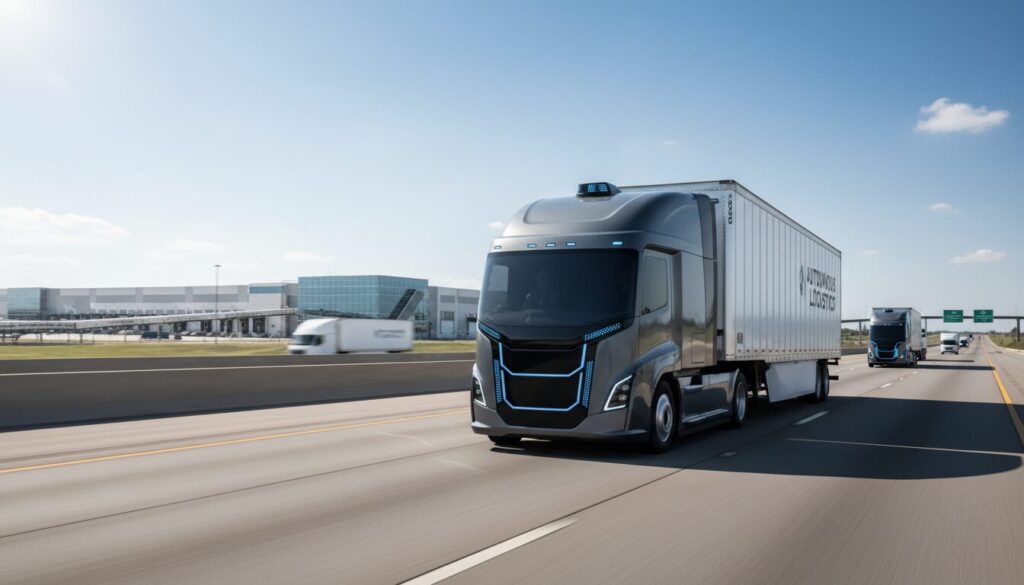
The promise of autonomous trucking has long hovered on the horizon, often obscured by regulatory fog and technological hurdles. However, the strategic partnership between Bot Auto and Ryan Transportation marks a decisive shift from theoretical pilots to commercial reality.
By launching driverless freight operations on the high-density Houston-Dallas corridor in Spring 2024, these companies are not just testing technology—they are rewriting the operational playbook for short-haul, middle-mile logistics. For executives, this is the signal that the autonomous brokerage model is open for business.
The Convergence of Tech and Brokerage
This partnership represents a maturation in the Autonomous Vehicle (AV) sector. Rather than an AV startup attempting to build a carrier network from scratch, Bot Auto is leveraging the established freight density of Ryan Transportation, a Top 20 North American freight brokerage.
The collaboration targets a specific inefficiency in the supply chain: the 200-mile overnight lane. While human drivers are constrained by Hours of Service (HOS) and biological fatigue, autonomous trucks thrive in these repetitive, overnight windows.
Why This Matters Now
The timing is critical. As the industry braces for capacity tightening in the coming years, shippers are seeking alternatives to volatile spot markets and labor-constrained lanes.
For a deeper understanding of the macroeconomic factors driving this need, see our analysis on 2026 Trucking Capacity: Why It Tightens & Who Wins. The Bot Auto deployment offers a hedge against the very capacity crunches we predicted.
The Facts: Bot Auto & Ryan Transportation Partnership
To understand the scope of this deployment, we must look at the operational specifics. This is not a vague “future goal”; it is a tactical deployment scheduled for immediate execution.
| Dimension | Details |
|---|---|
| Entities | Bot Auto (AV Tech) & Ryan Transportation (Brokerage/3PL). |
| Route | Houston to Dallas (I-45 Corridor). Approx. 200 miles. |
| Launch Timing | Spring 2024. |
| Operational Model | Transportation-as-a-Service (TaaS). Bot Auto operates the trucks; Ryan Transportation provides the freight. |
| Key Problem Solved | Overcoming Hours of Service (HOS) limitations and driver shortages on overnight lanes. |
| Risk Management | Specialized A-rated insurance coverage secured via Marsh, covering liability, cargo, and cyber risks. |
The “Golden Lane” Strategy
The choice of the Houston-Dallas route is calculated. The “Texas Triangle” is one of the densest freight corridors in the United States.
- Distance: ~240 miles.
- Human Limitation: A round trip often pushes the limits of an 11-hour driving window when accounting for loading/unloading (detention) times.
- AV Advantage: A robot can make the trip, turn around immediately, and return, doubling asset utilization without violating federal regulations.
Industry Impact: Who Wins and Who Adapts?
This deployment moves the conversation from “Does the tech work?” to “How do we insure and book it?” The ripple effects will be felt across three primary sectors.
1. The Brokerage Sector
Ryan Transportation’s move validates the “Hybrid Brokerage” model. Brokers will no longer just aggregate human carriers; they will become fleet managers of mixed assets—human and autonomous.
- Capacity Buffer: Brokers can offer “guaranteed” capacity on fixed lanes regardless of driver availability.
- Margin Expansion: Autonomous lanes, once stabilized, offer lower variable costs (fuel efficiency, 24/7 running time) compared to spot-market human rates.
2. Shippers and Manufacturers
For shippers, this introduces a new tier of service: Premium Standard.
- Predictability: Unlike human drivers who may be delayed by mandatory rest breaks or traffic fatigue, the AV schedule is mathematically consistent.
- Inventory Velocity: Overnight runs between major hubs allow for “warehouse-on-wheels” strategies, reducing static inventory costs in Dallas or Houston distribution centers.
3. Insurance and Regulation
The involvement of Marsh in securing A-rated insurance is perhaps the most significant “boring” detail of the news.
- Legitimacy: A-rated insurance signals that the actuarial data supports the safety case. This lowers the barrier to entry for future AV fleets.
- Precedent: This policy framework covers liability and cyber risks—a critical component as fleets become more digital.
As we discussed in Why Trucking Reform Lags Your Timeline: Essential Strategies, regulatory progress is often slow. However, commercial insurance often moves faster than federal law. When insurers back a route, regulators often follow.
LogiShift View: The Rise of “Middle-Mile” Autonomy
The headline is about two companies, but the trend is about the segmentation of the supply chain.
At LogiShift, we believe this partnership signals the death of the “Cross-Country Robot” dream in the short term, and the rise of the Regional Relay.
The “Boring” Lane Thesis
Tech companies previously chased the romantic idea of a truck driving from New York to LA. That is complex, crosses multiple jurisdictions, and faces massive weather variables.
Bot Auto is proving that the money is in the “boring” lanes.
- High Repetition: The machine learning models learn the I-45 corridor faster because they run it daily.
- Operational Ease: If a truck breaks down, it is never more than 100 miles from a support center.
Capital Efficiency vs. Moonshots
This pragmatic approach contrasts with other sectors of logistics autonomy. For instance, in our analysis of Zelos $300M Funding: A Global Logistics Unicorn Case Study, we looked at L4 autonomy for last-mile delivery. Bot Auto is the middle-mile equivalent—less flashy, but arguably more critical for moving bulk tonnage.
While Uber pivots to a global robotaxi strategy (see: Uber’s Global Swiss Army Knife Robotaxi Strategy), freight demands dedicated, heavy-duty solutions. The TaaS model employed by Bot Auto allows them to focus on the vehicle, while Ryan Transportation handles the customer facing complexity.
The Human Element
This does not replace drivers; it reallocates them. The Houston-Dallas lane is grueling for daily turns. By automating this, human drivers can be reallocated to more complex, regional pickup/delivery (P&D) routes or drayage operations where human intuition is required.
Takeaway: Strategic Steps for Executives
The Bot Auto and Ryan Transportation partnership is a proof of concept for 2024 logistics. Here is how you should react:
- Audit Your Lanes: Identify your high-volume, short-haul (150-300 mile) lanes. These are your prime candidates for future autonomous conversion.
- Challenge Your 3PL: Ask your current brokerage partners what their AV strategy is. If they don’t have access to autonomous capacity, they may be at a cost disadvantage by 2026.
- Review Insurance Standards: If you are a shipper, ensure your carrier contracts are updated to account for autonomous liability. The Marsh precedent provides a benchmark for what coverage should look like.
The era of autonomous freight is no longer about if; it is about which lane. The I-45 corridor is just the beginning.