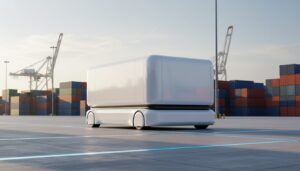

The autonomous vehicle (AV) industry is undergoing a seismic shift. For the last decade, the race was defined by algorithmic superiority—who could build the smartest driver. Today, the battleground has shifted from feasibility to scalability. As the technology matures, the logistical nightmare of managing thousands of driverless assets has become the primary bottleneck for commercialization.
Enter Uber. Once aspiring to build its own self-driving cars, the ride-hailing giant has pivoted dramatically. Through its newly launched division, Uber Autonomous Solutions, Uber wants to be a Swiss Army Knife for robotaxis. Instead of competing with AV manufacturers, Uber is positioning itself as the indispensable infrastructure layer—providing the fleet management, demand generation, and operational depth required to make autonomy profitable.
For innovation leaders and logistics strategists, this move signals a critical evolution in the global supply chain: the separation of asset ownership from asset operation.
Why It Matters: The Operational Gap in Autonomy
The excitement surrounding autonomous logistics often focuses on the “mile”—specifically the middle mile (trucking) or the last mile (delivery). However, the hidden challenge lies in the “zero mile”: the cleaning, charging, maintenance, storage, and dispatching of these vehicles.
The utilization challenge
Autonomous vehicles are capital-intensive assets. To achieve a return on investment (ROI), they must operate nearly 24/7. A robotaxi sitting idle is a financial liability.
- Hardware Costs: High-end LiDAR and compute stacks cost tens of thousands of dollars per unit.
- Operational Friction: AVs cannot fix flat tires, plug themselves into non-automated chargers, or clean up spills left by passengers.
Uber’s strategy addresses this gap. By offering a “Swiss Army Knife” of services—ranging from demand aggregation to physical fleet maintenance—Uber reduces the barrier to entry for AV developers.
As discussed in our analysis of Aurora Driverless Trucks: 15-Hour Transit Impact Alert, the capability of the software is only half the equation. The operational ecosystem must be robust enough to support continuous transit.
Global Trend: The Race for AV Ecosystem Dominance
While Uber is making headlines with its pivot, the trend of decoupling technology from operations is global. Different regions are approaching the commercialization of AVs with distinct strategies.
United States: The Hybrid Network Model
In the US, the market is moving toward a hybrid model where AVs and human drivers coexist on the same networks. Companies like Waymo and Zoox are leaders in technology, but they face scaling challenges. The trend here is partnership.
- Key Player: Waymo (Google) partnering with Uber.
- Focus: High-density urban centers (Phoenix, San Francisco, Los Angeles).
China: State-Backed Scale
China is deploying AVs at a speed and scale unmatched globally, largely due to government support and infrastructure integration. The approach here is vertical integration, where tech giants often control both the software and the fleet operations, though this is starting to fragment.
- Key Player: Baidu (Apollo Go) and Pony.ai.
- Focus: Massive scale deployment and smart city integration.
- Reference: For a visual understanding of this scale, see Human-less Logistics Scale: Qingdao’s 1,200 ADV Fleet.
Europe: The B2B Pragmatists
Europe has taken a more cautious, regulatory-heavy approach, focusing on industrial applications, closed-campus logistics, and freight rather than open-road robotaxis.
- Key Player: Einride (Sweden).
- Focus: Electric, autonomous freight mobility.
Regional Comparison: AV Commercialization Maturity
| Feature | United States | China | Europe |
|---|---|---|---|
| Primary Focus | Consumer Robotaxi & Long-haul Trucking | Consumer Robotaxi & Last-Mile Delivery | Industrial Freight & Closed Campus |
| Regulation Style | State-by-State Patchwork | Centralized & Agile | Strict & Safety-First (GDPR/EU AI Act) |
| Infrastructure | Private Investment | Public-Private Partnership | Mixed |
| Uber’s Role | Aggregator & Fleet Manager | Partner (via Baidu/Didi) | Market Connector |
Case Study: Uber Autonomous Solutions
Uber’s launch of Uber Autonomous Solutions is the definitive case study for the “Platform-as-a-Service” model in the physical world. This division is not merely a booking agent; it is a full-stack operational partner.
The Strategy: From Competitor to Utility
Years ago, Uber’s “Advanced Technologies Group” (ATG) burned billions trying to build a self-driving car to replace drivers. Recognizing that Waymo and others were winning the tech race, Uber sold ATG and pivoted. Now, Uber wants to be a Swiss Army Knife for robotaxis, offering tools that every AV company needs but none want to build from scratch.
Key Components of the “Swiss Army Knife”
The initiative includes a $100 million investment allocated for fast-charging stations and the ‘Uber AV Labs’ data team. Here is how the service stack breaks down:
-
Demand Aggregation (The Marketplace)
AV companies like Waabi or Aurora have the trucks, but they don’t have the shippers. Waymo has the cars, but not the user base of 130 million monthly active users. Uber plugs these AVs instantly into a global demand network. -
Operational Depth (The Infrastructure)
This is the core innovation. Uber handles the physical reality of logistics.- Fleet Financing: Helping partners secure capital to build cars.
- Remote Assistance: Human agents who can guide a confused robotaxi through a construction zone remotely.
- Maintenance & Charging: Uber is building hubs where AVs can be cleaned and supercharged.
-
Regulatory & Insurance Compliance
Navigating the insurance landscape for driverless vehicles is complex. Uber leverages its massive actuarial data to help insure these fleets.
Strategic Partnerships
Uber is currently partnering with nearly 24 AV companies, creating a diverse ecosystem:
- Robotaxis: Waymo (US), Cruise (US).
- Trucking: Waabi (long-haul freight), Aurora.
- International: Baidu (China).
- Delivery: Sidewalk delivery bots for Uber Eats.
Target: The initiative aims to scale robotaxi deployments to more than 15 cities by the end of 2024.
The Financial Logic
For an AV maker, building a fleet operations team in every city is prohibitively expensive. By outsourcing this to Uber, they convert fixed costs (warehouses, staff) into variable costs (revenue share). For Uber, this secures their future: they don’t need to own the robot, they just need to control the network it runs on.
Key Takeaways for Logistics Leaders
Uber’s pivot offers profound lessons for strategy executives in the logistics and supply chain sectors.
1. Own the Interface, Not the Asset
The most valuable position in the future supply chain is not necessarily owning the trucks or the ships, but owning the digital platform that orchestrates them. Uber is proving that being the “Swiss Army Knife”—the enabler—is more scalable than being the manufacturer.
2. Hybrid Fleets are the Medium-Term Reality
Pure autonomy is decades away from ubiquity. The winning strategy is managing a hybrid workforce. Uber’s algorithm dispatches a human driver for complex routes (like a pick-up at a crowded stadium) and a robotaxi for simple routes (highway trips). Logistics managers must build TMS (Transportation Management Systems) that can handle mixed fleets seamlessly.
3. The “Zero Mile” Determines Profitability
As automation increases, the competitive advantage shifts to maintenance and utilization.
- Lesson: Invest in the infrastructure that keeps assets moving. If your autonomous forklifts or trucks are down for charging/maintenance for 6 hours a day, your ROI collapses.
4. Collaboration over Vertical Integration
Uber partnering with its former arch-rival Waymo demonstrates that the era of “winner takes all” vertical integration is ending. The complexity of global logistics requires an ecosystem approach.
Future Outlook: The Operating System of Logistics
If Uber succeeds, it will become the operating system for autonomous movement. We can expect three major developments in the next 3-5 years:
Expansion into Freight
While robotaxis grab headlines, the “Swiss Army Knife” model is even more applicable to freight. Uber Freight could become the primary manager for autonomous trucking lanes, handling the “transfer hubs” where a human driver hands off a trailer to an autonomous truck for the long haul. This aligns with the efficiency gains seen in long-haul autonomous transit, as noted in the Aurora Driverless Trucks developments.
The Rise of “Fleet-as-a-Service” (FaaS)
We will likely see the emergence of third-party companies dedicated solely to the cleaning, charging, and rescuing of delivery bots and AVs, likely standardized by Uber’s protocols.
Data Monetization
The ‘Uber AV Labs’ data team will likely become a powerhouse, selling road data, mapping updates, and traffic patterns back to municipalities and other AV developers, creating a secondary revenue stream.
Conclusion
Uber wants to be a Swiss Army Knife for robotaxis because it understands a fundamental truth about the future of logistics: The technology is the engine, but the network is the fuel. By building the operational layer that connects high-tech vehicles with real-world demand, Uber is not just surviving the driverless transition—it is actively paving the road.
For global logistics leaders, the message is clear: Stop trying to build everything yourself. Find your “Swiss Army Knife” partner, or become one for your specific niche. The future belongs to the integrators.