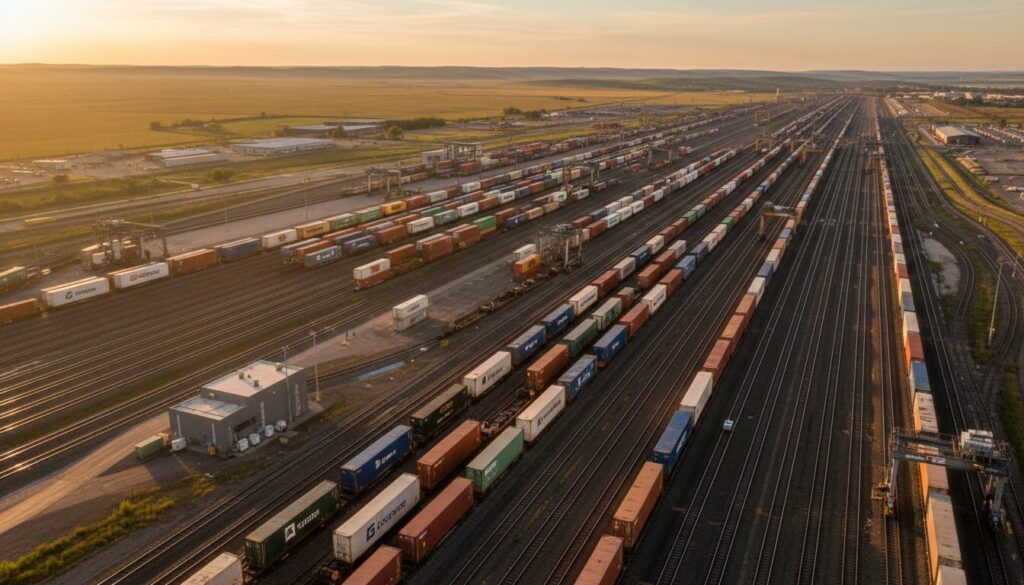
The era of fragmented, localized logistics is rapidly closing. In a move that signals a massive shift toward continental integration, Cando Rail & Terminals has announced the acquisition of Savage Rail. This transaction is not merely an asset purchase; it represents the unification of the North American industrial supply chain, creating a cross-border behemoth capable of servicing the entire continent through a single, integrated platform.
For innovation leaders and strategy executives, this deal is a signal flare. It highlights the growing necessity for “infrastructure density”—the ability to control the first and last mile of transit while maintaining neutral access to major long-haul networks.
Why It Matters: The Era of Continental Integration
The global logistics landscape is undergoing a fundamental restructuring. For the past two decades, the focus was on “Just-in-Time” efficiency, often at the expense of resilience. However, the post-pandemic reality has shifted the strategic priority to “Just-in-Case” and “Friend-shoring.”
The Cando, Savage Rail in far-reaching crossborder rail deal matters because it addresses the single biggest bottleneck in North American rail logistics: the fragmentation between the “long-haul” (Class I railroads) and the “first/last mile” (industrial switching and terminal services).
By combining operations, the new entity creates a seamless bridge between industrial producers and the major rail arteries. This is crucial for three reasons:
- Supply Chain Sovereignty: As the US, Canada, and Mexico tighten economic ties under agreements like USMCA, the ability to move goods fluidly across borders without handoff friction is a competitive moat.
- Decarbonization at Scale: Rail is 3-4 times more fuel-efficient than truck. However, the difficulty of accessing rail networks (the first mile) often pushes shippers to trucks. Optimizing this access point is a direct sustainability lever.
- Network Neutrality: This deal creates a massive independent operator with access to all six Class I railroads, giving shippers leverage and flexibility that single-carrier contracts cannot match.
Global Trend: The Race for Rail Interoperability
While this specific deal focuses on North America, it mirrors a global struggle to harmonize rail networks to compete with road and maritime transport.
Europe: The Battle for a Single European Railway Area
In the European Union, the “Shift to Rail” initiative aims to double rail freight market share by 2030. However, Europe faces a challenge that North America does not: technical fragmentation.
- Infrastructure: Differing track gauges (in the Baltics/Spain vs. Central Europe), electrification voltages, and signaling systems (ETCS adoption is slow).
- Operations: Cross-border handovers often require changing locomotives or drivers, causing significant delays.
While the EU is investing billions in the TEN-T (Trans-European Transport Network) corridors, the market remains fragmented among national incumbents (like DB Cargo, SNCF) and smaller private challengers. There is no single “first/mile” aggregator in Europe with the scale that the Cando-Savage entity will possess in North America.
Asia: China’s Strategic Corridors
China has taken a state-led approach via the Belt and Road Initiative (BRI).
- CR Express (China-Europe Railway Express): This is a centralized, government-subsidized effort to link Chinese manufacturing hubs with European markets.
- Integration: The challenge here is geopolitical rather than commercial. While infrastructure is rapidly built, the reliability of these corridors is subject to diplomatic relations.
- Domestic vs. Cross-Border: Domestically, China Rail moves massive volumes, but the “last mile” is often heavily truck-dependent due to the location of legacy rail yards versus new industrial parks.
North America: The Commercial Aggregator Model
The US and Canada share a unique advantage: a standardized gauge and integrated operating rules. The trend here—exemplified by the Cando-Savage deal—is commercial consolidation.
Unlike Europe’s regulatory push or China’s state mandates, North American resilience is being built by private equity and strategic M&A. The goal is to create “super-connectors” that sit between the shipper and the Class I giants (UP, BNSF, CSX, NS, CN, CPKC).
Comparative Analysis of Rail Logistics Trends
| Region | Primary Driver | Key Challenge | Connectivity Model |
|---|---|---|---|
| North America | Private M&A / Efficiency | Labor shortages & Terminal capacity | Vertical Integration: Aggregators connecting to Class I networks. |
| Europe | Regulatory (Green Deal) | Technical Interoperability (Borders) | Corridor Based: TEN-T network focus with national handovers. |
| China/Asia | State Strategic (BRI) | Geopolitics & Last-Mile Trucking | State-Led: Massive infrastructure spend with centralized planning. |
Case Study: Cando, Savage Rail in Far-Reaching Crossborder Rail Deal
The acquisition of Savage Rail by Cando Rail & Terminals is the definitive case study for modern logistics scaling. This is not just about growing revenue; it is about architectural perfection in supply chain design.
The Strategic Footprint
The combined entity presents a staggering infrastructure portfolio that resolves the geographic limitations of regional players.
- Terminals: 36 multi-purpose terminals.
- Operations: 80+ first/last mile rail operations.
- Railways: 3 owned short-line railways.
- Employees: ~1,700 logistics professionals.
The “Zero Overlap” Advantage
According to the deal announcements, there is effectively “zero geographic overlap” between the two companies.
- Cando has historically been a powerhouse in Canada (originating in Brandon, Manitoba) and has been pushing southward.
- Savage Rail (a unit of Savage Companies) has deep roots in the US industrial heartland and energy sectors.
This complementarity allows the merged entity to offer a customer—say, a lumber producer in British Columbia or a chemical manufacturer in Texas—a single standard of service at origin and destination, regardless of where they are on the continent.
Access to All Six Class I Railroads
Perhaps the most critical innovation element is the network neutrality. The combined network connects directly to:
- Canadian National (CN)
- Canadian Pacific Kansas City (CPKC)
- BNSF Railway
- Union Pacific (UP)
- CSX Transportation
- Norfolk Southern (NS)
Why this is a game-changer:
For a strategy executive at a major shipper, this de-risks the supply chain. If one Class I railroad experiences disruptions (strikes, washouts, congestion), a facility served by this neutral aggregator can often reroute volume to a competing Class I line if the terminal infrastructure allows it. It transforms the shipper from a “captive customer” to a “network user.”
Investment and Capital Scale
Cando is not growing organically; it is scaling aggressively through capital deployment. The company has invested over $1 billion in capital through four acquisitions in just the past two years. This signals that the “middle market” of rail logistics is consolidating into a tier of “infrastructure heavyweights” that have the balance sheet to automate terminals and invest in green technology.
For further reading on how rail fits into modern resilience strategies, refer to our analysis: Rail in Future-Proof Supply Chains: Expert Guide.
Key Takeaways for Logistics Leaders
The Cando-Savage deal offers distinct lessons for executives planning their logistics roadmap for 2026 and beyond.
1. The “First Mile” is the Strategic Control Point
The long-haul journey is a commodity; the value is created or lost in the first and last mile.
- Action: Audit your supply chain. Do you rely on generic switching services, or do you have integrated partners who optimize railcar staging, cleaning, and loading? Owning or partnering closely with first-mile infrastructure reduces dwell time and demurrage costs.
2. Resilience Requires Network Optionality
The ability to access multiple Class I railroads through a single terminal partner is a massive hedge against volatility.
- Action: When selecting distribution center locations or manufacturing sites, prioritize locations served by “neutral” short-lines or terminal operators like the new Cando entity, rather than sites captive to a single Class I railroad.
3. Cross-Border Friction is a Solvable Cost
With the integration of Canadian and US operations, the administrative and operational friction of cross-border rail is reduced.
- Action: Look for logistics partners who treat the US-Canada border as a seamless internal transit zone rather than a hard handover point.
Future Outlook
The transaction is expected to close in Q2 2026, subject to regulatory approvals. Upon closing, the new US headquarters will be established in Salt Lake City, Utah, a strategic choice given its proximity to major western rail junctions and the “Crossroads of the West.”
What to Watch
- Technological Integration: The next frontier for this merged giant will be digitizing the 80+ operations. Expect to see a unified digital customer portal that provides visibility from a terminal in Alberta to a yard in Texas.
- Further Consolidation: This deal will likely trigger a response from other infrastructure funds and logistics operators. We expect to see a wave of M&A targeting smaller, family-owned short-lines to roll them up into larger, more efficient networks.
- Sustainability Reporting: As Scope 3 emissions reporting becomes mandatory in global markets, this unified rail network will likely launch standardized carbon tracking for first/last mile rail moves, giving shippers certified data for their ESG reports.
The Cando, Savage Rail in far-reaching crossborder rail deal is more than a merger; it is the blueprint for the future of North American industrial transport. By prioritizing network density and cross-border fluidity, it sets a new standard for how goods move across the continent.