As geopolitical tensions tighten around the high-tech manufacturing sector, a pressing question dominates boardroom discussions in Washington, Brussels, and Seoul: Can the government fix the trouble with the supply of critical materials?
For decades, the global logistics and manufacturing sectors operated on the principle of efficiency—sourcing raw materials wherever they were cheapest. Today, that era is ending. With China controlling approximately 90% of global processing for critical minerals, Western governments are shifting from passive observers to active market participants.
The launch of the United States’ Project Vault and the allied trade partnership FORGE signals a massive pivot in global supply chain strategy. For innovation leaders and strategy executives, this represents a transition from “Just-in-Time” to “Just-in-Case,” backed by billions in public funding.
This article analyzes how government intervention is reshaping the logistics of critical minerals, using real-world data and case studies to forecast the impact on global trade.
Why It Matters: The End of Free-Market Minerals
The urgency of this trend cannot be overstated. Critical minerals—lithium, cobalt, nickel, and rare earth elements (REEs)—are the bedrock of the modern economy, powering everything from electric vehicle (EV) batteries to advanced defense systems.
However, the supply chain is dangerously concentrated.
The Vulnerability Index
Currently, the upstream supply chain faces a “single point of failure” risk profile:
- Processing Dominance: China controls 87-90% of global rare earth processing and nearly 100% of heavy rare earth refining.
- Lead Time Lag: According to S&P Global and IEA data, the average time to move a mining project from discovery to production in the U.S. is 29 years.
- Price Volatility: Dominant players can flood the market (dumping) to drive prices down, bankrupted emerging competitors in the West before they can scale.
As discussed in our analysis of China Bans Dual-Use Item Exports to Japan: Global Impact, the weaponization of export controls is already happening. Government intervention is no longer about protectionism; it is about survival.
Global Trend: The Rise of “State-Sponsored Resilience”
To answer the question—Can the government fix the trouble with the supply of critical materials?—we must look at the specific mechanisms being deployed. The strategy has shifted from “total independence” (which is impossible in the short term) to “managed reliance” and price stabilization.
1. Project Vault: The $12 Billion Buffer
The United States has launched Project Vault, a sovereign financing vehicle designed to insulate Western miners from predatory pricing.
- Structure: A $12 billion public-private partnership.
- Funding Split: $10 billion in loans/guarantees from the Export-Import Bank (EXIM) and $2 billion from private capital.
- Mechanism: It acts as a “strategic reserve” but for value. By guaranteeing price floors or offering low-interest liquidity, it ensures that Western mining projects do not go bankrupt during temporary price crashes engineered by competitors.
2. FORGE: The “NATO” of Minerals
While Project Vault handles financing, FORGE handles trade architecture. This new trade partnership, chaired by South Korea, is designed to counter market dumping.
- Goal: Establish a “buyers’ club” that agrees to pay a premium for sustainably sourced, non-conflict minerals.
- Function: It sets price floors and coordinate standards, ensuring that a mine in Australia or Canada has a guaranteed customer base in the EU and Asia, even if Chinese spot prices are lower.
3. The European Approach
The EU’s Critical Raw Materials Act (CRMA) complements these efforts by mandating that no more than 65% of any strategic raw material comes from a single third country by 2030.
Comparison of Global Intervention Strategies
| Feature | Project Vault (USA) | FORGE (Global Alliance) | China’s Strategy |
|---|---|---|---|
| Primary Tool | Financial Liquidity ($12B Fund) | Trade Policy & Price Floors | Export Quotas & Subsidies |
| Key Objective | Prevent bankruptcy of local miners | Create a protected market bloc | Maintain global processing dominance |
| Leadership | US EXIM Bank / Private Equity | South Korea (Chair) | State-Owned Enterprises (SOEs) |
| Time Horizon | Short-to-Medium Term (Liquidity) | Long Term (Structural) | Established (decades ahead) |
Case Study: Lynas Rare Earths and the DoD
To understand if government money actually translates to supply chain security, we look at Lynas Rare Earths. As the only significant producer of separated rare earths outside of China, Lynas serves as the perfect test case for the public-private model.
The Challenge
For years, Lynas mined ore in Australia but faced immense pressure due to Chinese price undercutting. Furthermore, while they could mine Light Rare Earths (LREE), the refining capability for Heavy Rare Earths (HREE)—critical for permanent magnets in defense and EVs—was almost non-existent outside China.
The Government Intervention
The U.S. Department of Defense (DoD) recognized that “the market” would not fix this gap fast enough. The ROI was too low, and the risk was too high.
- Phase 1 Funding: The DoD awarded Lynas roughly $120 million to build a commercial Heavy Rare Earths separation facility in Texas.
- Expansion: Subsequent funding and support mechanisms allowed Lynas to expand its footprint, creating a fully domestic processing capability on U.S. soil.
The Result
- Resilience: The Texas facility provides a strategic release valve. Even if Asian shipping lanes are disrupted, the U.S. has domestic refining capacity.
- Price Stability: By subsidizing the CapEx (Capital Expenditure), the government lowered Lynas’s breakeven price, allowing them to compete closer to Chinese price points without operating at a loss.
This case proves that the government can fix specific supply troubles, but only through direct capital injection. It mirrors the trends seen in other sectors, such as battery manufacturing. See also: Chinese Energy Storage: Localization vs. Tariffs, where similar localization pressures are reshaping the energy storage landscape.
Key Takeaways for Logistics & Strategy Leaders
For executives observing this shift, the implications extend beyond mining. The logistics of high-tech manufacturing are changing fundamentally.
1. The Rise of the “Security Premium”
Procurement leaders must accept that the era of “lowest cost wins” is over.
- New Reality: Sourcing from FORGE-compliant nations or Project Vault-backed companies will cost more than sourcing from the spot market.
- Action: Logistics contracts must account for this “Security Premium.” Companies should market their supply chain resilience as a value proposition to customers who fear disruption.
2. Inventory is King (Again)
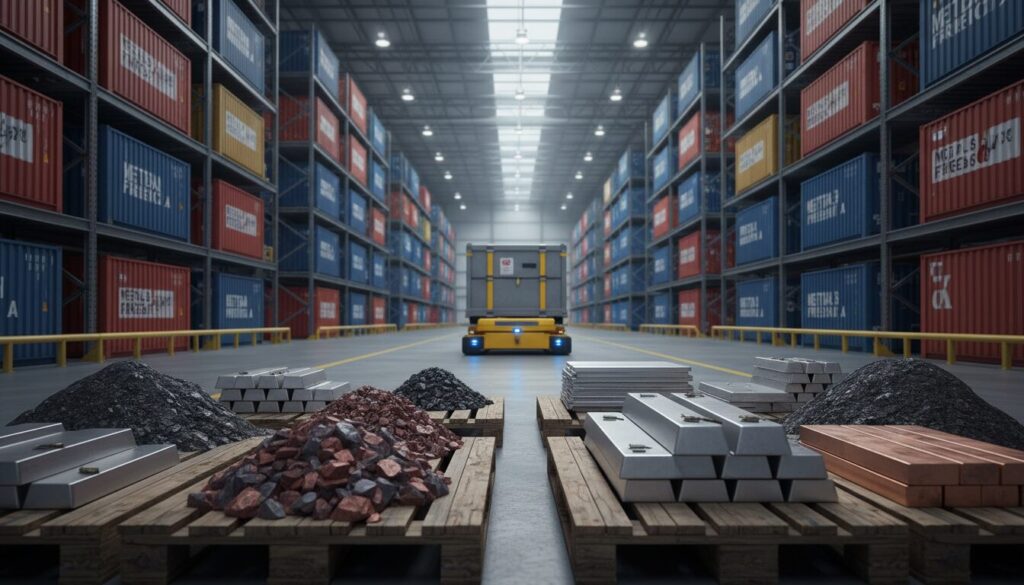
Project Vault is essentially a national inventory strategy. Private companies should emulate this.
- Strategy: Move from strict Just-in-Time (JIT) to strategic buffering for critical raw materials.
- Impact: This increases working capital requirements but insulates against the weaponization of exports (e.g., Gallium/Germanium bans).
3. Supply Chain Bifurcation
We are moving toward a two-track global supply chain:
- Track A (The FORGE Bloc): Higher cost, high ESG standards, government-backed, secure. Used for defense, critical infrastructure, and Western EVs.
- Track B (The Open Market): Lower cost, dominated by Chinese processing, subject to geopolitical volatility. Used for consumer electronics and non-strategic goods.
Future Outlook: Managing the “Interim Decade”
Can the government fix the trouble with the supply of critical materials entirely? No, not immediately.
The reality of the “29-year mining lead time” means that for the next decade, the West will remain partially dependent on Chinese processing. The goal of Project Vault and FORGE is not total independence—which is economically unfeasible—but strategic de-risking.
The 2026-2030 Forecast
- Hybrid Supply Chains: Manufacturers will maintain dual sourcing strategies. They will buy baseline volumes from China (for cost) while securing 20-30% of their supply from Project Vault-backed entities (for security).
- Regulatory Escalation: Expect stricter “Rules of Origin” for EVs and electronics in the EU and US to force companies into the FORGE ecosystem.
- Innovation in Recycling: With mining being slow, governments will likely pivot funding toward “urban mining” (recycling) as a faster way to secure materials.
Conclusion
The government cannot wave a wand and create mines overnight. However, through initiatives like Project Vault and FORGE, they are effectively placing a “floor” under the market. For logistics strategy executives, success in the coming years will depend on navigating this complex web of subsidies, trade blocs, and dual-track supply chains. The free hand of the market has been replaced by the guiding hand of the state.