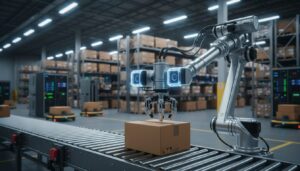

The modern supply chain is no longer a linear path; it is a complex, volatile web. For logistics leaders and operations executives, the daily reality often feels like firefighting. You are drowning in data yet starving for actionable insights. Rising fuel costs, unpredictable consumer demand, and persistent labor shortages have rendered traditional, spreadsheet-based planning obsolete.
If you are struggling to answer “What happens if…?” scenarios in real-time, or if your team spends more time cleaning data than making decisions, this article is your roadmap.
We are witnessing a shift toward Supply Chain Planning Reimagined: Embedded AI that senses, explains, and optimizes. This is not just about automation; it is about creating a cognitive supply chain that acts as a strategic partner rather than a passive tool.
What is Supply Chain Planning Reimagined?
To understand this concept, we must move beyond the idea of AI as a simple calculator. Supply Chain Planning Reimagined: Embedded AI that senses, explains, and optimizes represents a technological leap where Artificial Intelligence is native to the planning platform, not a bolt-on accessory.
It transforms planning from a periodic, manual exercise into a continuous, automated process. Here is the breakdown of the three critical functions:
1. Senses: The Move from Reactive to Proactive
Traditional planning relies on historical data—looking in the rearview mirror to drive forward. Embedded AI “senses” the current environment in real-time. It ingests vast amounts of unstructured and structured data, including:
- IoT sensor data from shipping containers.
- Weather patterns impacting shipping routes.
- Social media sentiment analysis for demand surges.
- Economic indicators and supplier financial health.
By sensing these external signals, the system detects disruptions before they impact the P&L.
2. Explains: The End of the “Black Box”
One of the biggest barriers to AI adoption in logistics is trust. Planners often reject AI recommendations because they don’t understand the logic. This “Black Box” problem is solved by “Explainable AI” (XAI).
When the system recommends moving inventory from Warehouse A to Warehouse B, it explains why:
“Recommendation based on a predicted 20% demand spike in Region B due to upcoming weather event, combined with a supplier delay in Region A.”
As discussed in our analysis of data layers, understanding the logic behind the data is crucial. See also: Who Owns Your AI Layer? Glean CEO Explains.
3. Optimizes: Balancing Trade-offs Automatically
Optimization is not just about finding the fastest route; it is about balancing conflicting business goals. Embedded AI runs thousands of simulations to find the mathematical “frontier” of efficiency.
It constantly balances:
- Cost vs. Service Level: Can we use slower shipping without missing the delivery window?
- Inventory vs. Capital: How much safety stock is needed without tying up too much cash?
Comparison: Traditional vs. Reimagined Planning
| Feature | Traditional Planning | Reimagined (Embedded AI) |
|---|---|---|
| Data Source | Historical, Internal (ERP) | Real-time, External & Internal |
| Cadence | Monthly/Weekly Batches | Continuous/Real-time |
| Decision Logic | Static Rules (Min/Max) | Dynamic/Probabilistic |
| User Role | Data Entry & Calculation | Exception Management & Strategy |
| Visibility | Siloed Departments | End-to-End Orchestration |
Why Now? The Drivers of Transformation
Why is Supply Chain Planning Reimagined: Embedded AI that senses, explains, and optimizes trending now? The convergence of three market forces has made this transition mandatory for survival.
The Complexity of Global Volatility
The era of stable supply chains is over. Geopolitical tensions, climate change events, and pandemic aftershocks have created a “new normal” of constant disruption. Static spreadsheets cannot calculate the impact of a port strike in one region on production schedules in another fast enough to matter.
The Rise of “Agentic” Capabilities
AI has evolved from predictive (what will happen) to agentic (taking action). We are seeing systems that can autonomously execute procurement tasks or adjust inventory levels within pre-set guardrails.
For a deeper look into how autonomous agents are reshaping procurement, read: Didero $30M Series A: Agentic AI Transforms Procurement.
The Talent Gap
The logistics industry faces a severe shortage of skilled planners. There are simply not enough humans to process the volume of data generated by modern supply chains. Embedded AI acts as a force multiplier, allowing a junior planner to operate with the insight of a veteran by handling the “heavy lifting” of data analysis.
For a comprehensive view on how labor shortages are driving automation, refer to: Autonomous Supply Chain Planning: 2025 Guide.
Benefits of Adopting Embedded AI Planning
Implementing Supply Chain Planning Reimagined: Embedded AI that senses, explains, and optimizes delivers measurable value across the organization.
Quantitative Advantages
- Inventory Reduction: By accurately sensing demand, companies can reduce safety stock levels by 10-30%, freeing up working capital.
- Logistics Cost Savings: Optimized routing and load consolidation can lower freight spend by 5-15%.
- Reduced Expediting: Proactive sensing allows for standard shipping modes rather than expensive emergency air freight.
Qualitative Advantages
- Planner Productivity: Teams shift from “data janitors” cleaning spreadsheets to strategic analysts managing exceptions.
- Organizational Agility: The ability to pivot strategies in hours rather than weeks creates a competitive moat.
- Touchless Planning: High-volume, low-complexity decisions are automated, achieving “touchless” operations for significant portions of the supply chain.
Case studies show that large enterprises are already reaping these rewards. For example, Kraft Heinz successfully moved toward this model to eliminate firefighting. Learn more: Kraft Heinz Case Study: 5 Steps to Touchless Planning.
Implementation: How to Successfully Reimagine Planning
Adopting Supply Chain Planning Reimagined: Embedded AI that senses, explains, and optimizes is a journey. It requires a strategic approach to data, technology, and culture.
1. Unify Your Data Foundation
AI is only as good as the data it senses. If your ERP, WMS, and TMS data are siloed, the AI cannot “sense” effectively.
- Action: Invest in a data lake or unified data layer that harmonizes disparate data sources.
- Goal: Ensure the AI has a “Single Source of Truth.”
2. Prioritize “Explainability” for Adoption
The most common point of failure is user rejection. If planners do not trust the AI, they will override it.
- Action: Choose vendors that prioritize “Glass Box” or “White Box” AI.
- Goal: The system must provide natural language explanations (e.g., “Stock increased due to projected holiday surge”).
3. Start with a “Pilot and Scale” Approach
Do not attempt to rip and replace your entire planning process overnight.
- Phase 1: Apply embedded AI to a specific product line or region.
- Phase 2: Validate the “Sense” and “Explain” capabilities.
- Phase 3: Turn on “Optimize” (autonomous execution) once trust is established.
4. Redefine the Planner Role
As the AI takes over calculation, the human role must evolve.
- Training: Upskill planners in data literacy and exception management.
- Culture: Foster a culture where AI is viewed as a co-pilot, not a replacement.
Conclusion
The logistics landscape is unforgiving to those who rely on outdated methods. Supply Chain Planning Reimagined: Embedded AI that senses, explains, and optimizes is no longer a futuristic concept—it is the standard for operational excellence in 2025 and beyond.
By enabling your supply chain to sense disruptions early, explain the logic behind decisions, and optimize trade-offs automatically, you move from a cost center to a strategic driver of business growth.
Recommended Next Steps:
- Audit your current planning maturity: Are you reactive or proactive?
- Review your data architecture: Is your data ready for AI ingestion?
- Explore autonomous planning: Read our Autonomous Supply Chain Planning: 2025 Guide to map your path forward.
The technology is ready. The question is, is your organization ready to reimagine its potential?