
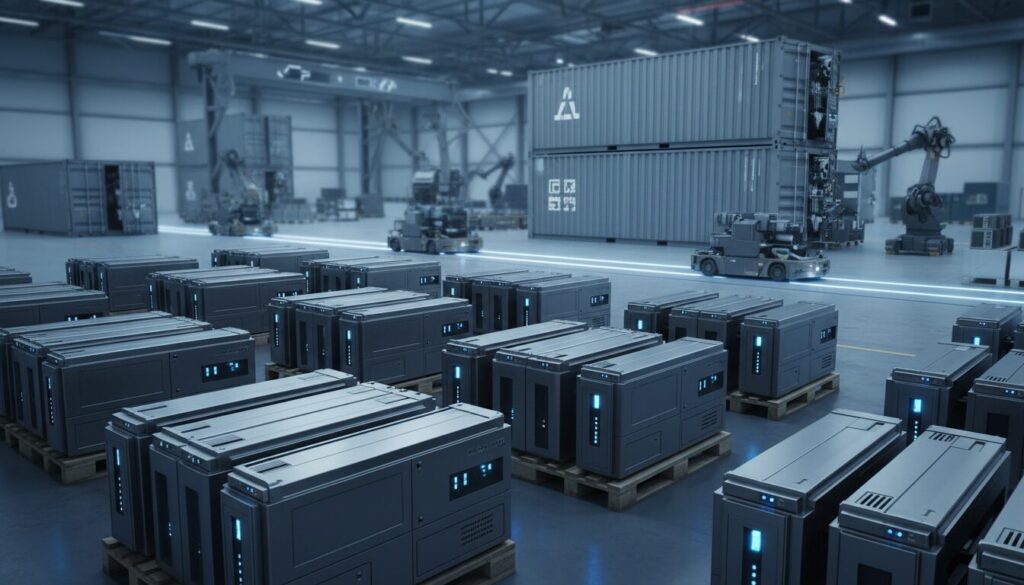
The global energy supply chain is undergoing a seismic shift. For the past decade, the dominant model for the energy storage sector—crucial for stabilizing renewable grids and powering the AI revolution—was simple: design in China, manufacture in China, and export to the world.
However, 2025 marks the end of that era and the beginning of a new one: Strategic Localization.
Driven by aggressive tariff hikes in the United States and stringent sustainability mandates in the European Union, Chinese energy storage giants are no longer just exporting products; they are exporting their industrial capacity. Companies like Sungrow, Cornex, and CALB are aggressively pivoting to a localized manufacturing model, building factories in Egypt, Europe, and North America.
This article explores how Chinese energy storage companies are navigating the “rush to build overseas factories” (中国エネルギー貯蔵企業、海外工場建設ラッシュ) and what this “glocalization” of the battery supply chain means for global logistics and strategy executives.
1. Why It Matters: The End of the “Export-Only” Era
For logistics leaders and strategy executives, this shift represents a fundamental restructuring of global trade lanes. The drivers are not subtle market corrections but structural walls being built around major economies.
The most immediate catalyst is the breakdown of the free-trade model for green technology. As geopolitical tensions rise, Western governments are prioritizing supply chain security and domestic industry protection over pure cost efficiency.
The Numbers Behind the Shift
The economic rationale for direct exports is collapsing under the weight of protectionism.
- Tariff Shock: US tariffs on Chinese non-EV batteries are projected to skyrocket to 48.4% by 2026. This renders direct exports from China to the US commercially unviable.
- Demand Surge: Despite these barriers, global demand is insatiable. Overseas energy storage orders for Chinese firms in 2025 surged over 90% year-over-year, exceeding 350GWh.
The paradox is clear: The world demands Chinese battery technology, but Western governments are blocking Chinese exports. The only solution for these firms is to jump the fence—building factories inside (or near) the target markets to bypass tariffs and comply with local content laws.
As discussed in our analysis of trade volatility, policy shifts can happen overnight (see: Trump Boosts Tariff to 15%: Global Logistics Case Study), making physical proximity to the customer a crucial hedge against regulatory risk.
2. Global Trend: A Tale of Two Markets (US vs. EU)
While the outcome—localized factories—is the same, the drivers in the US and Europe differ significantly. Understanding these nuances is key for supply chain planning.
The United States: The Tariff Wall
In the US, the primary driver is cost defense. The Inflation Reduction Act (IRA) offers massive subsidies for clean energy, but only if components are sourced domestically or from Free Trade Agreement (FTA) partners. Conversely, Section 301 tariffs are being used as a blunt instrument to price out Chinese imports.
By 2026, a 48.4% tariff on batteries effectively forces Chinese companies to set up shop on US soil (often via joint ventures to navigate political scrutiny) or in FTA-friendly nations like Mexico.
See also: Mexico Nearshoring: 3 Ways to Evaluate Regional Labor ROI for insights on how regional hubs are absorbing this manufacturing capacity.
The European Union: The Regulatory Moat
In Europe, the barrier is less about tariffs and more about transparency and sustainability. The EU’s new Battery Regulation acts as a “green passport” for market entry.
- Carbon Footprint: Batteries must carry a declaration of their carbon footprint. Transporting heavy batteries halfway across the world from China drastically increases this footprint, putting exporters at a disadvantage.
- Traceability: Strict requirements on material sourcing and recycling mean that having the supply chain physically closer allows for better auditability and compliance.
Comparison of Regional Drivers
The following table outlines the diverging pressures forcing Chinese firms to localize:
| Feature | United States Market | European Union Market |
|---|---|---|
| Primary Barrier | High Tariffs (Section 301) | Non-Tariff Barriers (ESG Regulations) |
| Key Policy | Inflation Reduction Act (IRA) | EU Battery Regulation & GDPR |
| Tariff Impact | Up to 48.4% on non-EV batteries (2026) | Moderate tariffs, but high carbon taxes (CBAM) |
| Strategic Response | “Friend-shoring” (Mexico) or US JV Manufacturing | Localizing for Carbon Reduction & Recycling |
| Logistics Impact | Shift from Trans-Pacific to Regional Road/Rail | Emphasis on Reverse Logistics (Recycling loops) |
3. Case Study: The Structural Pivot of Sungrow and CALB
To understand the scale of this trend, we must look at the specific moves of industry leaders. This is not merely about setting up a small assembly line; these are massive capital investments intended to anchor the companies in foreign markets for decades.
Sungrow: The $1.8 Billion Egypt Hub
Sungrow Power Supply Co., a global leader in solar inverters and energy storage, provides the clearest example of this trend.
The Move:
Sungrow has committed to a massive $1.8 billion investment to build a manufacturing hub in Egypt.
The Strategy:
Why Egypt? It serves as the perfect “neutral ground” logistics hub.
- Strategic Location: Sitting at the mouth of the Suez Canal, Egypt offers rapid access to European markets without the regulatory friction of manufacturing inside the EU initially.
- Trade Agreements: Egypt enjoys favorable trade status with various regions, potentially allowing Sungrow to bypass certain direct China-to-US/EU tariffs.
- Cost & Capacity: It offers a lower labor cost base than Europe while avoiding the punitive tariffs levied on mainland China.
This move allows Sungrow to secure its 350GWh+ order book by servicing European and Middle Eastern clients from a near-shore location, reducing lead times and shipping costs simultaneously.
CALB: The European Integration
CALB (China Lithium Battery Technology) is taking a direct approach to the EU market.
The Move:
CALB is advancing a major lithium-ion battery project in Portugal.
The Strategy:
This is a direct response to the EU Battery Regulation. By manufacturing in Portugal:
- Compliance: CALB can power its factories with Portugal’s high mix of renewable energy, drastically lowering the “embedded carbon” of the batteries to meet EU thresholds.
- Traceability: Being inside the EU customs union eliminates the administrative burden of importing hazardous goods and simplifies the “Battery Passport” data requirements.
Cornex: The Structural Investment
Cornex and other emerging players are describing these moves not as temporary fixes but as “structural investments.” They are acknowledging that the global supply chain has fractured. To sell globally, they must manufacture locally. This mirrors the Japanese automotive expansion into the US in the 1980s—a defensive move that eventually led to market dominance.
4. Key Takeaways for Logistics Leaders
The rush of Chinese energy storage companies to build overseas factories offers several critical lessons for global logistics and supply chain executives.
1. Tariff Engineering is Now Network Design
Logistics networks can no longer be designed solely on transport cost. They must be designed around tariff optimization. The choice of Egypt by Sungrow or Mexico by other firms highlights that “intermediary manufacturing hubs” are the new hotspots.
- Action: Review your supply chain for exposure to direct US-China lanes. Consider diversifying into “connector” economies like Mexico, Vietnam, or Morocco.
- Reference: For more on the legal complexities of tariff shifts, see Tariff Ruling Sparks $170B Refund Fight: Case Study.
2. Sustainability is a Market Access License
The EU case proves that environmental compliance is no longer just PR; it is a license to operate.
- Action: Integrate carbon accounting into your logistics procurement. If your battery supplier cannot prove low-carbon logistics, they may be locked out of the EU market regardless of price.
3. Supply Chain Resilience > Low Cost
The 90% surge in overseas orders for these Chinese firms proves that demand for technology is high, but the delivery mechanism must be resilient.
- Action: Move from Just-in-Time global shipping to Just-in-Case regional manufacturing. The “Factory-in-Market” model reduces the risk of maritime disruption (e.g., Red Sea crisis) and trade war volatility.
4. The Rise of “Grey Box” Logistics
As Chinese firms build factories abroad, they often import sub-components rather than finished goods. This changes logistics requirements from handling finished containers to managing complex, high-mix component flows (chemicals, cells, casings).
- Action: Prepare for increased complexity in inbound logistics to these new factory sites (e.g., handling hazardous raw materials in Portugal or Egypt rather than just finished batteries at Rotterdam).
5. Future Outlook: The Fragmented Energy Grid
The trajectory is clear: The global energy storage market is fragmenting into regional blocs.
By 2030, we expect the “Global Factory” model of China to be replaced by a “Distributed Hub” model.
- North American Hub: Served by US domestic plants and Mexican near-shoring sites.
- EMEA Hub: Served by Eastern European and North African (Egypt/Morocco) facilities.
- Asian Hub: Served by Chinese and Vietnamese factories.
The Innovation Challenge:
For Chinese firms, the challenge will shift from manufacturing excellence to management excellence. Can they manage a decentralized global workforce and navigate complex local labor laws?
The Logistics Opportunity:
For 3PLs and supply chain strategists, this is a boom time. The construction of these facilities requires project cargo expertise. Once operational, they will require sophisticated regional distribution networks, reverse logistics for battery recycling, and rigorous digital tracking for regulatory compliance.
The message for the industry is stark: The trade walls are going up. The only way to keep the energy flowing is to build the batteries on the other side.
See also: Trump’s Tariff Pivot: Supply Chain Innovation Study for a deeper dive into how policy pivots drive innovation.