Introduction
Are you struggling to fill shifts in your warehouse? Is your cost-per-pick rising while your operational efficiency stagnates? You are not alone. Operations leaders across the globe are facing a “perfect storm” of labor shortages, aging demographics, and explosive e-commerce demand.
Amidst this crisis, a viral narrative has emerged, often captioned: “Watch: Humanoid Robots Are the Future. Or Not.”
You have likely seen the videos: bipedal machines lifting boxes, walking over uneven floors, and working alongside humans. But for a logistics executive responsible for the bottom line, viral videos are not enough. You need to know if this technology is a viable solution for your facility or just expensive “innovation theater.”
This article moves beyond the hype. We will dissect the reality of humanoid robotics in logistics, evaluating whether they are the future of your supply chain or a premature investment. We will explore the tangible benefits, the real-world challenges, and how major players are already shifting from pilot programs to full-scale deployment.
What is “Watch: Humanoid Robots Are the Future. Or Not.”?
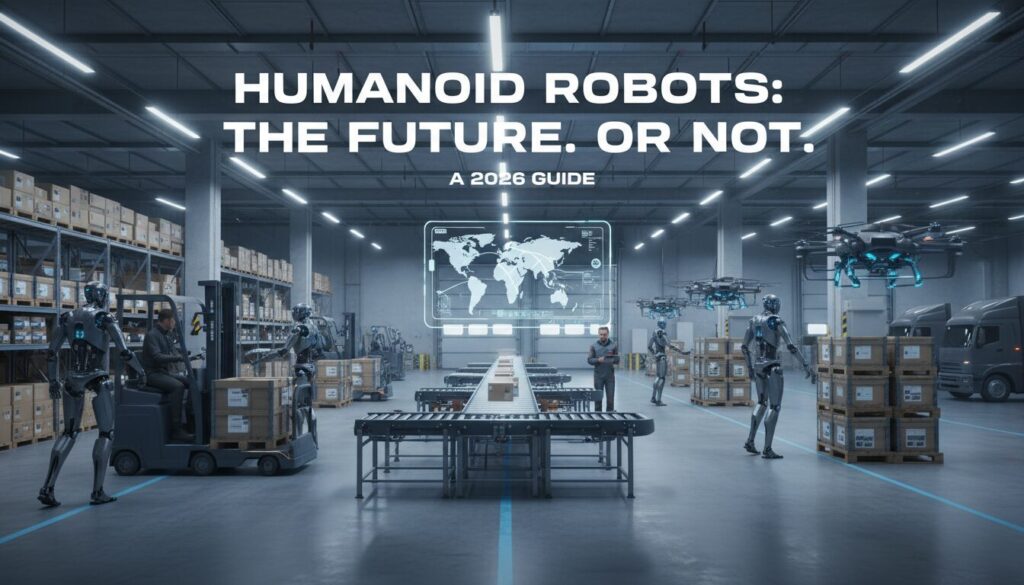
When industry insiders discuss the topic “Watch: Humanoid Robots Are the Future. Or Not.”, they are debating the transition of General Purpose Humanoid Robots (GPHRs) from research labs to commercial warehouse floors.
Unlike traditional automation, which requires purpose-built infrastructure (cages, tracks, or specific shelving), humanoid robots are designed to fit into the human world.
The Core Concept: Embodied AI
The “future” aspect relies on Embodied AI. This is not just a robot following a script; it is artificial intelligence housed in a body that mimics human kinematics.
- Form Factor: Two legs, two arms, and a height similar to an average worker.
- Function: Capable of manipulating boxes, reaching high and low shelves, and navigating narrow aisles designed for people.
- Adaptability: The ability to switch tasks (e.g., from unloading a trailer to depalletizing) without hardware changes.
The “Or Not” Skepticism
The “Or Not” side of the debate addresses the historical failures of robotics:
- High costs.
- Low battery life.
- The complexity of balance and safety.
However, as discussed in our analysis of Boston Dynamics’ Atlas Pilot: The Humanoid Logistics Shift, the technology has recently crossed a threshold from “cool demo” to “commercial necessity.”
Why Now? The Convergence of Crisis and Tech
Why is this conversation happening in 2025-2026? Why wasn’t this relevant five years ago? Three distinct factors are driving the urgency.
1. The Brownfield Dilemma
Most warehouses are “Brownfield” sites—existing facilities designed for humans, not robots. Retrofitting these with traditional heavy automation (AS/RS systems or conveyor belts) is:
- Exorbitantly expensive.
- Disruptive to current operations.
- Rigid (hard to change once installed).
Humanoid robots solve this by walking into an existing facility and working within the current layout. They climb the same stairs and use the same tote bins as your current workforce.
2. The Labor Cliff
The global supply chain is facing a structural deficit of labor.
- Aging Workforce: Skilled warehouse veterans are retiring.
- Recruitment Struggles: Younger generations are less inclined to accept physically demanding manual material handling jobs.
- Wage Inflation: The cost to attract temporary labor peaks seasonally, destroying margins.
3. Technological Maturation
Battery density has improved, and AI processing power has skyrocketed. Furthermore, the supply chain for the robots themselves is scaling up. As noted in China’s Humanoid Surge: 28k Units & Supply Chain Shift, the market is preparing for mass production, which will drive down the unit cost of these machines significantly.
Benefits: The Quantitative Argument
For an operations leader, the decision to adopt humanoids is not about “cool tech”; it is about ROI. Here is how humanoid robots stack up against other forms of automation.
Humanoids vs. Traditional AMRs vs. Manual Labor
| Feature | Manual Labor | Traditional AMRs (Wheeled) | Humanoid Robots |
|---|---|---|---|
| Flexibility | High (Multi-tasking) | Low (A to B transport only) | High (Multi-tasking) |
| Infrastructure | Minimal | Requires flat floors, fiducials | Minimal (Adapts to stairs/gaps) |
| Vertical Reach | Limited by height/ladders | None (usually floor level) | High (Torso extension/Arms) |
| Cost Structure | OPEX (Wages) | CAPEX (Hardware) | RaaS (Robots as a Service) |
| Availability | 1-2 Shifts (Fatigue) | 24/7 | 24/7 |
1. Multi-Purpose Utility
An Autonomous Mobile Robot (AMR) is excellent at moving a pallet from Point A to Point B. However, it cannot pick a box off that pallet and place it on a conveyor. A humanoid can. This “manipulation capability” is the missing link in end-to-end automation.
2. Scalability of Deployment
See also: Case Study: Toyota Scales Agility Humanoid Deployment
As Toyota has demonstrated with Agility Robotics, you can start with a small fleet (Pilot) and scale up without shutting down the facility. If demand drops, you can turn the robots off—you cannot “turn off” a conveyor belt system to save on depreciation.
3. Data Integrity and WMS Integration
Humanoids act as mobile IoT devices. Every time they touch a box, they can scan, weigh, and verify it against the Warehouse Management System (WMS). This reduces inventory shrinkage and picking errors associated with human fatigue.
The “Or Not” Reality: Challenges to Implementation
To provide a balanced view on “Watch: Humanoid Robots Are the Future. Or Not.”, we must address the hurdles. Implementing this technology is not plug-and-play.
1. The Data Training Bottleneck
Robots do not “know” how to hold a crushed box or handle a slippery item instinctively; they must be trained. This requires massive amounts of motion data.
- The Challenge: Programming every joint movement manually is impossible.
- The Solution: Companies are using motion capture and simulation to “teach” robots.
As detailed in Noitom Robotics: The Data Engine for Logistics Humanoids, specialized “Data Factories” are now essential to feed the Embodied AI the training data it needs to function safely in unpredictable warehouse environments.
2. Safety and Speed
Currently, many humanoids move slower than an experienced human worker. While they don’t take breaks, the “picks per hour” (PPH) metric in a direct comparison can initially look lower.
- Safety Protocols: These robots are heavy and made of metal. Ensuring they can work safely alongside humans (collaborative robotics) requires strict ISO safety standards and advanced sensor arrays.
3. Capital and ROI Timelines
While costs are dropping, the upfront investment is significant. However, new financial models are emerging. For instance, Apptronik Raises $520M for Humanoid Logistics highlights how massive capital injection is shifting the model toward “Robots as a Service” (RaaS), allowing companies to pay via OPEX rather than massive CAPEX.
Implementation: How to Prepare Your Facility
If you decide that humanoids are the future for your operations, follow this roadmap to avoid common pitfalls.
Step 1: The “Dirty, Dull, Dangerous” Audit
Do not try to replace your best problem-solvers. Identify tasks that are:
- Dirty: Environments with dust, heat, or cold.
- Dull: Repetitive tasks like palletizing or induction.
- Dangerous: Lifting heavy items (ergonomic risks).
Step 2: Digital Twin Simulation
Before buying a robot, simulate your warehouse environment. Use digital twins to test if a humanoid can actually navigate your aisle widths and reach your shelving heights.
Step 3: Network Infrastructure
Humanoid robots require low-latency communication.
- Ensure your facility has robust industrial Wi-Fi or a private 5G network.
- Verify your WMS has APIs capable of communicating with a robot fleet manager.
Step 4: Change Management
The biggest barrier is often cultural. Workers may fear replacement. Position the robots as “Assistants” that handle the heavy lifting, allowing human staff to focus on quality control, exception handling, and higher-value tasks.
Conclusion
So, back to the keyword: Watch: Humanoid Robots Are the Future. Or Not.
The verdict for logistics professionals in 2026 is clear: The “Or Not” phase is ending. The technology has matured from experimental research into a viable operational strategy. While they will not replace the entire human workforce overnight, they are becoming an essential tool for scaling operations in a labor-constrained world.
The question is no longer if humanoids will enter the warehouse, but when your facility will be ready to accommodate them.
Next Steps for Leaders:
- Educate: Review the case studies linked in this article (Toyota, Boston Dynamics).
- Assess: detailed analysis of your manual material handling costs.
- Pilot: Consider a small-scale pilot program for a specific workflow, such as trailer unloading or palletizing.
By taking a measured, data-driven approach, you can ensure that when the future arrives, your logistics operations are ready to greet it.